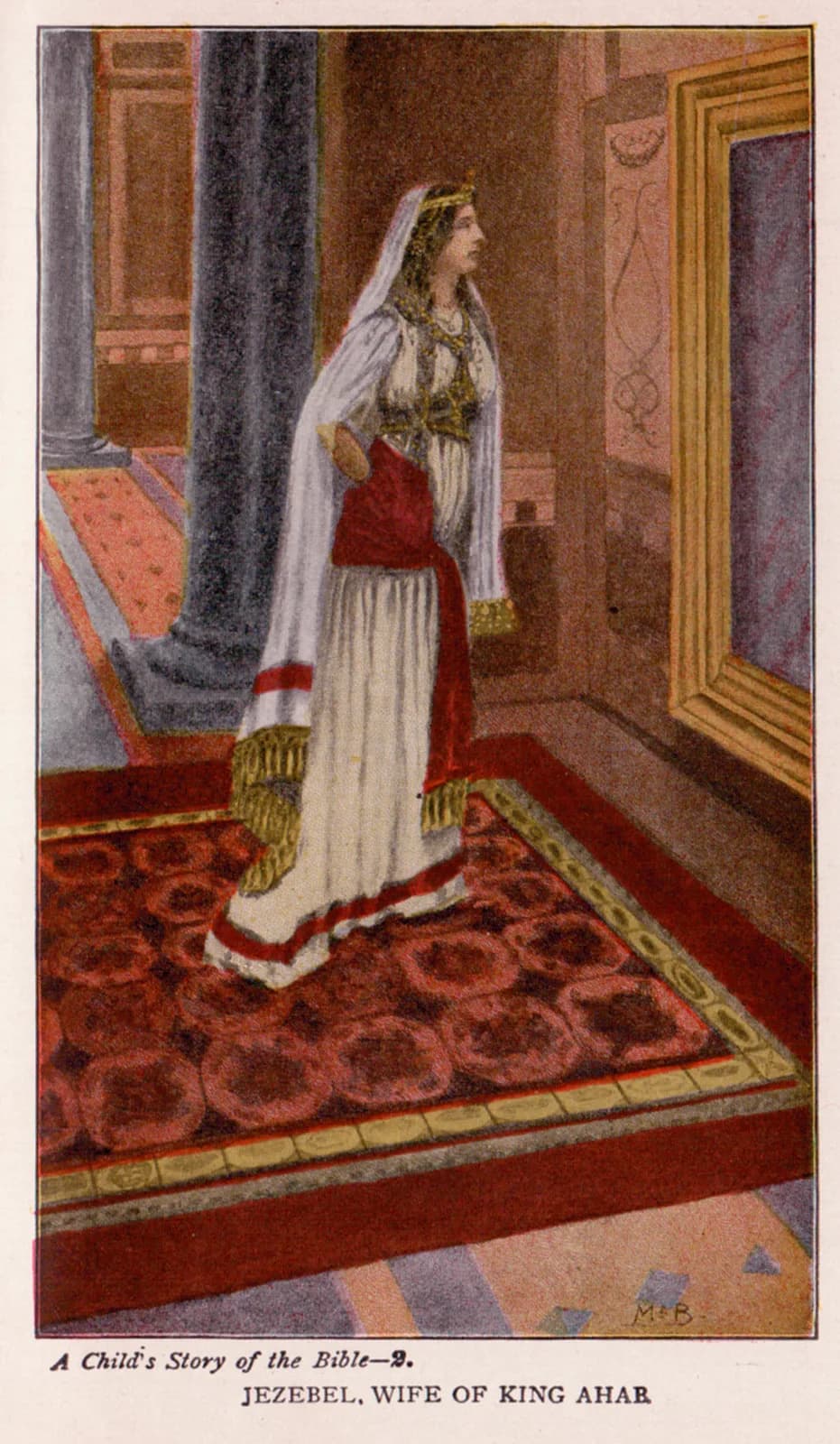
The Story of Jezebel
Jezebel, a Phoenician princess from Sidon, enters the biblical narrative as the queen consort of King Ahab in the Northern Kingdom of Israel during the 9th century BC. Her Marriage to Ahab, recorded in 1 Kings 16:31, marks a political alliance but also a spiritual rupture for Israel. Jezebel introduces the worship of Baal, a Canaanite deity, challenging the monotheistic worship of Yahweh, central to Israelite identity. Political instability and religious syncretism characterize this era, setting the stage for conflict. Jezebel, determined to establish Baal worship, begins persecuting the prophets of Yahweh, as noted in 1 Kings 18:4, where she orders a massacre that forces Obadiah, a faithful servant of Yahweh, to hide a hundred prophets in caves.
Jezebel's most notorious act of manipulation and abuse of power unfolds with the story of Naboth's vineyard. Ahab covets the vineyard of Naboth, a man of Jezreel, but Naboth refuses to sell it, adhering to the Israelite law of ancestral inheritance. In 1 Kings 21:7-16, Jezebel exerts her influence. She orchestrates a scheme where false witnesses accuse Naboth of blasphemy, leading to his execution by stoning. This calculated move allows Ahab to claim the vineyard, demonstrating Jezebel's willingness to employ deceit and murder for political gain. Her actions shock the Israelite community and set her on a collision course with the prophet Elijah, who prophesies divine retribution against her.
The confrontation with Elijah escalates the tension. Following Elijah's dramatic victory over the prophets of Baal on Mount Carmel, as recounted in 1 Kings 18, Jezebel vows to kill him (1 Kings 19:1-2). Her threat forces Elijah to flee into the wilderness, showing her influence and the fear she instills, even in a prophet of Yahweh. However, the tide begins to turn with the rise of Jehu, a commander in Israel's army. In 2 Kings 9, Jehu leads a rebellion against the house of Ahab, targeting Jezebel specifically. Upon Jehu's arrival in Jezreel, Jezebel, in a final act of defiance, adorns herself and looks out from a window (2 Kings 9:30). The situation transforms as Jehu orders her eunuchs to throw her from the window, leading to her violent death, trampled by horses.
Jezebel's demise fulfills Elijah's prophecy that dogs would devour her body, as detailed in 2 Kings 9:36. This event signifies the divine judgment against her and the house of Ahab. Her death marks the end of her reign and the eradication of her influence in Israel. The consequences of her actions and the subsequent judgment extend beyond her lifetime, as her name resurfaces in the New Testament. Revelation 2:20 uses Jezebel as a symbolic name for a false prophetess in Thyatira, linking her legacy of idolatry and immorality to later Christian warnings. Her story continues to echo through history as a cautionary tale of unchecked power and defiance against divine authority. The Hebrew word "zanah" (זָנָה), meaning "to commit fornication" or "to be unfaithful," occurs in Jezebel's life in 2 Kings 9:22, where Jehu accuses her of harlotries and sorceries. This term captures the essence of her transgressions, not in the literal sense of personal infidelity, but in her spiritual and political betrayal of Israel through idolatry. Jezebel, a Phoenician princess from Sidon, became the queen of Israel by marrying King Ahab. Her defining acts are not just in her promotion of Baal worship but in her aggressive actions against the prophets of Yahweh, as seen in 1 Kings 18:4, where she sought to kill them. She was a formidable and manipulative figure, orchestrating the death of Naboth (1 Kings 21:8-10) to satisfy Ahab's desire for a vineyard. Her influence was not passive; she wielded her power decisively and often ruthlessly.