The Charity Organization Society
Christian Charity · Updated August 15, 2026
Overview
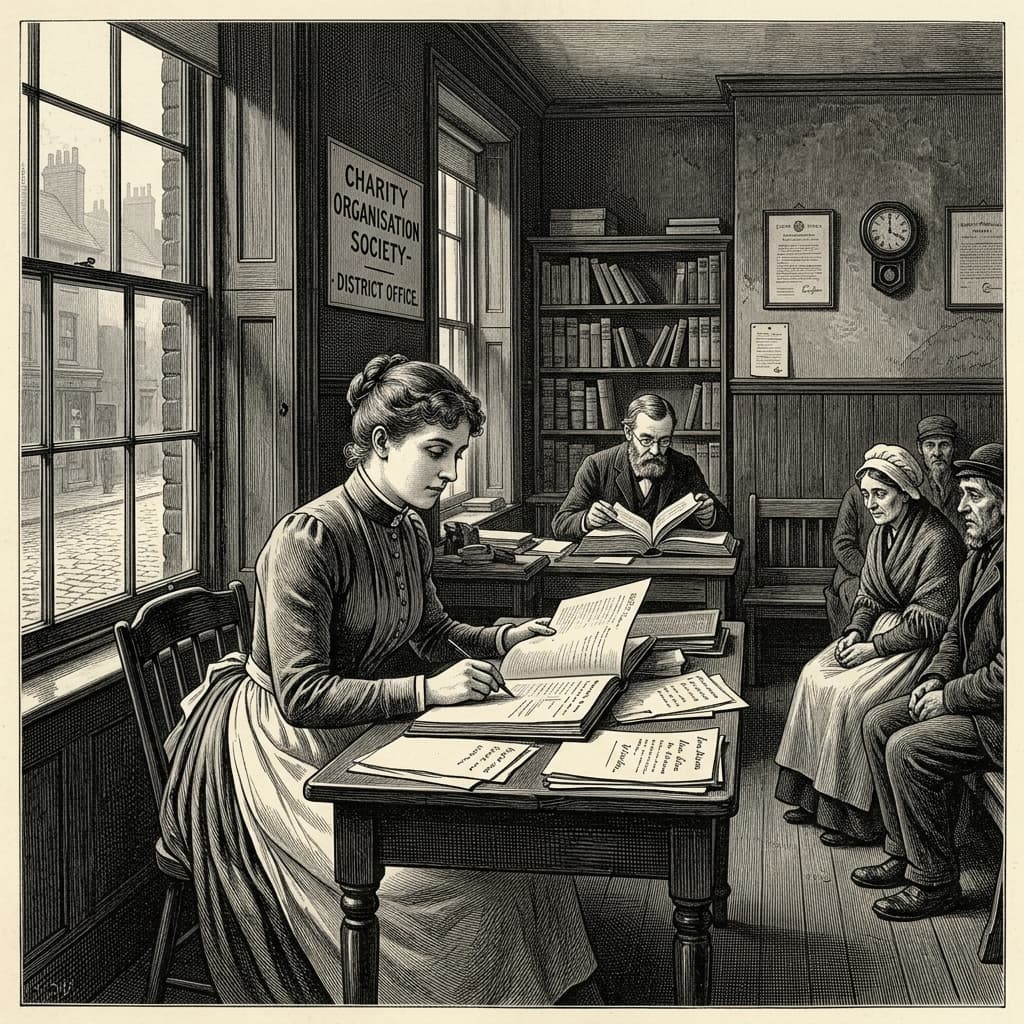
The Charity Organization Society, now seen as a forerunner of modern social work, was built on the belief that giving charity without investigation actually harmed the poor by creating permanent dependency. The first society opened in London on April 22, 1869, as a direct response to the urban poverty that accompanied industrialization. As people flooded into cities for work, they left behind the small communal support networks that had once sustained them through hard times. Octavia Hill, a housing reformer who pioneered the visitor system, co-founded the organization alongside thinkers like Helen Bosanquet, a leading advocate of scientific charity, and C.S. Loch, who served as secretary of the London chapter and shaped its methods.
The society modeled itself on the Elberfeld system, a relief method developed in Elberfeld, Germany. That system divided cities into small districts and assigned unpaid visitors from the upper classes to a set number of impoverished households. The visitors gained intimate knowledge of each family's circumstances and administered relief accordingly. The London society adopted this approach and built a scientific method around it. Teams of investigators and supervisors fanned out to understand the specific causes of poverty in their areas before offering any aid. The central goal was to distinguish between the deserving poor , those willing to work but undone by circumstance , and the undeserving poor, who the society believed had grown dependent on handouts. Loch and Bosanquet argued that distributing money without this investigation created a permanent class of citizens reliant on alms. The model spread across British cities in the 1870s and crossed the Atlantic in 1877, when the first American chapter opened in Buffalo, New York.
By the early twentieth century, the society's methods had evolved into professional social work. The systematic use of investigators, supervisors, and home visitors established practices that formed the foundation of a new profession. Many of the local societies merged into family welfare agencies as the field professionalized and the distinction between deserving and undeserving poor fell out of favor.
The Charity Organization Society, now seen as a forerunner of modern social work, was built on the belief that giving charity without investigation actually harmed the poor by creating permanent dependency.