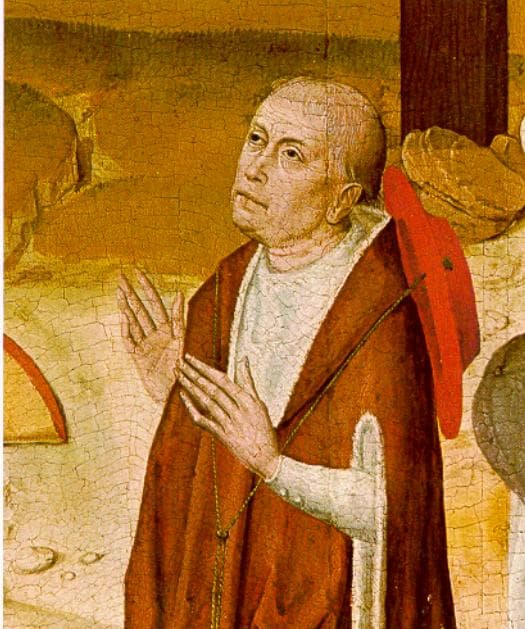
Nicholas of Cusa
theologianMedieval (9th-15th C) · 1401-1464 CE · Updated April 8, 2026
Biography
Nicholas of Cusa was a German cardinal, bishop, and philosopher-theologian of the 15th century, known for his influential role in the transition between medieval and Renaissance thought. He played a pivotal role in shaping the intellectual landscape of his time, bridging the gap between the declining medieval scholasticism and the burgeoning Renaissance humanism. His work was characterized by a deep engagement with philosophical and theological questions, including the nature of knowledge and the relationship between faith and reason.
Born in 1401 in Kues, Germany, Nicholas was educated in Heidelberg, Padua, and Cologne, where he developed his interest in philosophy and theology. He was appointed as a cardinal by Pope Nicholas V in 1448, a position that allowed him to influence both ecclesiastical and intellectual circles. His major philosophical work, "On Learned Ignorance," published in 1440, challenged existing scholastic traditions by proposing that true wisdom lies in recognizing the limits of human understanding. Initially a supporter of conciliarism, which held that church councils should have authority over the pope, Nicholas later shifted his stance to support papal supremacy.
Nicholas lived during a period marked by significant changes in Europe, including the rediscovery of classical texts and the rise of new scientific ideas. Theological debates were intense, with the struggle between conciliarism and papal supremacy at the forefront. Nicholas's engagement with Islam in "On the Peace of Faith" reflected the era's increasing interactions between Christianity and other religions, advocating for dialogue and harmony. His exploration of the relationship between mathematics and theology was groundbreaking, as he used mathematical concepts to understand the divine, a reflection of the era's blending of science and faith.
If God is truly infinite and human intellect is finite, what does genuine theological knowledge look like — and is the most honest theological statement an acknowledgment of ignorance?
The ideas
Nicholas of Cusa grappled with the profound question of how finite human minds could ever truly understand an infinite God. He saw a fundamental gap between human comprehension and divine reality, one that could not be bridged by reason alone. This challenge drove him to explore the boundaries of human knowledge and the nature of the divine, seeking a path that reconciled human limitations with the transcendent mystery of God. His journey was not just an intellectual exercise, but a deeply spiritual quest to fathom the divine presence in a way that acknowledged both the awe-inspiring greatness of God and the humble position of humanity.
Central to Nicholas's thought was the concept of "learned ignorance," which posited that the highest form of knowledge is realizing one's own ignorance in the face of God's infinite nature. This idea challenged the confidence of scholastic philosophers who believed human reason could unravel divine mysteries. Influenced by mystical traditions, Nicholas argued that recognizing the limits of our intellect is the first step towards true wisdom. Another key idea was the "coincidence of opposites," which asserted that in God, all contradictions are reconciled. This notion, inspired by Neoplatonism, suggested that God exists beyond all human categories, offering a radical vision of divine unity. He also proposed that God is both the maximum and the minimum, transcending all concepts of size and magnitude, thus challenging traditional views of God as a being within the universe.
Nicholas made other significant contributions that pushed the boundaries of thought in his era. He envisioned an infinite universe, reflecting God's boundless nature, which prefigured later scientific ideas and opposed the limited cosmology of the medieval world. His shifting stance on church authority, from supporting conciliarism to advocating papal primacy, highlighted his engagement with the complex political and theological debates of his time. His works, such as "De Docta Ignorantia" (On Learned Ignorance) and "De Concordantia Catholica" (On Catholic Concordance), were pivotal in shaping these discussions.
Nicholas of Cusa's signature argument, that true theological knowledge begins with acknowledging one's ignorance before God's infinity, was revolutionary. This "learned ignorance" was not a mere admission of not knowing, but a profound understanding of human intellect's limits, encouraging a deeper, mystical engagement with the divine. It compelled philosophers and theologians to rethink the relationship between human knowledge and divine mystery, shifting the focus from rational certainty to spiritual humility. By embracing the mystery of God, Nicholas opened up new avenues for theological exploration, leaving a lasting impact on both medieval and Renaissance thought.
What changed
Before Nicholas of Cusa, Christian thought was largely shaped by Scholasticism, which relied on Aristotelian logic and metaphysics to explore and define theological truths. Scholars believed that human reason, despite its limitations, could attain a certain grasp of God and the universe. This intellectual environment was dominated by clear distinctions and oppositions, both in theological discourse and in the understanding of the universe, which was seen as finite and geocentric. At the same time, the Church faced unresolved tensions between conciliarism and papal supremacy, with debates over whether ultimate authority lay with church councils or with the pope.
Nicholas of Cusa introduced radical ideas that shifted these prevailing assumptions. He proposed the concept of "learned ignorance," arguing that true knowledge of God recognizes the limits of human understanding in the face of divine infinity. This challenged the confidence in human reason's ability to fully comprehend God. He also introduced the idea of the "coincidence of opposites," suggesting that in God, opposites unite, which disrupted the binary thinking of his time. Additionally, Cusa proposed an infinite universe without a fixed center, a notion that overturned the established geocentric and finite view of the cosmos. In the realm of church politics, he initially supported conciliarism but later advocated for a balance that acknowledged the pope's primacy while valuing council input, paving the way for a synthesis of authority.
The impact of Nicholas of Cusa's ideas rippled through future theological and scientific developments. His notion of "learned ignorance" influenced later mystical thinkers such as Meister Eckhart and John of the Cross, who emphasized the humility and limits of human reason in understanding God. The concept of an infinite universe anticipated the Copernican revolution and laid groundwork for modern cosmology, influencing astronomers like Copernicus and Kepler. His reconciliation of conciliarism and papal supremacy helped shape the Catholic Church's approach to authority, as evidenced by the resolutions at the Council of Trent. Nicholas of Cusa's insights continue to echo in both theological and scientific discussions, illustrating the profound legacy of his thought.
Disputed legacy
Nicholas of Cusa's work has been criticized in several areas, where his ideas either caused confusion or failed to withstand scrutiny. His early support for conciliarism, which advocated for the supremacy of church councils over the pope, was later abandoned in favor of papal supremacy. This shift invited accusations of inconsistency and opportunism. His work "On the Peace of Faith" aimed to foster dialogue with Islam but was criticized as overly idealistic and impractical, failing to address the real complexities of interfaith relations. His attempts to use mathematical concepts to explain theological ideas appeared obscure and overly abstract, leading to misunderstandings. The notion of the "coincidence of opposites" also faced criticism for being too paradoxical to align with traditional theology.
Nicholas's transition from conciliarism to papal supremacy is often seen as his darkest chapter. Initially, he supported the idea that church councils should hold authority over the pope, a stance that appealed to those seeking reform within the church. However, as political tides shifted, so did Nicholas's position. Critics accused him of abandoning his principles for political expediency, thereby undermining his credibility. This shift was perceived as a pragmatic move rather than one grounded in conviction, suggesting a willingness to compromise integrity for influence within ecclesiastical politics. The consequences were significant, as this decision cast a long shadow over his reputation and raised questions about his motivations.
Some modern scholars argue that Nicholas's change in stance was a strategic adaptation to the evolving political landscape of the church rather than a betrayal of his principles. They suggest that his actions reflected a nuanced understanding of the church's needs at the time. However, the criticism that his shift was politically motivated rather than principled remains influential. Despite attempts at rehabilitation, the verdict largely holds. Nicholas of Cusa's reputation continues to be marred by the perception of inconsistency, with his switch from conciliarism to papal supremacy standing as a concrete example of this critique.
Legacy
After his early involvement in the conciliar movement, Nicholas of Cusa continued to hold significant roles within the Church, serving as a papal legate and later as a cardinal. Despite his initial support for the idea that church councils should have authority over the pope, he was never punished for these views. Instead, he adapted his stance and eventually advocated for the primacy of the pope. Nicholas's diplomatic skills and intellectual contributions kept him in the good graces of the Church hierarchy until his death in 1464. He remained a respected ecclesiastical figure, balancing his philosophical pursuits with his church duties.
Nicholas of Cusa's philosophical teachings had a lasting impact on Renaissance humanism and the evolution of modern thought. His ideas about "learned ignorance" and the "coincidence of opposites" found fertile ground among thinkers such as Giordano Bruno, who expanded on his concepts regarding the universe's infinite nature. Later, Gottfried Wilhelm Leibniz drew inspiration from Nicholas's work, particularly in the realm of metaphysics. Nicholas's thoughts resonated with mystical theologians and were discussed across Europe, influencing various intellectual movements that sought a deeper understanding of the divine and the cosmos.
Today, Nicholas of Cusa's influence persists in theological and philosophical discussions about the limitations of human knowledge in understanding the divine. His ideas are particularly relevant in Catholic and some Protestant circles, where they provoke dialogue about faith and reason. Academics study his contributions to explore the relationship between science and religion, reflecting on the enduring relevance of his thought. For instance, his concept of "learned ignorance" continues to challenge scholars to embrace the humility of recognizing the boundaries of human comprehension, a theme that remains poignant in contemporary debates about the intersection of science and spirituality.
Continue reading with a Scholar plan
Upgrade to ScholarCommon questions
- What is Nicholas of Cusa most known for in Christian history?
- Nicholas of Cusa is most known for his concept of 'learned ignorance,' which emphasizes the limits of human knowledge in understanding the divine. He is also recognized for his ideas about the infinite nature of the universe and the unity of opposites in God.
- What were Nicholas of Cusa's most important works?
- Nicholas of Cusa's most important works include 'On Learned Ignorance' (1440), 'On Conjectures' (1441-44), and 'On the Vision of God' (1453). These texts explore his philosophical and theological ideas about knowledge, God, and the universe.
- What were Nicholas of Cusa's most influential theological ideas?
- His most influential ideas include 'learned ignorance,' the notion that true wisdom comes from recognizing one's ignorance before God, and the 'coincidence of opposites,' which suggests that God transcends all human categories. He also proposed that the universe is infinite and that God is the maximum and minimum.
- What controversies did Nicholas of Cusa engage in — and what was at stake?
- Nicholas of Cusa was involved in the conciliarism vs papal supremacy debate, advocating for the authority of church councils over the pope. This was a significant issue during the 15th century, as it challenged the centralized power of the papacy.
- How did Nicholas of Cusa influence later Christianity — Catholic, Protestant, and beyond?
- Nicholas of Cusa's ideas influenced both Catholic and Protestant thinkers by encouraging a more mystical and philosophical approach to theology. His thoughts on the infinite universe prefigured later scientific developments, and his emphasis on the limits of human knowledge resonated with Enlightenment thinkers.
- What did Nicholas of Cusa get wrong, or what ideas have been seriously disputed?
- Some of Nicholas of Cusa's cosmological ideas, such as the infinite universe, were ahead of his time but lacked empirical support. His views on conciliarism were controversial and eventually rejected by the Catholic Church, which affirmed papal supremacy.
- Is Nicholas of Cusa considered a saint? By which traditions?
- Nicholas of Cusa is not officially recognized as a saint by any major Christian tradition. He is, however, respected as a significant theologian and philosopher within the Catholic Church.
- Why does Nicholas of Cusa still matter today?
- Nicholas of Cusa matters today because his ideas about the limits of human knowledge and the nature of the universe continue to resonate with both theologians and scientists. His work bridges medieval and modern thought, offering insights into the relationship between faith and reason.
- What is the most surprising or counterintuitive thing about Nicholas of Cusa?
- One surprising aspect of Nicholas of Cusa's thought is his anticipation of modern cosmology with his idea of an infinite universe, which was contrary to the prevailing geocentric views of his time. This demonstrates his innovative thinking and willingness to challenge established norms.
- What is the best place to start reading Nicholas of Cusa?
- The best place to start reading Nicholas of Cusa is his work 'On Learned Ignorance,' as it lays the foundation for his theological and philosophical ideas. This text introduces his key concepts and provides a comprehensive overview of his thought.