Reinhold Niebuhr
theologianModern (17th C+) · 1892-1971 CE · Updated April 8, 2026
Biography
Reinhold Niebuhr was an American Protestant theologian and public intellectual, active in the 20th century, known for his influential contributions to Christian theology and political thought. He was recognized for his critical engagement with the social and political issues of his time, particularly during periods of intense global conflict. His work resonated beyond academia, influencing both religious and political leaders with its blend of realism and ethical critique.
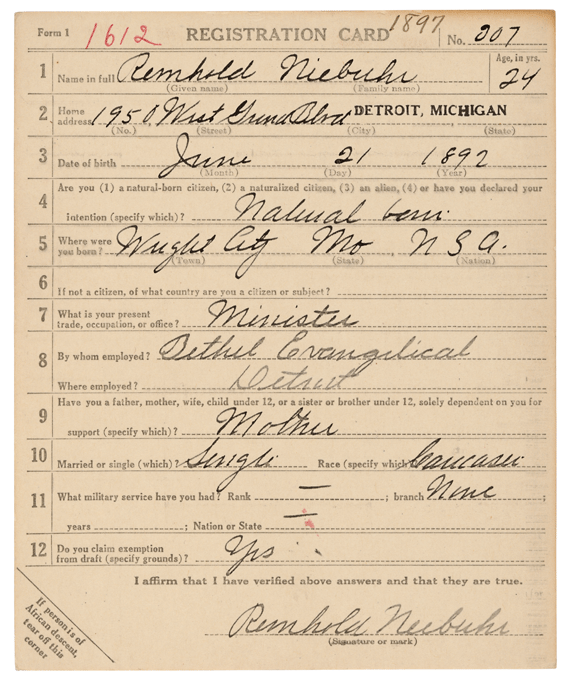
Born on June 21, 1892, in Wright City, Missouri, Niebuhr embarked on a career that would see him become one of the foremost thinkers of his generation. He authored several major works, including "Moral Man and Immoral Society" (1932) and "The Nature and Destiny of Man" (1941-43), which explored the complexities of human nature and morality. Niebuhr is also credited with the widely recognized Serenity Prayer. Throughout his career, he challenged prevailing religious and political norms, notably breaking from pacifism to support Allied intervention against Nazism during World War II. He spent much of his career teaching at Union Theological Seminary in New York, where he engaged in intellectual debates with contemporaries such as Karl Barth.
Niebuhr lived through a period marked by the Great Depression, World War II, and the Cold War, which deeply influenced his views on the persistent sinfulness in human nature and its impact on politics and society. His concept of Christian Realism rejected both utopian idealism and isolationist pacifism, arguing for a pragmatic approach to the moral dilemmas of political power. This was a time when theological debates focused on the nature of human sin and the potential for social progress. Niebuhr's ideas provided a stark critique of the optimistic assumptions about human nature that were prevalent in certain religious and political circles. His reflections on the irony of American history continue to offer insights into the moral complexities faced by nations wielding significant power.
If humans are capable of both reason and radical self-deception, what does that mean for democracy, progress, and the possibility of a just society?
The ideas
Reinhold Niebuhr devoted his life to grappling with a profound question: how can humans, inherently flawed and self-interested, construct a just society? This question drove Niebuhr to explore the tension between moral ideals and the harsh realities of political power. His work emerged from the conviction that acknowledging human sinfulness is crucial for developing realistic approaches to social ethics. Niebuhr sought to reconcile the Christian understanding of sin with the practical demands of political life, emphasizing that ignoring human nature's darker aspects can lead to dangerous idealism or oppressive cynicism.
Among Niebuhr's most significant ideas is Christian Realism, which asserts that human sinfulness and self-interest are constant in politics, making utopian ideals impractical and often perilous. This perspective arose as a response to the failures of pacifism and liberalism when faced with the rise of totalitarian regimes like Nazism. Another key idea is the paradox of human nature: people are capable of both justice and self-deception, leading to moral complexities. This paradox challenges the notion of unending human progress and highlights the necessity for humility and vigilance. Niebuhr's insights were shaped by his observations of historical events and the moral failures of societies considered 'good.'
Niebuhr's contributions extend to the application of the doctrine of original sin in political theory. He argued that recognizing inherent flaws in human nature is essential for understanding the limitations of political systems and guarding against the dangers of unchecked power. This theological perspective was influenced by the historical context of World War II and the Cold War. In "The Irony of American History" (1952), Niebuhr explored the unintended negative consequences of America's virtues, offering a critical lens on American foreign policy. Additionally, his "Serenity Prayer," composed in the 1930s, encapsulates his belief in the need for serenity, courage, and wisdom when confronting the complexities of life.
Niebuhr's signature argument is that the persistence of human sinfulness necessitates a realistic approach to politics. He contended that moral ideals must be balanced with an understanding of human limitations, advocating for a nuanced approach to achieving justice in an imperfect world. This perspective challenged both utopian idealism and cynical realism, offering a middle path that acknowledged the potential for both good and evil within human nature. Niebuhr's reasoning was compelling because it provided a framework for navigating the moral complexities of political life, influencing thinkers and leaders who sought to balance idealism with pragmatism. His work reshaped discussions on democracy, justice, and the role of ethics in politics, leaving an enduring impact on both theology and political philosophy.
What changed
Before Reinhold Niebuhr's influence, American Christian thought was largely shaped by the Social Gospel movement. This movement aimed to apply Christian ethics to solve social issues, carrying an optimistic view of human nature and the potential for societal progress. Many theologians leaned towards idealism, believing in human perfectibility and the possibility of creating a just society through moral reform. Pacifism was a significant stance, as it reflected a belief in achieving peace through non-violence. However, this idealism often ignored the complexities of human nature and the persistence of moral failings, leaving unresolved questions about the limits of human morality and the nature of evil.
Reinhold Niebuhr introduced a dramatic shift with his concept of Christian Realism. He challenged the prevailing idealism by emphasizing the persistent nature of human sin and the limitations of human morality, arguing that utopian ideals were unrealistic and even dangerous. Niebuhr reasserted the relevance of original sin, using it to explain human self-deception and moral shortcomings. He critiqued pacifism, especially in light of real-world threats like Nazism, asserting that force might be necessary in certain situations to combat such evils. Niebuhr also integrated theology with political analysis, insisting that religious insights were crucial for understanding political issues. His ideas forced the church to confront the complexities of human nature and the interplay between faith and politics.
Niebuhr's influence is seen in the development of political theology, which examines the relationship between faith and political structures. His ideas shaped theologians like Paul Tillich and contributed to movements such as liberation theology, which seeks to address social injustices through a theological lens. Christian Realism continues to play a role in discussions about ethics and international relations, influencing how these subjects are approached in both theological and political arenas. Without Niebuhr, the interplay between theology and politics might not be as robustly explored. His legacy endures, evidenced by the persistent relevance of his ideas in contemporary debates on ethics and global affairs.
Disputed legacy
Reinhold Niebuhr's work has sparked significant criticism, especially in his support for American Cold War policies. His endorsement of military interventions has been viewed as justifying imperialism, neglecting the ethical implications of such actions. Critics argue that Niebuhr's pragmatic approach compromised ethical principles for political expediency. His critique of pacifism also drew fire. He dismissed nonviolent resistance as naive, but opponents point to successful historical examples of nonviolence achieving political goals. Additionally, Niebuhr's Christian Realism has been criticized for its vagueness, allowing morally questionable actions under the guise of flexibility. This lack of clear ethical guidelines risks moral inconsistency. Lastly, his departure from the theological rigor of neo-orthodoxy led to debates about the depth of his work.
The hardest aspect of Niebuhr's legacy to defend is his support for American interventionist policies during the Cold War, especially the Vietnam War. He justified these actions as necessary for containing communism, aligning with the political stance of the time. Critics argue this contributed to the moral and ethical dilemmas associated with American foreign policy. His stance is seen as giving moral cover to actions that resulted in significant human suffering and geopolitical instability. Niebuhr's arguments for containment neglected the ethical consequences of military intervention, casting a long shadow over his intellectual legacy.
Some scholars argue that Niebuhr's insights into human nature and political ethics remain relevant, suggesting that critics may overlook the context in which he wrote. However, the criticisms largely stand. His support for Cold War interventions and dismissal of pacifism continue to be seen as ethical missteps. The ambiguity in his Christian Realism still raises concerns about moral relativism. Niebuhr's pragmatic approach, while influential, left a legacy that is difficult to defend in light of the clear ethical consequences of the policies he supported. His complex legacy remains a subject of debate, but the impact of his ideas on American foreign policy is undeniable.
Legacy
After Reinhold Niebuhr faced criticism for his views, he remained a significant public figure until his death in 1971. He continued to engage actively in political and theological discussions, drawing attention from both religious and secular audiences. Niebuhr's lectures and writings addressed the complex moral questions of his time, and he became a respected voice on issues ranging from war to social justice. Despite any condemnation, his role as an intellectual did not falter, and he maintained an influential presence in debates over the ethical dimensions of politics and society.
Niebuhr's teachings endured through the works of theologians and political thinkers who embraced his concept of Christian Realism. This approach influenced major movements such as the civil rights movement and Cold War liberalism, providing a framework for understanding the intersection of faith and politics. Mainline Protestant denominations, particularly in the United States, adopted many of his ideas. Academic circles dedicated to ethics and political theory also found value in his work, integrating his thoughts into their studies and discussions. Figures like Martin Luther King Jr. and political leaders during the Cold War period drew on Niebuhr's insights to navigate the moral complexities of their respective struggles.
Today, Niebuhr's influence persists in conversations about the role of religion in politics, especially within mainline Protestant circles. His ideas continue to resonate in secular discussions, particularly in the realms of political realism and the ethical aspects of international relations. His thoughts on the limits of human nature and the necessity of balancing moral action with political pragmatism remain relevant. A concrete example of his enduring legacy is the frequent citation of his thoughts in discussions on U.S. foreign policy, illustrating how his insights into human nature and power continue to inform and challenge contemporary thought.
Continue reading with a Scholar plan
Upgrade to ScholarCommon questions
- What is Reinhold Niebuhr most known for in Christian history?
- Reinhold Niebuhr is most known for developing the concept of Christian Realism, which emphasizes the persistent presence of sin in human affairs, particularly in politics. He argued that utopian idealism is dangerous due to human nature's capacity for self-deception and injustice.
- What were Reinhold Niebuhr's most important works?
- Reinhold Niebuhr's most important works include 'Moral Man and Immoral Society' (1932), 'The Nature and Destiny of Man' (1941-43), 'The Children of Light and the Children of Darkness' (1944), and 'The Irony of American History' (1952). These works explore the complexities of human nature and the implications for ethics and politics.
- What were Reinhold Niebuhr's most influential theological ideas?
- Niebuhr's most influential ideas include the concept of Christian Realism, the paradox of human nature as capable of both justice and self-deception, and the application of the doctrine of original sin to political theory. He also emphasized the importance of humility and the limits of human understanding in political and social action.
- What controversies did Reinhold Niebuhr engage in — and what was at stake?
- Niebuhr engaged in controversies over the role of religion in politics, particularly criticizing pacifism and advocating for a realistic approach to international relations. He debated with pacifists and idealists, arguing that acknowledging human sinfulness is crucial for effective political action.
- How did Reinhold Niebuhr influence later Christianity — Catholic, Protestant, and beyond?
- Niebuhr influenced later Christianity by shaping the discourse on the intersection of faith and politics, impacting both Protestant and Catholic thought. His ideas on Christian Realism influenced theologians, ethicists, and political leaders, including figures like Martin Luther King Jr. and President Barack Obama.
- What did Reinhold Niebuhr get wrong, or what ideas have been seriously disputed?
- Niebuhr's critics argue that his emphasis on sin and realism can lead to cynicism and justify unethical political actions. Some dispute his dismissal of pacifism and question whether his views adequately address systemic injustices.
- Is Reinhold Niebuhr considered a saint? By which traditions?
- Reinhold Niebuhr is not considered a saint by any Christian tradition. He is recognized as a significant theologian and public intellectual but has not been canonized or venerated as a saint.
- Why does Reinhold Niebuhr still matter today?
- Niebuhr remains relevant for his insights into the complexities of human nature and the ethical challenges in politics. His ideas on the limits of idealism and the necessity of humility in political action continue to resonate in contemporary discussions on ethics and international relations.
- What is the most surprising or counterintuitive thing about Reinhold Niebuhr?
- One surprising aspect of Niebuhr is his ability to bridge the gap between theology and practical politics, influencing both religious and secular leaders. His acknowledgment of human sinfulness as a basis for political realism challenges the more optimistic views of human nature prevalent in his time.
- What is the best place to start reading Reinhold Niebuhr?
- A good starting point for reading Niebuhr is 'Moral Man and Immoral Society,' which introduces his key ideas on the tension between individual morality and social ethics. This work lays the foundation for understanding his approach to Christian Realism and political ethics.