Mount Athos
Monastic Orders · Updated August 15, 2026
Overview
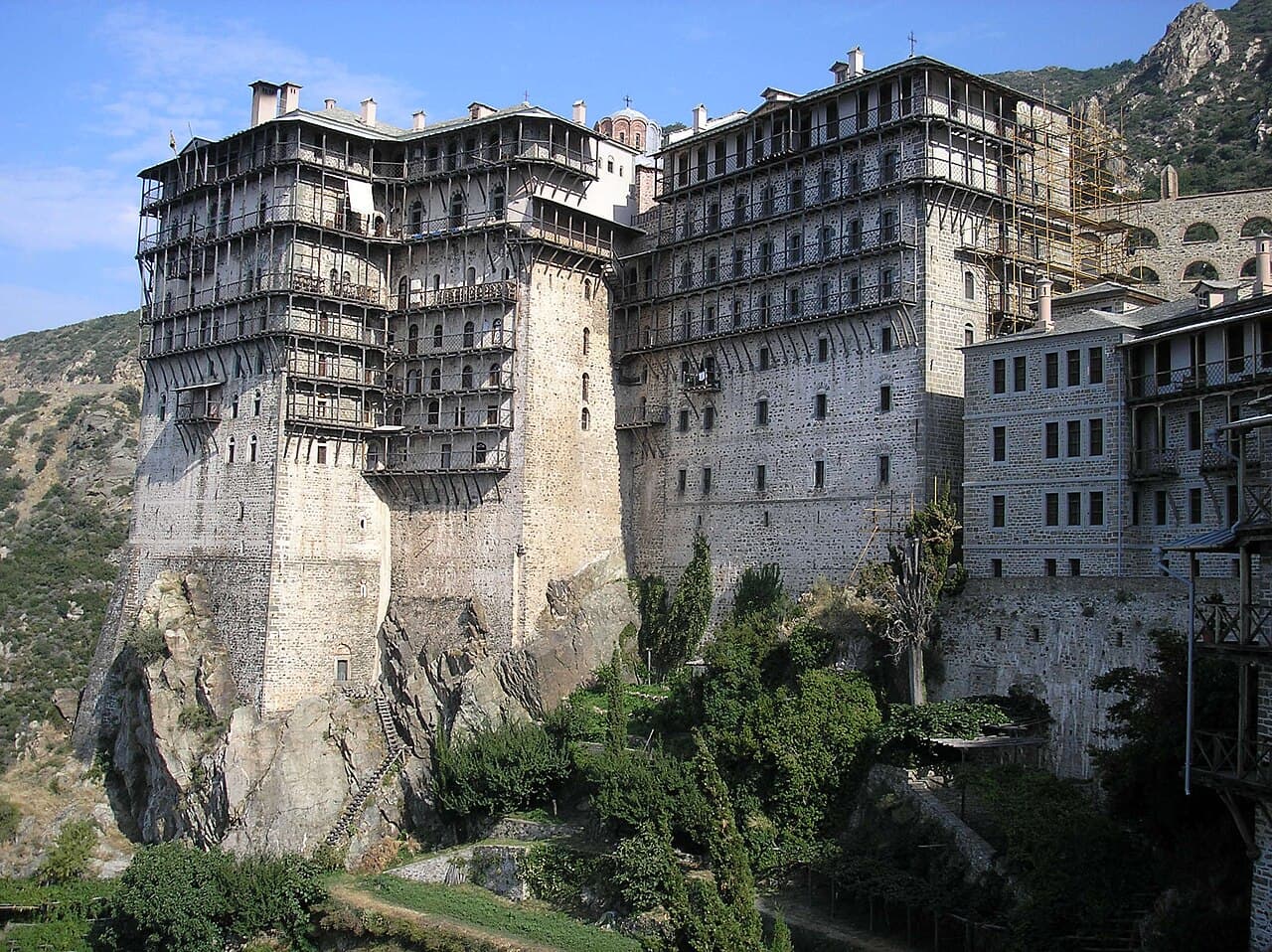
Mount Athos operates as a self-governing monastic state within Greece where women have been legally banned from entering for over a thousand years by both Greek law and religious tradition. The mountain rises 2,033 meters on the easternmost of three peninsulas extending from Chalkidiki into the northern Aegean Sea, and its monastic community answers ecclesiastically to the Ecumenical Patriarch of Constantinople rather than the Church of Greece. This prohibition, called the avaton, applies to all female humans and most female animals, enforced continuously since the Byzantine era. Christian monastic presence on the peninsula dates to at least the 800s, when historical records confirm organized religious life there, though tradition claims hermits settled the mountain as early as the 4th century.
The formal monastic republic took shape in 963, when Saint Athanasius the Athonite founded the Great Lavra, the first and largest of the twenty ruling monasteries on Athos. He built it with direct financial and political support from Byzantine Emperor Nikephoros II Phokas, a military ruler who saw monastic expansion as a pillar of imperial strength. Nine years later, in 972, Emperor John I Tzimiskes issued the Tragos, the first formal charter governing the community. This document established the legal framework that still regulates monastic life on the mountain, setting rules for property, governance, and the admission of new monks. The peninsula outside the autonomous monastic territory forms part of the Aristotelis municipality in the Chalkidiki regional unit, but inside the boundary, Greek civil administration does not apply.
The community earned a place on the UNESCO World Heritage List in 1988, recognized for its preserved monastery architecture, unbroken religious history, and protected natural environment. Twenty monasteries still operate under the charter first issued over a millennium ago, housing roughly 2,000 monks who maintain liturgies, agricultural work, and manuscript preservation as they have since the early medieval period. The avaton remains enforceable under Greek constitutional law, and border police at the peninsula's only entry point turn back any woman who attempts to cross.
Mount Athos operates as a self-governing monastic state within Greece where women have been legally banned from entering for over a thousand years by both Greek law and religious tradition.