Matthew 8:23-27 · Matthew

Calming the Storm

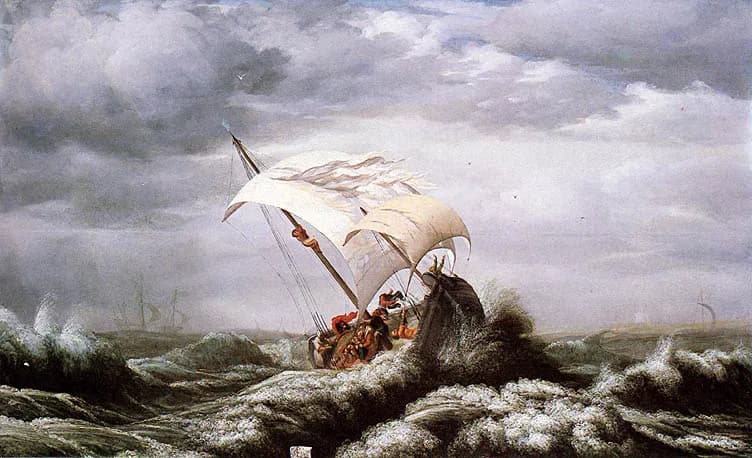
Jesus and his disciples are on a ship when a great storm arises. The disciples wake Jesus, fearing for their lives, and he calms the storm, leaving them amazed at his power over nature.

Summary

In the passage known as "Calming the Storm" from Matthew 8:23-27, Jesus and his disciples are traveling by ship. This event is significant as it underscores the authority of Jesus over nature. The scene begins with Jesus entering a ship, followed by his disciples (8:23). As they set sail, a sudden and violent storm arises, causing waves to crash over the vessel. Despite the chaos, Jesus is asleep, setting the stage for the events that follow (8:24).

Amidst the storm, the disciples, fearing for their lives, wake Jesus and plead for his help, saying, "Lord, save us: we perish" (8:25). Jesus responds by questioning their fear and lack of faith. He then rises and commands the winds and the sea to be still, resulting in a great calm (8:26). The transformation from chaos to tranquility is immediate and dramatic, highlighting the power of his command.

The passage concludes with the disciples marveling at what they have witnessed. They express their astonishment by asking, "What manner of man is this, that even the winds and the sea obey him!" (8:27). The event establishes Jesus' authority over the natural world, as the text presents the calm as a direct result of his intervention.

Chiastic structure

A

Matthew 8:24-25

there arose a great tempest in the sea... his disciples came to him, and awoke him, saying, Lord, save us: we perish.

B

Matthew 8:26

Then he arose, and rebuked the winds and the sea; and there was a great calm.

A'

Matthew 8:27

But the men marvelled, saying, What manner of man is this, that even the winds and the sea obey him!

Both A and A' involve the disciples' reaction to the situation: fear and marveling at Jesus' power.

Interpretation and theological stakes

The primary conclusion of the passage in Matthew 8:23-27 is the establishment of Jesus' authority over the natural world. The text itself emphasizes that Jesus' ability to calm the storm is a direct display of power that leaves the disciples in awe. The disciples' reaction, captured in their question, "What manner of man is this, that even the winds and the sea obey him!" (8:27), points to a recognition that Jesus possesses a command over nature that is not typical of humanity. This event is not just about a miraculous intervention; it serves as a testament to who Jesus is and why his presence matters.

The Catholic interpretation often underscores this passage as a clear demonstration of Jesus' divine authority. This reading sees the miracle as evidence that Jesus is not merely a teacher or prophet but one with divine power, reinforcing the belief in his divinity. The key lies in Jesus' command over the storm "rebuked the winds and the sea" (8:26) which parallels the divine authority God holds over creation, as seen in other scriptural contexts. For Catholic tradition, this passage affirms the deeper theological truth of the incarnate God exercising control over the universe.

In contrast, the Reformed Protestant tradition reads this passage with a focus on faith and the call to trust in Jesus' sovereignty. While acknowledging the divine power demonstrated, this interpretation places greater emphasis on Jesus' rebuke of the disciples' fear and lack of faith (8:26). The event serves as a lesson for believers to trust in Jesus amidst life's storms. The immediacy of the calm following Jesus' command is seen as a metaphor for spiritual peace available to those who place their faith in him, highlighting the relationship between divine power and personal faith.

Considering both interpretations, the passage can be seen as a dual message about Jesus' identity and the response it demands from his followers. It suggests that recognizing Jesus' authority is not merely an intellectual acknowledgment but a call to faith and trust. The narrative, therefore, not only affirms Jesus' divine nature but also challenges believers to confront their fears with faith. This dual focus on authority and faith creates a comprehensive view that honors both the theological and personal implications of the miracle.

Continue reading with a Scholar plan

Upgrade to Scholar