Matthew 8:5-13 · Matthew · Updated April 25, 2026
Centurion's Servant
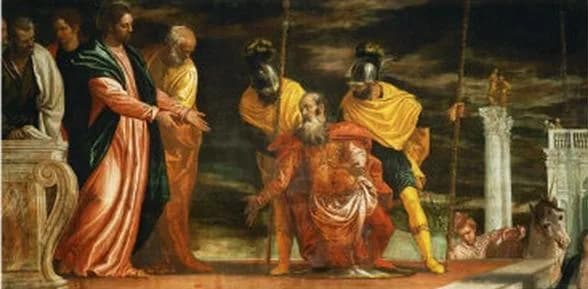
In Capernaum, a centurion approaches Jesus, asking for healing for his servant who is suffering from paralysis. Jesus offers to come and heal the servant, but the centurion expresses his faith that Jesus can heal from a distance. Jesus praises the centurion's faith and heals the servant at that moment.
Summary
The passage from the Gospel of Matthew describes an encounter between Jesus and a Roman centurion in Capernaum. A military officer, the centurion approaches Jesus with a request for help. His servant is at home, suffering from paralysis and in great distress (8:5-6). This interaction between the centurion and Jesus reveals the centurion's concern for his servant and his belief in Jesus' ability to heal.
Jesus responds to the centurion's plea by offering to come to his home and heal the servant (8:7). However, the centurion expresses his unworthiness to have Jesus enter his house, suggesting instead that Jesus simply speak a word to heal the servant from a distance (8:8). He explains his understanding of authority, comparing it to his own experience as a commander who gives orders and is obeyed (8:9). Impressed by the centurion’s faith, Jesus marvels and remarks on the centurion's exceptional faith, stating that he has not found such faith even in Israel (8:10).
The passage concludes with Jesus granting the centurion's request. He tells the centurion to return home, assuring him that his faith has resulted in the servant's healing (8:13). The text confirms that the servant was healed at that very hour. The outcome demonstrates the centurion's faith and establishes the power of belief in Jesus' authority to heal. The main conclusion of the passage is the extraordinary faith of the centurion and its impact on Jesus. The text emphasizes the centurion's belief in Jesus' authority to heal, even from a distance, without physical presence. This faith is noteworthy because Jesus, a Jewish teacher, recognizes it as unparalleled, even among the people of Israel, who were traditionally seen as the keepers of faith (Matthew 8:10). The centurion's trust is not rooted in religious law or ritual but in the understanding of authority and power. This interaction suggests that faith, rather than ethnicity or religious background, is key to experiencing Jesus' power.
Chiastic structure
ⓘMatthew 8:5-6
“there came unto him a centurion, beseeching him, And saying, Lord, my servant lieth at home sick”
Matthew 8:10
“When Jesus heard it, he marvelled, and said... I have not found so great faith, no, not in Israel.”
Matthew 8:13
“And Jesus said unto the centurion, Go thy way; and as thou hast believed, so be it done unto thee.”
Both A and A' involve the centurion's interaction with Jesus, focusing on the healing of the servant and the centurion's faith.
Interpretation and theological stakes
Continue reading with a Scholar plan
Upgrade to Scholar