Matthew 14:13-21 · Matthew

Feeding the 5000

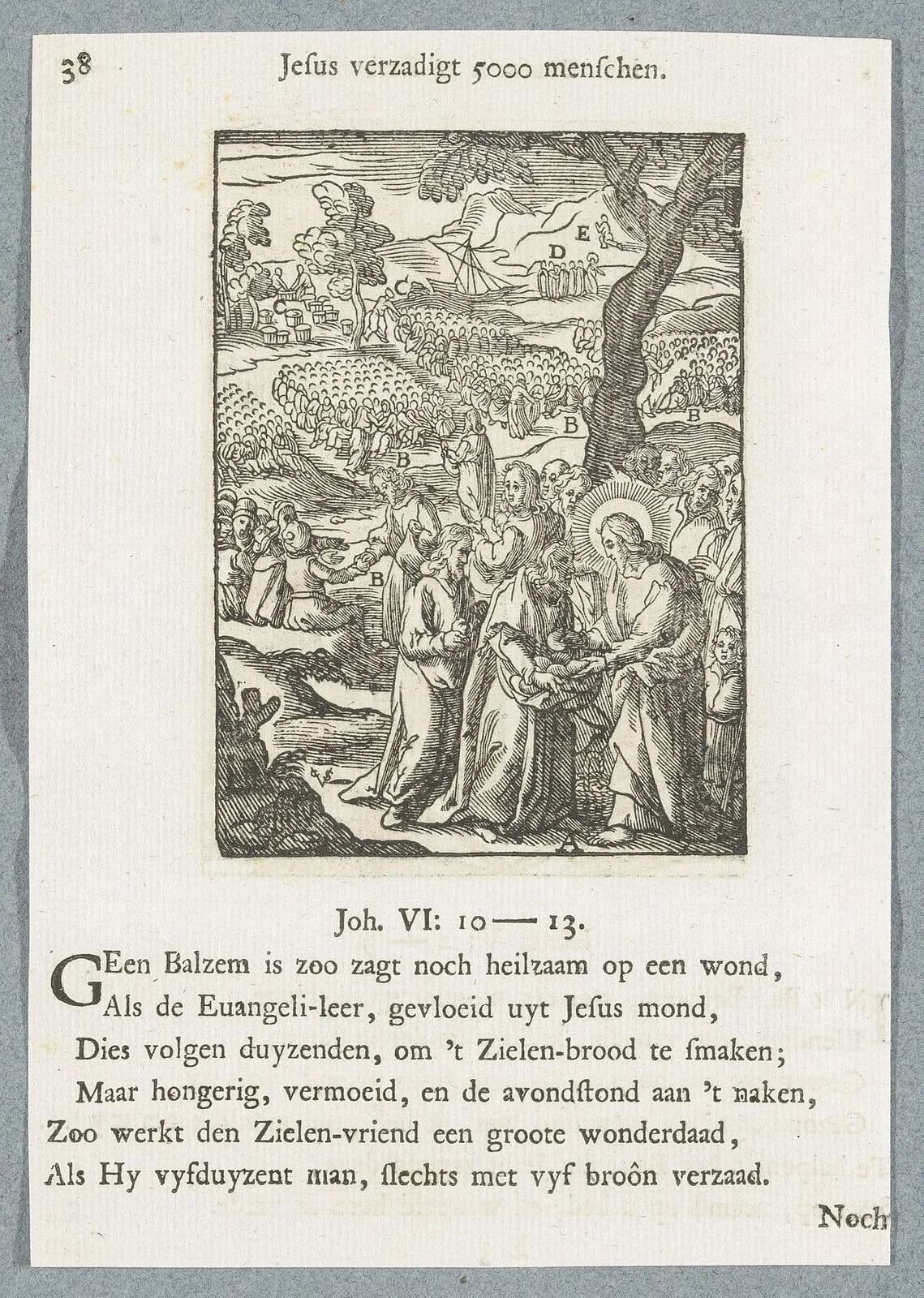
Jesus departs to a desert place, followed by a multitude. Moved with compassion, he heals the sick and feeds about five thousand men, plus women and children, with five loaves and two fishes, leaving twelve baskets of leftovers.

Summary

The passage from Matthew 14:13-21 is about Jesus performing a miracle by feeding a large crowd with a small amount of food. This event is significant because it demonstrates Jesus' ability to provide for a multitude in a seemingly impossible situation. The story begins with Jesus withdrawing to a remote place by boat after hearing some news. However, crowds from nearby cities follow him on foot. When Jesus sees the large gathering, he is moved with compassion and heals their sick (14:14).

As evening approaches, the disciples express concern about the crowd's hunger, suggesting that Jesus send them away to buy food from nearby villages (14:15). Jesus, however, tells the disciples that the people do not need to leave and instructs them to feed the crowd themselves (14:16). The disciples point out that they only have five loaves of bread and two fish (14:17). Jesus asks for the food, directs the crowd to sit on the grass, and then blesses the loaves and fish. He breaks the loaves and gives them to the disciples, who distribute them to the people (14:19).

The passage concludes with everyone eating and being satisfied. Remarkably, the disciples collect twelve baskets full of leftover fragments (14:20). The text notes that about five thousand men, in addition to women and children, were fed (14:21). The passage establishes that Jesus provided abundantly for the crowd, emphasizing the miraculous nature of the event.

Chiastic structure

A

Matthew 14:13-14

Jesus...saw a great multitude, and was moved with compassion toward them, and he healed their sick.

B

Matthew 14:16

But Jesus said unto them, They need not depart; give ye them to eat.

A'

Matthew 14:19-21

And they did all eat, and were filled: and they took up of the fragments that remained twelve baskets full.

Both A and A' involve the setting and the crowd's need for sustenance, highlighting Jesus' compassion and provision.

Interpretation and theological stakes

The Feeding of the 5000 in Matthew 14:13-21 primarily establishes that Jesus has the power to provide abundantly in situations that seem impossible. The narrative emphasizes the miraculous nature of this event, where a small amount of food becomes more than enough for a vast crowd. The passage highlights Jesus' compassion and his divine ability to meet human needs, underscoring the idea that with divine intervention, scarcity can be transformed into surplus. This miracle matters because it reassures the followers of Jesus of his power and compassionate care, reinforcing their trust in his provision.

One mainstream interpretation, commonly held in Catholic tradition, views this event as a literal miracle where Jesus physically multiplies the loaves and fishes through divine power. This reading argues that the text straightforwardly describes a supernatural act, underscored by verses like 14:19, where Jesus blesses the food, resulting in everyone being fed and having leftovers. The collection of twelve baskets of fragments (14:20) serves as evidence of the abundance produced by the miracle. This interpretation sees Jesus' actions as a direct demonstration of his divine authority and a testament to his ability to provide beyond natural means.

In contrast, a liberal Protestant interpretation considers the event symbolic, focusing on themes of sharing and community. According to this reading, the real miracle lies in the transformation of the crowd's attitude from scarcity to generosity. The disciples' initial concern about the lack of food (14:17) shifts as Jesus prompts them to distribute what little they have. This interpretation suggests that as people shared their own provisions, everyone was fed. The emphasis is on Jesus inspiring a communal spirit, where the miracle is not in the multiplication of physical loaves and fishes but in the creation of a caring community willing to share.

Considering both interpretations, the passage offers a dual perspective on the nature of miracles and community. While the Catholic view underscores Jesus' divine intervention, the liberal Protestant reading emphasizes the role of human action in realizing abundance. Together, they suggest that divine provision can work through both supernatural means and the fostering of communal generosity. This dual perspective encourages readers to recognize both the power of divine intervention and the importance of human cooperation in addressing needs.

Continue reading with a Scholar plan

Upgrade to Scholar