Mark 10:46-52 · Mark · Updated April 25, 2026
Healing Blind Bartimaeus
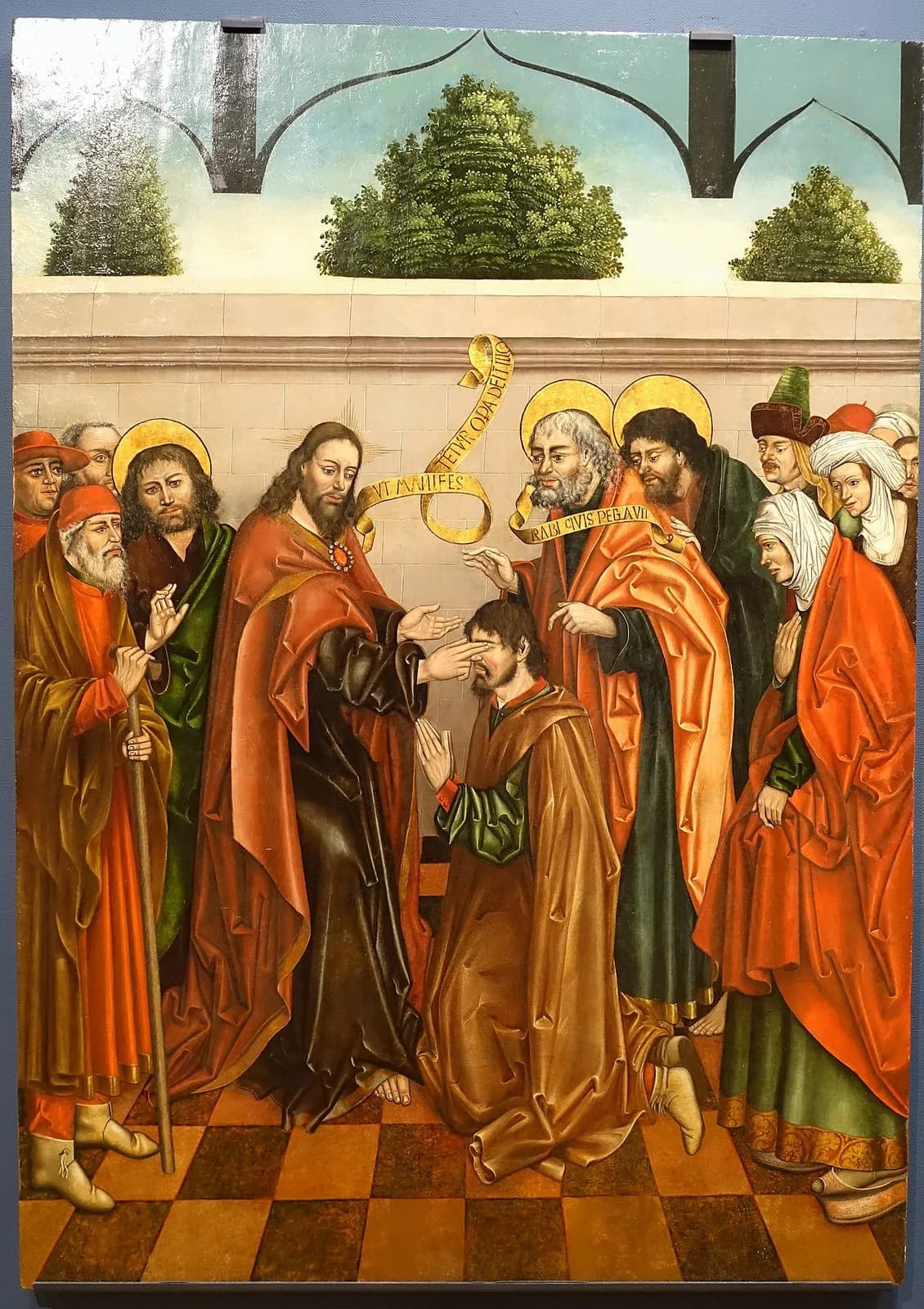
As Jesus leaves Jericho with his disciples and a crowd, blind Bartimaeus calls out to him for mercy. Despite being told to be quiet, Bartimaeus persists, and Jesus heals him, granting him sight because of his faith.
Summary
Mark 10:46-52 describes the healing of blind Bartimaeus during Jesus' ministry as he travels from Jericho. As Jesus leaves the city with his disciples and a large crowd, Bartimaeus, a blind beggar, sits by the roadside. His presence and actions set the stage for the encounter. Bartimaeus is introduced as the son of Timaeus, emphasizing his identity and condition as a blind man dependent on alms.
As Jesus passes by, Bartimaeus hears that it is Jesus of Nazareth and begins to cry out, calling Jesus "Son of David" and asking for mercy (10:47). Despite being told by many to be quiet, he persists, shouting even louder for Jesus' attention (10:48). Jesus stops and instructs the crowd to call Bartimaeus over. Encouraged by the crowd, Bartimaeus throws aside his garment, gets up, and approaches Jesus (10:50). Jesus asks him what he wants, and Bartimaeus requests to regain his sight (10:51).
Jesus tells Bartimaeus that his faith has made him whole, and immediately Bartimaeus receives his sight (10:52). He then follows Jesus along the way. Bartimaeus is no longer blind and becomes a follower of Jesus, focusing on faith and healing. Faith is crucial in the interaction between Jesus and Bartimaeus. Bartimaeus's persistent cries for mercy, despite the crowd's attempts to silence him, show his belief in Jesus' power to heal. When Jesus acknowledges Bartimaeus's faith, it acts as the catalyst for his healing. Bartimaeus's immediate recovery and decision to follow Jesus demonstrate the power of faith, culminating in both physical healing and spiritual discipleship (10:52).
Chiastic structure
ⓘMark 10:46-47
“blind Bartimaeus... began to cry out, and say, Jesus, Son of David, have mercy on me.”
Mark 10:51
“What wilt thou that I should do unto thee? The blind man said unto him, Lord, that I might receive my sight.”
Mark 10:52
“And immediately he received his sight, and followed Jesus in the way.”
Both A and A' involve Bartimaeus' condition and his interaction with Jesus, focusing on his faith and resulting transformation.
Interpretation and theological stakes
Continue reading with a Scholar plan
Upgrade to Scholar