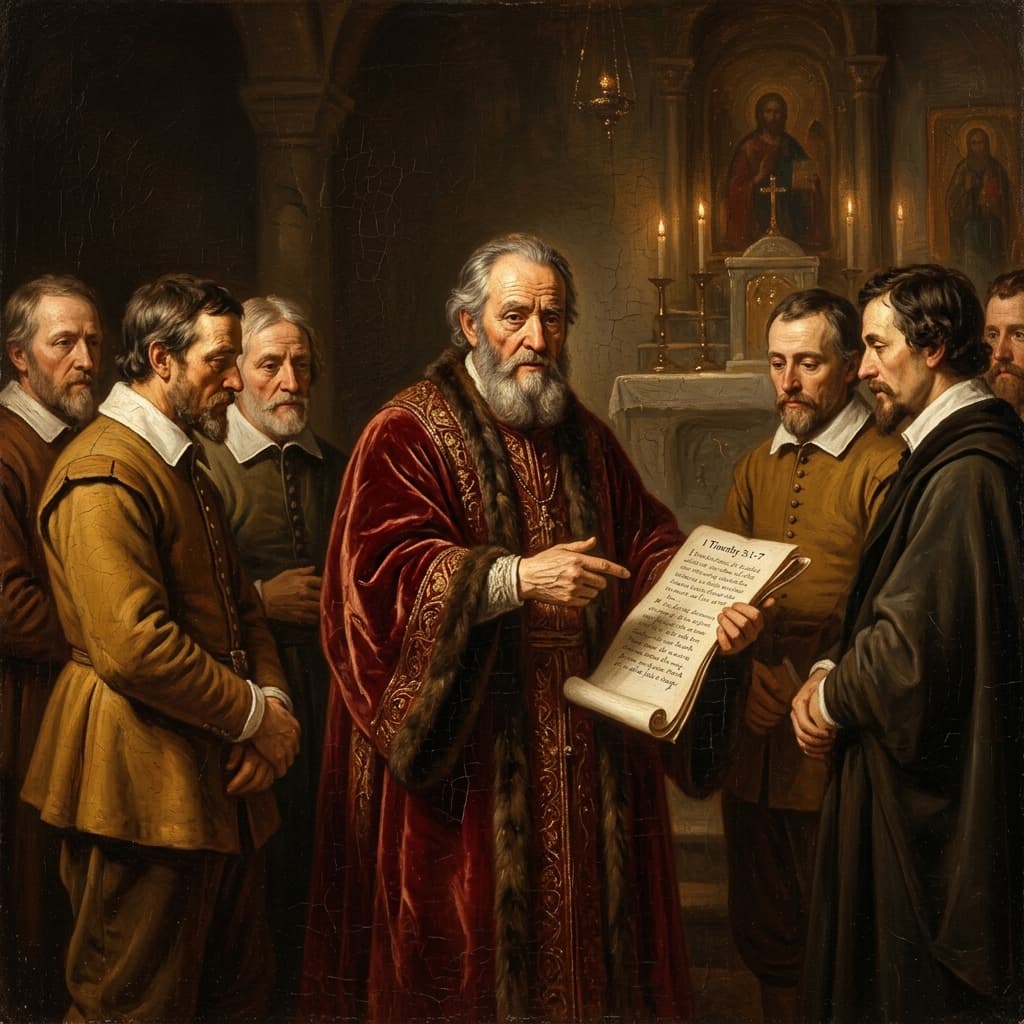
1 Timothy 3:1-13 · 1 Timothy · Updated April 25, 2026
Qualifications for Overseers
The passage outlines the qualifications for overseers and deacons in the church. It emphasizes the need for these leaders to be blameless, sober, and faithful, with a good reputation both inside and outside the church.
Summary
This passage from 1 Timothy 3:1-13 outlines the qualifications for church leaders, specifically bishops and deacons, in the early Christian church. It is part of a letter attributed to the Apostle Paul, who is providing guidance on church governance. The passage begins by affirming the importance of the role of a bishop, describing it as a noble task (3:1). This sets the stage for a detailed list of character traits and behaviors expected of those who aspire to these leadership positions.
The passage details the qualifications for a bishop, emphasizing that he must be blameless, married to one wife, vigilant, sober, well-behaved, hospitable, and able to teach (3:2). He should not be a heavy drinker, violent, greedy, or quarrelsome, but rather patient and not covetous (3:3). It is important that he manages his household well, with obedient children, as this reflects his ability to care for the church (3:4-5). Additionally, he should not be a recent convert to avoid pride, and he must have a good reputation with outsiders to prevent falling into disgrace (3:6-7). The passage then shifts to deacons, who should also be dignified, sincere, moderate in drinking, and not greedy (3:8). They must hold firm to their faith with a clear conscience and be tested before serving (3:9-10). Their wives must be serious, not slanderous, sober, and faithful (3:11). Deacons, like bishops, should be husbands of one wife and manage their children and households well (3:12).
The passage concludes by stating that those who serve well as deacons gain a good standing and increased confidence in their faith in Christ Jesus (3:13). This final note underscores the significance of these roles within the church, highlighting the spiritual rewards that come with faithful service.
Chiastic structure
ⓘ1 Timothy 3:2-4
“A bishop then must be blameless...One that ruleth well his own house...”
1 Timothy 3:5
“(For if a man know not how to rule his own house, how shall he take care of the church of God?)”
1 Timothy 3:12-13
“Let the deacons be the husbands of one wife, ruling their children and their own houses well...”
Both A and A' emphasize the qualifications for church leadership, specifically focusing on personal and household management.
Interpretation and theological stakes
Continue reading with a Scholar plan
Upgrade to Scholar