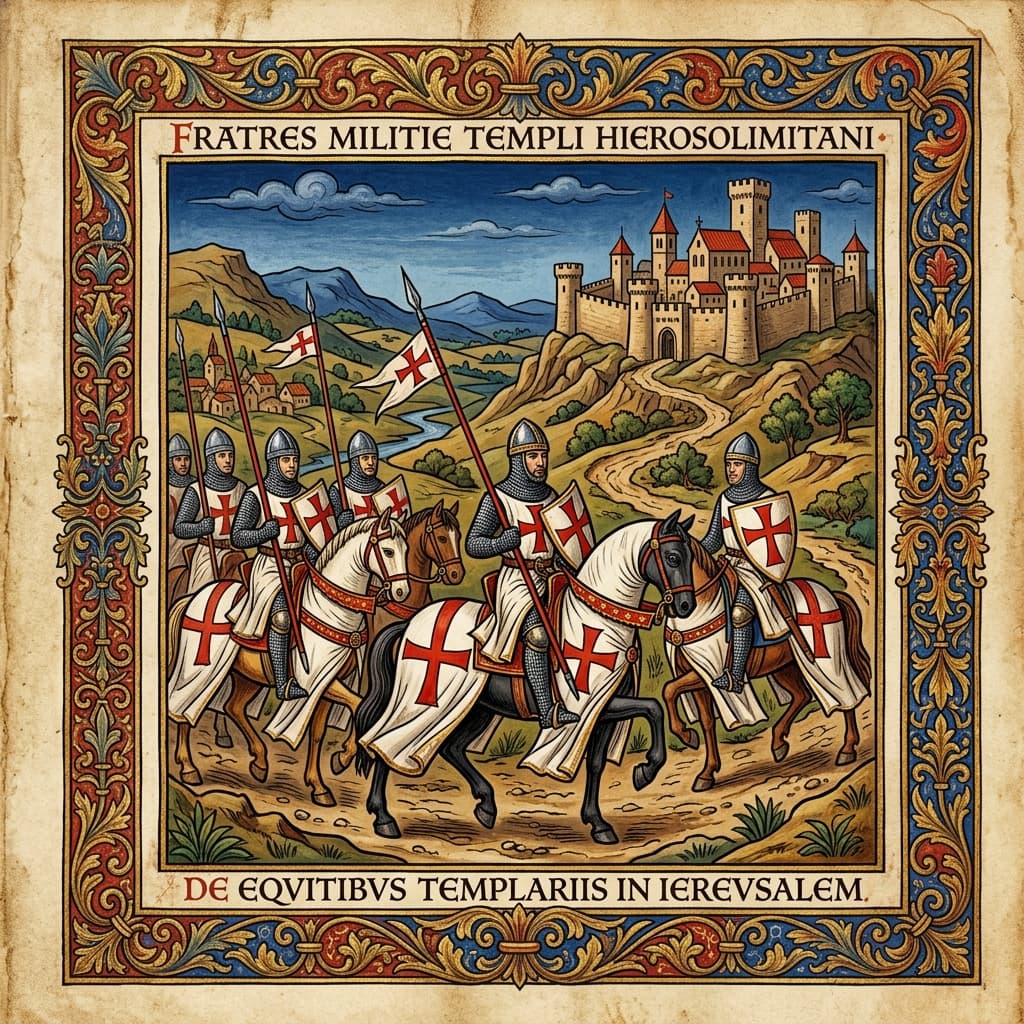
Who Were the Knights Templar
Secret Societies · Updated August 15, 2026
Overview
The Knights Templar were primarily a financial institution, not a fighting force,up to 90% of members were non-combatants who managed an early banking network across Europe. The order embodied the medieval conviction that monastic devotion and armed defense of pilgrims could be unified in a single vocation. They saw themselves as fulfilling Christ's command to shelter the stranger and bear one another's burdens through both charity and sword. Their existence rested on the belief that faith without works is dead, and that works included physical protection of the vulnerable. This matters to a Christian reader because the Templars attempted to live out biblical commands in a concrete, historical setting,and their story reveals both the power and the peril of combining spiritual mission with temporal power.
Founded in 1118 in Jerusalem, the order established itself to defend pilgrims traveling to the Holy Land, headquartered on the Temple Mount, the site of Solomon's Temple. Pope Innocent II's 1139 bull Omne datum optimum granted the order exemption from local church authority, allowing them to keep spoils and operate independently under papal jurisdiction alone. Non-combatant members managed a network of nearly 1,000 commanderies across Europe and the Holy Land, offering letter-of-credit systems allowing pilgrims to deposit funds in Europe and withdraw in Jerusalem. The order met its end when Pope Clement V dissolved it in 1312 under pressure from King Philip IV of France, who arrested and tortured Templars in 1307, extracting false confessions of heresy. Many were burned at the stake.
The Templars drew on passages like Matthew 25:35-40, where Christ identifies himself with the stranger, the hungry, and the imprisoned,categories that included pilgrims traveling dangerous roads. James 2:14-17 supplied the theological framework: faith without works is dead, legitimizing an order that combined prayer with military action. Isaiah 58:6-7's call to loose the bands of wickedness and free the oppressed was read as a mandate for armed intervention on behalf of persecuted Christians. Scripture commands believers to protect the vulnerable and bear one another's burdens, which the Templars attempted through armed pilgrimage defense. The order's vast wealth, political entanglement with European monarchs, and eventual destruction by the very church that endorsed it reveal the danger of combining temporal power with spiritual mission. The Bible warns that faith divorced from genuine compassion is dead, but history shows that compassion armed with swords and banking networks can become corrupted by the power it accumulates.
The Templars are commonly remembered as a secretive occult order, but they were a mainstream Catholic military order whose financial innovations and political power,not secret rituals,led to their destruction. The order that began with nine knights guarding roads in 1118 had grown into a financial empire with branches from London to Antioch by the time Philip IV moved against it. The king owed them money. Destroying them solved his debt problem.
The Knights Templar were primarily a financial institution, not a fighting force—up to 90% of members were non-combatants who managed an early banking network across Europe.