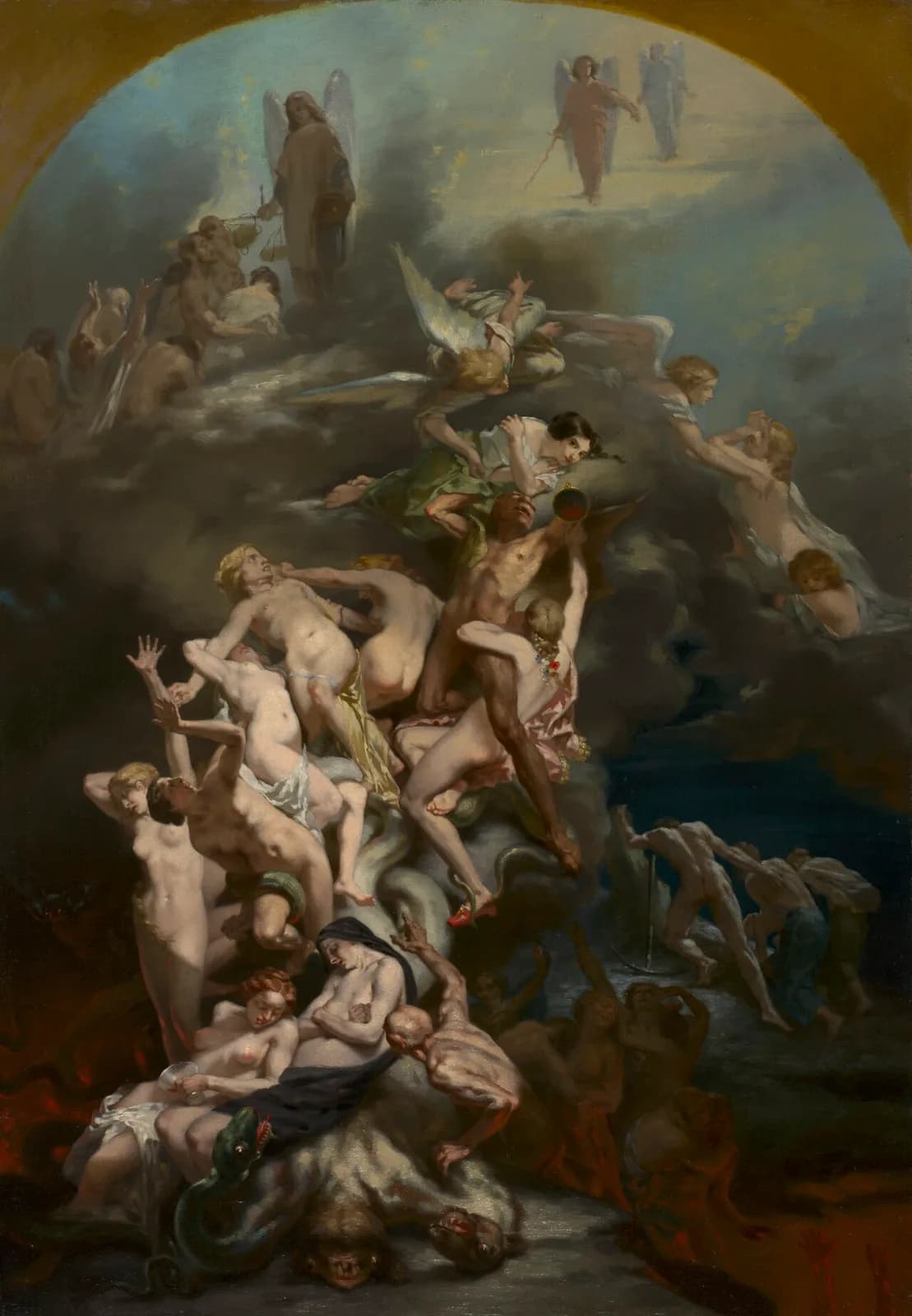
Heaven
Theology · Updated August 15, 2026
Overview
The concept of heaven has changed over centuries, and early Christians held different ideas about it than most people today. In the earliest days of Christianity, heaven was often understood as a temporary resting place where souls awaited the eventual resurrection of the body. This view drew from Jewish beliefs and the early Christian hope of a new Earth. As Christianity expanded, it absorbed elements of Greek philosophy, particularly Platonic ideas that described an eternal, non-physical realm. This philosophical shift produced a more ethereal and everlasting notion of Heaven, distinct from the bodily resurrection anticipated by many early Christians.
During the Middle Ages, the imagery of Heaven grew more elaborate and hierarchical, shaped by literary works like Dante Alighieri's "Divine Comedy," which depicted heaven as a realm of concentric circles, each representing a different level of bliss. The Catholic Church's teachings during this period further defined heaven as a structured and stratified place. The Protestant Reformation in the 16th century altered this framework. Reformers like Martin Luther and John Calvin rejected the Catholic Church's interpretations and advocated for a personal and direct relationship with God, which recast heaven as an intimate spiritual experience rather than a structured hierarchy.
Today, the concept of Heaven varies widely among Christian denominations, but many contemporary interpretations emphasize a personal and spiritual experience rather than a concrete physical location. This modern view centers on an eternal presence with God rather than a celestial city with golden streets, reflecting broader shifts toward individualistic spiritual beliefs. While the imagery of clouds and angels persists in popular culture, for many believers, heaven represents a state of being rather than a place to go.
Common questions
- What is heaven according to the Bible?
- In the Bible, heaven is often described as the dwelling place of God, angels, and the righteous after death. It is depicted as a place of eternal peace and joy, where believers are in the presence of God.
- How do different religions define heaven?
- Different religions have varied interpretations of heaven. In Christianity, it is often seen as an eternal presence with God; in Islam, it is a paradise with physical and spiritual pleasures; in Hinduism, it is a temporary stop in the cycle of reincarnation; and in Buddhism, it is a realm of bliss but not the ultimate goal.
- Is heaven mentioned in the Quran?
- Yes, heaven is mentioned in the Quran as Jannah, a paradise where believers are rewarded with eternal bliss and closeness to God.
- What are the characteristics of heaven in Christianity?
- In Christianity, heaven is characterized by eternal life, peace, joy, and the presence of God. It is often seen as a spiritual state of being rather than a physical place, where believers experience a direct relationship with God.
- Do all Christians believe in the same concept of heaven?
- No, Christians have varied beliefs about heaven. While some view it as a physical place, others see it as a spiritual experience, and interpretations can differ among denominations.
- What is the difference between heaven and paradise?
- In Christian theology, 'heaven' is often the ultimate eternal state with God, while 'paradise' can refer to a temporary place of bliss before the final resurrection. In Islam, paradise (Jannah) is the eternal reward for the faithful.
- Do animals go to heaven according to religious beliefs?
- Religious beliefs about animals in heaven vary. Some Christians believe animals may be present in heaven, while others see heaven as a human-centric experience. Other religions may have different views or not address the topic explicitly.
- What does heaven look like in religious art?
- In religious art, heaven is often depicted with imagery of clouds, angels, and divine light. It may include scenes of saints, the throne of God, and symbols of peace and harmony.
- Is heaven a physical place or a state of being?
- In modern Christian thought, heaven is often seen more as a state of being in eternal presence with God rather than a physical place. This reflects a shift from earlier views of a tangible celestial city.
- What do people do in heaven according to different religions?
- In Christianity, people in heaven worship God and experience eternal joy. In Islam, they enjoy physical and spiritual pleasures. Other religions may describe heavenly activities differently, often focusing on spiritual fulfillment.
- How is heaven described in Hinduism?
- In Hinduism, heaven is a temporary realm of pleasure and reward for good deeds, known as 'Svarga.' It is not the ultimate goal, as the cycle of reincarnation continues until achieving moksha, or liberation.
- Do Jews believe in heaven?
- Jewish beliefs about the afterlife, including heaven, vary. Traditional Judaism focuses more on life on Earth, but some Jewish texts describe a spiritual afterlife or 'Olam Ha-Ba,' the world to come.
- What role does heaven play in Buddhism?
- In Buddhism, heaven is considered a temporary realm of pleasure within the cycle of samsara, the cycle of birth and rebirth. It is not the ultimate goal, which is achieving Nirvana, a state of liberation from suffering.
- How has the concept of heaven evolved over time?
- The concept of heaven has evolved from a temporary resting place influenced by Jewish beliefs to a more eternal, non-physical realm shaped by Greek philosophy. Over time, it has shifted from a structured hierarchy to a personal spiritual experience, reflecting broader changes in religious thought.