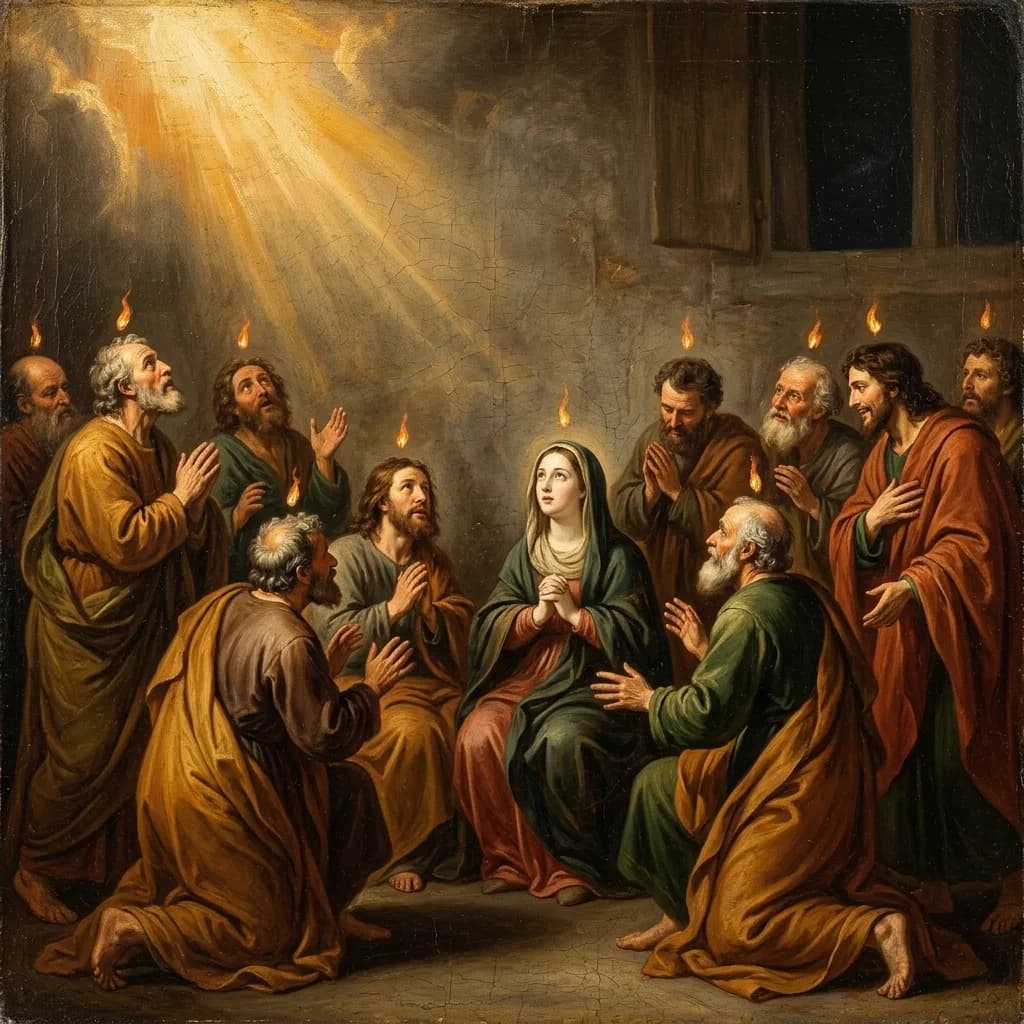
Speaking in Tongues
Theology · Updated August 15, 2026
Overview
For nearly 2,000 years, the practice of speaking in tongues has sparked both unity and division among Christians. Known as glossolalia, this phenomenon is believed by practitioners to be a divine language inspired by the Holy Spirit. It appears in the New Testament, suggesting its presence among the earliest Christians. However, as the church evolved, so did opinions on the practice. At times, it has been celebrated as a spiritual gift that unites believers in a shared experience of the divine. At other times, it has been viewed with skepticism and even declared heretical, leading to divisions within the church.
In the 2nd century, the Montanist movement, which placed a strong emphasis on prophecy and speaking in tongues, emerged as a fervent expression of early Christianity. Its followers believed they were experiencing direct revelations from the Holy Spirit, yet mainstream church leaders rejected Montanism as heretical, partly due to its ecstatic practices. Fast forward to the 20th century, the Azusa Street Revival in Los Angeles in 1906 marked a turning point for the practice. Led by preacher William J. Seymour, this revival ignited the modern Pentecostal movement, where Speaking in Tongues became a hallmark. This movement spread rapidly, birthing various Pentecostal denominations. By the 1960s, the Charismatic Movement brought glossolalia into the mainstream of Protestant and Catholic churches, furthering acceptance but also stirring debate.
Today, Speaking in Tongues continues to be a contentious issue within Christianity. Some denominations embrace it as a powerful manifestation of the Holy Spirit, considering it essential for spiritual life. Others, however, regard it as unnecessary or even disruptive, preferring a more restrained approach to worship. The debate persists, reflecting the diverse landscape of modern Christianity where the practice remains both a source of inspiration for many and a point of contention for others.
The practice of speaking in tongues has been a source of both unity and division among Christians for nearly 2,000 years.
Why Fighting Over Speaking in Tongues Was a Big Deal
The debate over speaking in tongues centers on who decides what constitutes true Christian practice and belief. The controversy concerns the authority to define legitimate spiritual experiences. Some Christians argue that modern spiritual gifts, including speaking in tongues, have a rightful place in contemporary faith. Others hold to traditional interpretations of scripture that either downplay or dismiss these practices. This issue pits modern spiritual expression against historical doctrine, shaping the way individuals and churches understand their faith.
The Azusa Street Revival of 1906 intensified this struggle. William J. Seymour led this revival in Los Angeles, where Speaking in Tongues became a central practice. The event attracted attention and intensified the debate over spiritual gifts. Out of this revival, the Pentecostal movement emerged, with figures like Charles Parham advocating for Speaking in Tongues as a legitimate and necessary sign of the Holy Spirit's presence. They sought to validate their spiritual experiences and carve out a distinct identity within Christianity. On the opposite side, traditionalists like Benjamin B. Warfield argued that such practices were misinterpreted or no longer relevant in modern times, aiming to preserve doctrinal purity. Moderates, represented by A.B. Simpson, tried to bridge the gap by acknowledging the validity of the experience without making it essential to faith. Each faction stood to gain something concrete: Pentecostals sought identity and legitimacy; traditionalists sought the defense of established doctrine; and moderates sought a middle ground that could unite divergent views.
The issue remains unresolved because it deals with personal spiritual experiences that are subjective. These experiences resist uniform doctrinal regulation, making it difficult for any single perspective to prevail universally. The tension between personal spiritual expression and institutional doctrine continues to play out in modern Christianity. A tangible example of this ongoing conflict is the diverse landscape of Christian denominations today, where speaking in tongues is embraced by some, questioned by others, and cautiously accepted by yet another group.
Continue reading with a Scholar plan
Upgrade to ScholarCommon questions
- What is speaking in tongues and how does it work?
- Speaking in tongues, or glossolalia, is a practice where individuals utter sounds or speech-like syllables that are believed to be a divine language inspired by the Holy Spirit. It is often considered a spiritual gift and is practiced during religious worship.
- Why do some Christians speak in tongues and others don't?
- Some Christians believe speaking in tongues is a manifestation of the Holy Spirit and an important part of their spiritual life, while others view it as unnecessary or disruptive. The practice is more common in Pentecostal and Charismatic movements, which emphasize spiritual gifts, whereas other denominations may prioritize traditional interpretations of scripture.
- Is speaking in tongues mentioned in the Bible?
- Yes, speaking in tongues is mentioned in the New Testament, particularly in the Acts of the Apostles and 1 Corinthians, where it is described as a spiritual gift given by the Holy Spirit.
- What are the different interpretations of speaking in tongues?
- Interpretations vary, with some viewing it as a divine language or a sign of the Holy Spirit's presence, while others see it as an outdated or misinterpreted practice. Some denominations embrace it as essential, while others regard it with skepticism or prefer more restrained worship.
- How can I learn to speak in tongues?
- Speaking in tongues is generally considered a spontaneous spiritual experience rather than a learned skill. Those interested often seek it through prayer, worship, and participation in communities that practice it, such as Pentecostal or Charismatic churches.
- What is the purpose of speaking in tongues in religious practice?
- The purpose is often seen as a way to communicate with God in a divine language, express spiritual fervor, and experience a direct connection with the Holy Spirit. It can also serve to edify the individual and the church community.
- Why do some churches emphasize speaking in tongues more than others?
- Churches that emphasize speaking in tongues, like Pentecostal and Charismatic movements, view it as a key sign of the Holy Spirit's presence and a vital part of spiritual life. Other denominations may focus on different aspects of faith or interpret spiritual gifts differently, leading to less emphasis on the practice.
- What does it feel like to speak in tongues?
- Those who speak in tongues often describe it as a deeply spiritual and emotional experience, feeling a sense of connection with the divine. The experience can vary widely among individuals, with some feeling a sense of peace and others experiencing intense emotions.
- Is speaking in tongues the same as glossolalia?
- Yes, speaking in tongues is also known as glossolalia. Both terms refer to the practice of uttering speech-like sounds believed to be inspired by the Holy Spirit.
- How does speaking in tongues differ between Pentecostal and Charismatic movements?
- In Pentecostal movements, speaking in tongues is often seen as a necessary sign of receiving the Holy Spirit, while Charismatic movements may view it as one of many spiritual gifts. Charismatics are typically more integrated into mainstream denominations, whereas Pentecostals form distinct denominations.
- What are the psychological explanations for speaking in tongues?
- Psychological explanations suggest that speaking in tongues may result from heightened emotional states, group dynamics, or a form of dissociative experience. It can also be seen as a learned behavior within religious communities.
- Can speaking in tongues be considered a spiritual gift?
- Yes, many Christians consider speaking in tongues a spiritual gift, as described in the New Testament, where it is listed among other gifts of the Holy Spirit.
- What was the historical significance of speaking in tongues in early Christianity?
- Speaking in tongues was significant in early Christianity as a sign of the Holy Spirit's presence, as seen in the New Testament. It was practiced by early Christian groups like the Montanists, although it was later viewed with skepticism by mainstream church leaders.
- Is there scientific evidence for or against speaking in tongues?
- Scientific studies have explored the neurological and psychological aspects of speaking in tongues, but there is no definitive evidence proving or disproving its divine nature. Researchers have noted differences in brain activity during the practice, but interpretations vary.
- How should one interpret speaking in tongues during a church service?
- Interpretation can vary depending on the denomination and individual beliefs. Some see it as a powerful expression of faith and the Holy Spirit's presence, while others may view it with skepticism or prefer services without such expressions.