Why Church Volunteers Burn Out (And How Good Systems Prevent It)
Fix the system, not the people.

Every church has seen it. Someone shows up eager, says yes to everything, serves faithfully for a season -- and then quietly disappears. They stop responding to messages. They skip a Sunday. Then another. Then they're gone.
Leadership usually blames themselves. Maybe they didn't appreciate that person enough. Maybe the role wasn't a good fit. Maybe life just got busy.
Sometimes those things are true. But more often than not, volunteer burnout is not a people problem. It's a systems problem. And that means it's fixable.
The national volunteer retention rate sits around 65%, meaning roughly one out of every three volunteers walks away each year. For a small church running on a lean team, losing even two or three key people can set a whole ministry back.
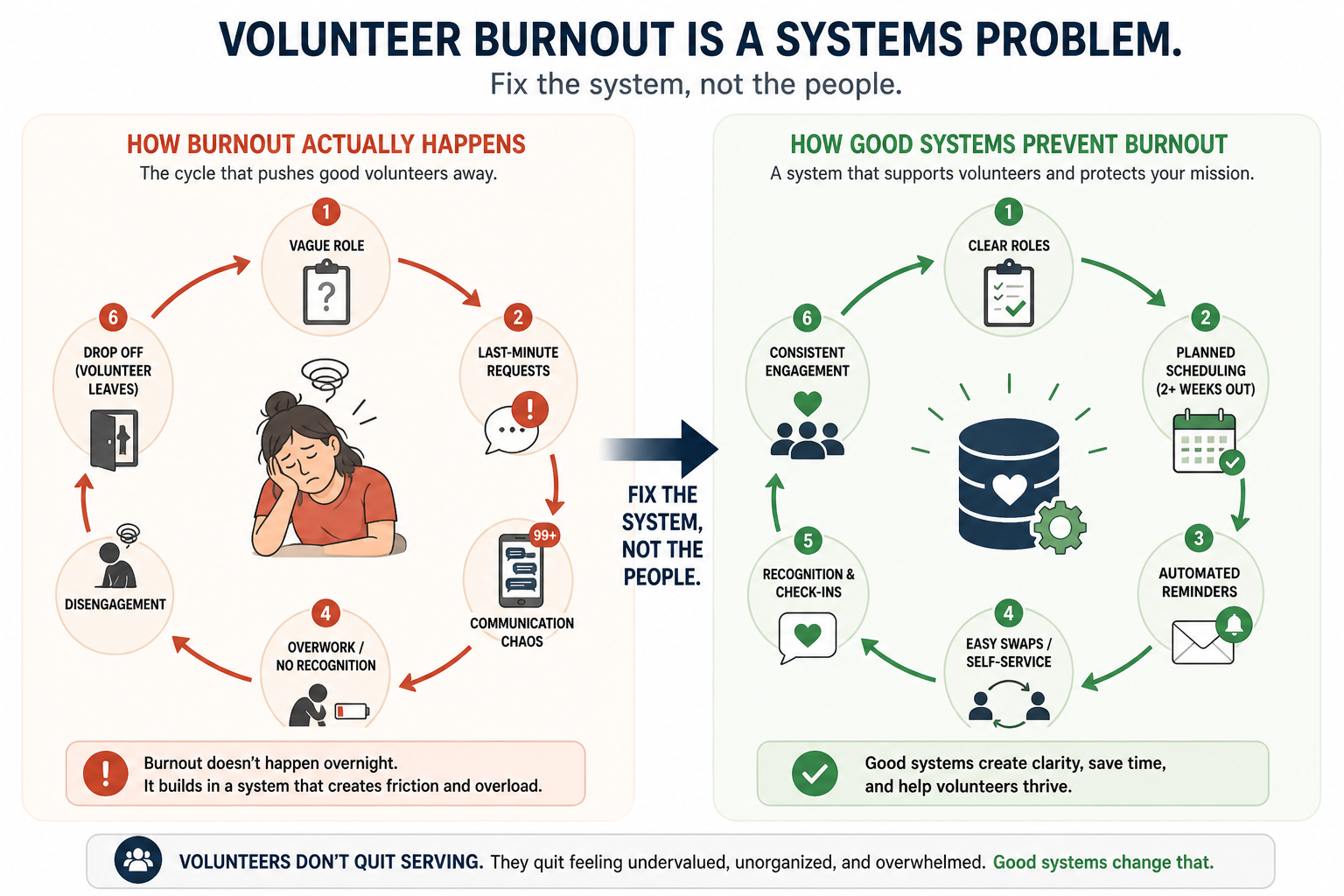
The Real Reasons Volunteers Quit
Before you can fix burnout, you have to understand what's actually causing it. The usual suspects are not what most church leaders expect.
They don't know what's expected of them. Vague roles are exhausting -- volunteers end up either over-functioning or under-functioning.
They get last-minute requests constantly. Being asked to cover something on Friday for Sunday signals disorganization and disrespects their time.
Nobody notices if they show up or not. No attendance tracking and no follow-up teaches volunteers their presence doesn't matter.
They're asked to do the same thing forever. Three years in the same role with no acknowledgment or rotation turns even passionate volunteers into burned-out ones.
The communication is chaos. Group texts, forwarded emails, last-minute announcements -- the mental load adds up fast.
They were never matched to the right role. Placing a volunteer where you need them, not where they fit, turns serving into a burden.
Systems Don't Replace Relationships. They Protect Them.
There's a common resistance in church culture to the word 'systems.' It sounds corporate. Impersonal. The concern is that building structured processes will make the church feel like a business instead of a family.
That concern gets it backwards. Good systems free your leaders up to actually be present with people. When administrative burdens are handled systematically, leaders gain capacity for genuine human connection. Systems handle the logistics so people can handle the relationships.
What a Volunteer-Sustaining System Actually Looks Like
You don't need anything complicated. You need a few things working together consistently:
A clear volunteer database -- who your volunteers are, what roles they've served, how long they've been involved, when they last served.
Structured scheduling with advance notice -- volunteers should know their upcoming schedule at least two weeks out.
Automated reminders -- a reminder sent 48 hours before someone serves is good communication. Set it up once and let it run.
Easy sign-up and swap processes -- when a volunteer can't make it, they need a simple way to flag it without it falling entirely on a coordinator.
Regular check-ins and recognition -- consistent acknowledgment after a big Sunday, a personal check-in when someone goes quiet, a note when someone hits a milestone.
Onboarding Matters More Than You Think
A lot of burnout is seeded in the first few weeks of volunteering -- long before anyone notices a problem. A new volunteer who jumps in without a clear orientation, a defined role, or an introduction to the team is a high dropout risk from day one.
Good onboarding communicates that this church takes its volunteers seriously, that their time is valued, and that someone is paying attention. Churches that invest in those first 30 to 60 days see significantly better long-term retention.
Catch Burnout Before It Happens
One of the most underused features of good volunteer management is the ability to spot warning signs early. Most churches don't lose volunteers to a dramatic exit — they lose them to a slow fade. By the time leadership notices there's a problem, the damage is already done.
Someone who served every week for a year and has now missed four in a row is telling you something. A team that's consistently understaffed is heading toward collapse. A volunteer who keeps getting scheduled for the same role despite requesting a change is a retention risk. Someone serving in three ministries simultaneously is almost certainly your next burnout story.
When your data is organized and visible, these patterns jump out. When everything lives in a group text and a volunteer coordinator's memory, they stay invisible until someone is already out the door.
The Tool That Makes This Manageable
None of this requires a large staff or a complex tech stack. It requires one organized system that brings volunteer management, communication, and scheduling under one roof.
ChMeetings is built exactly for this. It gives churches of any size the tools to manage volunteers properly: scheduling, reminders, role tracking, communication, and the visibility to catch problems before they become losses. It's designed to be simple enough that a part-time admin or a dedicated volunteer can run it without a learning curve.
Your volunteers showed up because they believe in what your church is doing. They stay when they feel valued, organized, and cared for — when someone noticed that they showed up, when they knew what was expected of them, and when serving felt sustainable rather than overwhelming. That's not just a culture question. It's a systems question.