Why Did Ronan Farrow Depict Sam Altman as a Demon?
The curious cover art from The New Yorker’s Sam Altman investigation has a very specific precedent.
On April 13, Ronan Farrow and Andrew Marantz published an investigation into Sam Altman and OpenAI in The New Yorker. The piece was the product of eighteen months of reporting.¹ It ran to sixteen thousand words and drew on interviews with more than a hundred people and hundreds of pages of internal documents.²
The picture that emerged was not flattering. Multiple sources, speaking independently of each other, described Altman as a pathological liar.³ The article documented contradictions between his public statements and his conduct — between the safety-first mission OpenAI presents publicly and the decisions made internally, between what Altman said to the board and what he said to investors. Altman called the article incendiary.⁴ Some weeks later, someone threw a molotov cocktail at his house.⁵
Most readers focused on the reporting. But there is something in the illustration that deserves its own attention.
The curious cover art
The New Yorker commissioned an AI-generated portrait from artist David Szauder. In it, Altman stands in a blue sweater with a blank expression. Around his head floats a constellation of disembodied faces — different moods, different expressions, none of them his. One face rests in his hands. The New Yorker’s art team described the result as a “Hydra-esque eldritch monstrosity.” Approximately fifteen sketches were submitted before this one was selected.⁶
For readers familiar with a particular 17th-century text, the image carries an immediate resonance. It maps, with unusual specificity, onto a figure named Dantalion — the 71st demon catalogued in the Ars Goetia.
What Is the Ars Goetia?
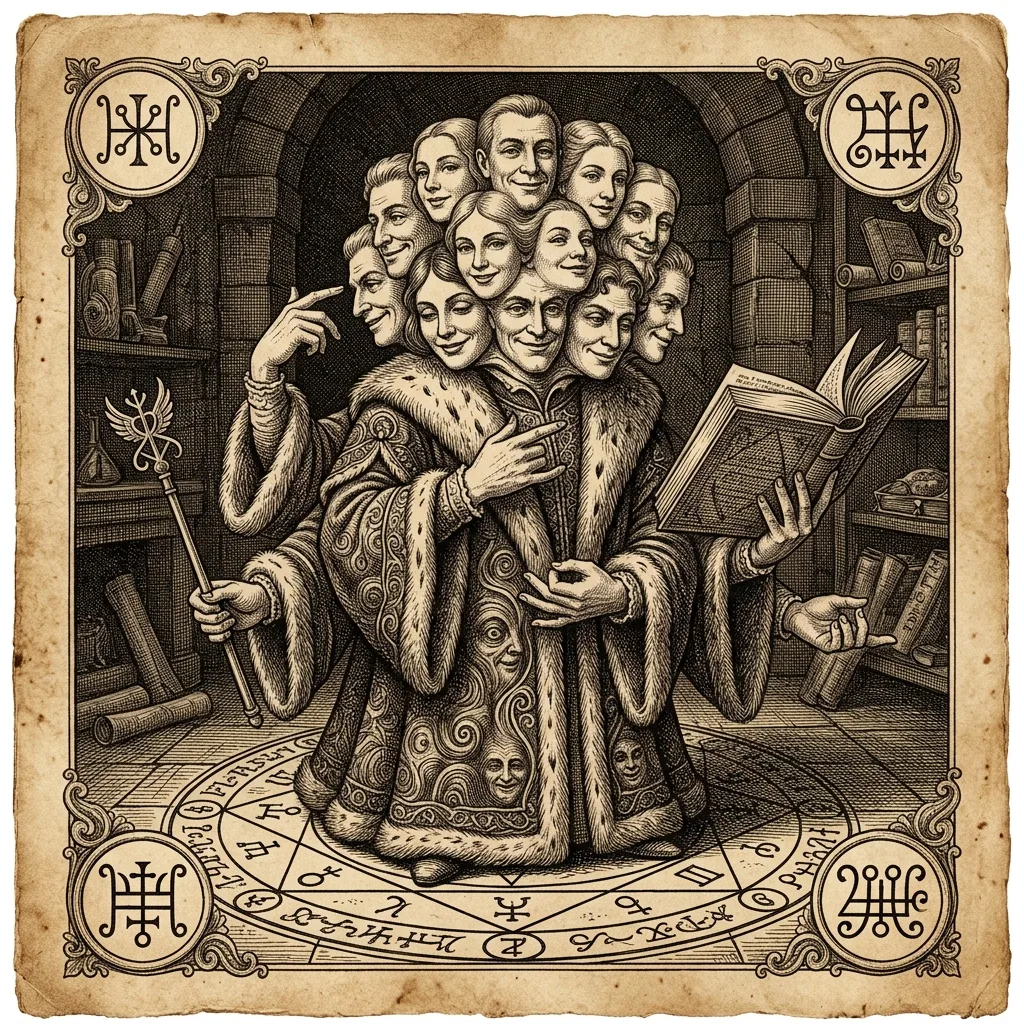
The Ars Goetia is a grimoire — a medieval catalog of demons. It forms the first section of the Lemegeton, a 17th-century collection of magical texts. The catalog describes seventy-two spirits in precise detail: their rank, their appearance, and the specific powers they hold.
Other traditions frame demons differently. In the New Testament, demons are possessing spirits, forces aligned with sin and opposed to the good. When Jesus rebukes his disciple Peter with the words “Get behind me, Satan,” the demonic is the pull toward self-interest, toward betrayal, toward the corruption of trust between people.
The Ars Goetia tradition is something else. Its seventy-two spirits are not primarily tempters or possessors. Many of them are teachers. Several grant knowledge of science, language, or hidden things. Some bring wealth or fulfill requests. They function more like bureaucrats of a fallen spiritual order — each holding a defined domain of power, each operating through a specific mechanism.
The 71st Spirit
Dantalion is the 71st spirit of the Ars Goetia. He is a Duke of Hell, commanding thirty-six legions.
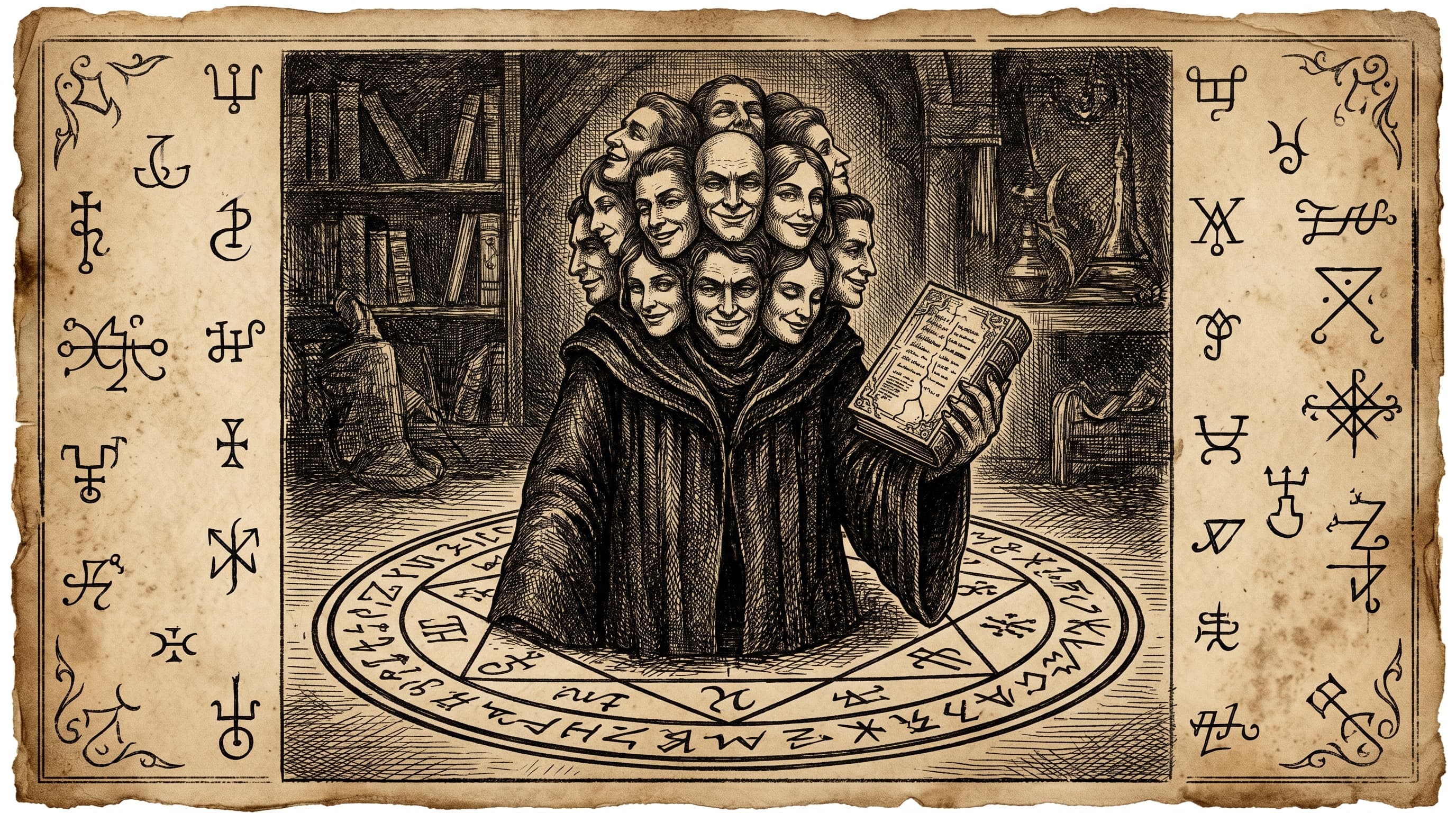
He appears with many faces — all men’s and women’s, all smiling — and holds a book in his right hand.
He knows the thoughts of all men and women. He can change them at will.
The New Yorker illustration shows a man surrounded by multiple shifting faces, one held in his hands, depicted in an article whose central argument is that he has spent his career knowing what each person needed to hear — and telling them exactly that. Farrow’s sources did not describe a man who lies clumsily. They described someone who understands what you want to believe, and who constructs himself accordingly.
Was it intentional?
We cannot claim to know what Szauder or the New Yorker’s art team had in mind. They have not said.
A few things are worth noting. The Ars Goetia does not originate in Christianity. Its spirit catalog draws primarily from Kabbalistic and Talmudic traditions — an intellectual world the New Yorker’s editorial environment has long engaged. The Lemegeton circulates actively in 2026, particularly in the overlap between Silicon Valley, accelerationism, and esoteric culture. That overlap is not a niche. The question of whether AI development is a form of world-creation — whether the people building it are, in some sense, playing at being gods — is debated with genuine seriousness in the same circles that produced OpenAI.
Altman himself has spoken publicly about AI in near-theological terms. OpenAI’s founding documents describe a mission to ensure the long-run benefit of humanity — a formulation with unmistakably religious ambition. The symbolic vocabulary of creation, power, and accountability is already in the room.
Our thoughts
We can't put ourselves in the place of the writers at the New Yorker, but there's something about the choice of imagery and its historical symbolic meaning that fits remarkably cleanly. The image of Dantalion and his knowledge-giving powers seem remarkably tightly linked.
Sources
1 Ronan Farrow and Andrew Marantz, “Sam Altman May Control Our Future—Can He Be Trusted?” The New Yorker, April 13, 2026. Farrow described the investigation as spanning “a year and a half” in his announcement thread on X.
2 Ibid. The article states interviews with “more than a hundred people with firsthand knowledge” and review of previously undisclosed internal documents.
3 Ibid. The characterizations “pathological liar” and “sociopath” were attributed to multiple former colleagues and executives speaking independently.
4 Sam Altman, statement reported by TechCrunch, April 11, 2026.
5 “Sam Altman Responds to ‘Incendiary’ New Yorker Article After Attack on His Home,” TechCrunch, April 11, 2026.
6 David Szauder illustration details and the “Hydra-esque eldritch monstrosity” description reported by Infralog and Observ Media. New Yorker digital art director Aviva Michaelov confirmed the submission and selection process.