How Small Churches Can Run Like a Big Church (Without a Big Budget)
The right systems help you care for more people with the time and resources you have.

There's a quiet assumption that holds a lot of small churches back: the idea that organized, professional-grade operations are only for congregations with a full-time staff, a six-figure tech budget, and a dedicated IT person on call.
It's not true. And it's worth pushing back on.
Small churches don't have to choose between staying scrappy and staying effective. With the right mindset and tools, a congregation of 80 can operate with the same clarity, follow-through, and care as one with 800.
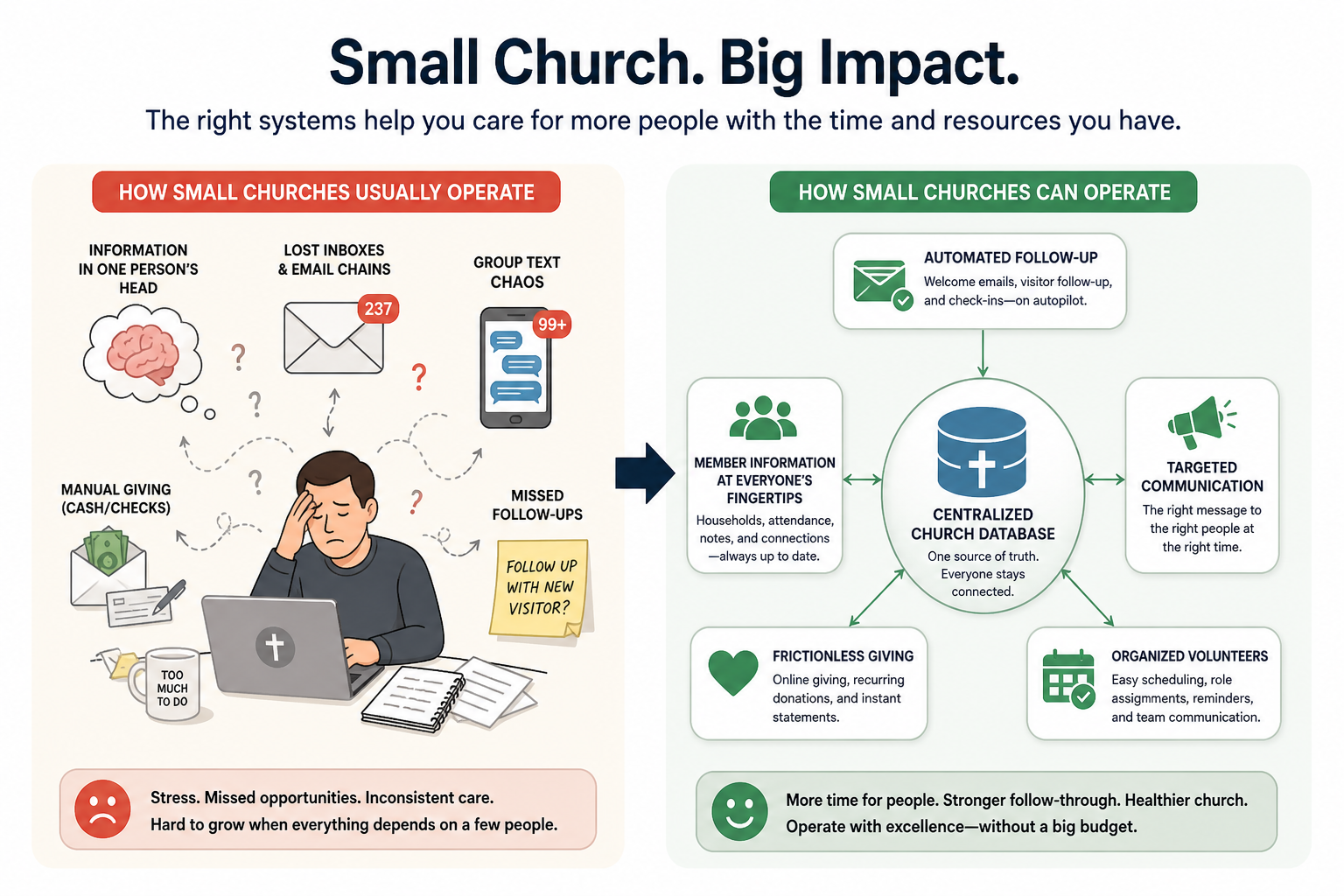
1. Stop Relying on One Person's Brain (or Inbox)
In small churches, institutional knowledge tends to live in one place: the pastor's head, the admin volunteer's notebook, or a reply-all email chain that nobody can find anymore. This works until it doesn't -- when someone gets sick, a volunteer moves away, or a newcomer slips through the cracks.
Large churches solve this by centralizing member data in a shared system. Small churches can do the same thing: a simple member directory with contact information, attendance notes, and family connections gives the whole leadership team a unified reference point.
2. Automate the Follow-Up You're Already Forgetting
The difference between churches that retain visitors and those that don't often comes down to consistent follow-up execution. Research consistently shows that visitor retention rates are highest when churches follow up within 48 hours.
Big churches build systematic approaches: assigning visitors to care teams, sending automated welcome messages, flagging inactive attendees. Small churches can implement these same systems through the right software -- without requiring a large staff.
3. Make Giving Frictionless
Small churches often experience inconsistent giving not due to lack of generosity but because of barriers in the donation process -- limited payment methods, no recurring gift option, cash-only plates.
Online giving platforms let members contribute easily and set up automatic gifts. Recurring donors contribute substantially more annually than one-time givers, which means churches can budget with far greater confidence.
4. Coordinate Volunteers Without the Group Text Chaos
Group text coordination creates predictable problems: buried scheduling conflicts, unconfirmed confirmations, forgotten sign-ups. Large churches use structured volunteer management -- sign-up forms, scheduling tools, automated reminders, clear role assignments.
Small churches benefit from the same basic systems to reduce no-shows and eliminate last-minute scrambling, without needing enterprise-level software.
5. Communicate Like a Church That Cares, Not One That Blasts
Mass emails sent indiscriminately train congregations to ignore church communications. Big churches segment their lists -- every message feels relevant to the person receiving it. That's not a budget advantage. It's a systems advantage.
Targeted communication increases open rates and engagement while building the relationships that keep visitors returning.
The Real Equalizer: Choosing the Right Tools
None of this requires a big budget or a tech-savvy staff. It requires tools built specifically for churches: tools that handle member management, giving, communication, volunteers, and attendance in one place, without a steep learning curve.
That's exactly what church management software is designed to do. Platforms like ChMeetings exist precisely for small and mid-sized congregations that want to operate with excellence but don't have the bandwidth to stitch together ten different apps or hire a part-time administrator just to manage the backend.
The congregations that thrive long-term aren't always the biggest ones. They're the ones that stay organized, follow through on care, and use their limited resources wisely. That's a game any church can play.