Bible study / Biblical figures / Delilah

Old Testament

Delilah

Period of the Judges (c. 1100 BC)

betrayalseductionstrength and weaknesspersistenceavarice

The Story of Delilah

Delilah, a woman from the Valley of Sorek, emerges in the biblical narrative during the turbulent period of the Judges, around 1100 BC. This era is marked by frequent skirmishes between the Israelites and their neighbors, most notably the Philistines, who held sway over the coastal regions of Canaan. Among the Israelites, Samson stood out as a formidable judge endowed with extraordinary strength, attributed to his Nazirite vow. His strength, however, was entwined with his uncut hair, a secret he guarded closely. Despite this, Samson fell deeply in love with Delilah (Judges 16:4), a relationship that would set the stage for his eventual undoing.

The Philistine lords, keenly aware of the threat Samson posed, saw an opportunity in Delilah. They approached her with a lucrative offer: 1,100 pieces of silver each if she could uncover the source of Samson's strength (Judges 16:5). Delilah's decision to accept their bribe marks a pivotal moment in the story. Her relentless pursuit for the truth about Samson's strength is both strategic and methodical. She begins her inquiry with a direct question to Samson, "Please tell me where your great strength lies, and how you might be bound, that one could subdue you" (Judges 16:6). Her persistence, coupled with the substantial financial incentive, drives her to repeatedly question Samson, despite his initial evasions.

Eventually, worn down by Delilah's persistence, Samson reveals his secret, confessing that his strength is tied to his uncut hair, a symbol of his Nazirite dedication to God (Judges 16:17). With this revelation, the stakes are heightened as Delilah prepares to act on the information. She orchestrates a situation where Samson falls asleep on her knees and summons a man to shave off the seven locks of his hair (Judges 16:19). As his hair is cut, Samson's strength leaves him, and Delilah calls in the Philistines to seize him. In a dramatic reversal of fortune, the mighty judge is subdued, his eyes gouged out, and he is taken prisoner.

The conclusion of Delilah's actions ripples through the narrative of the Judges. Samson, once invincible, finds himself powerless and imprisoned, highlighting the vulnerability even the strongest can face when betrayed. Delilah, meanwhile, collects her reward, her role in the story complete. Samson's capture leads to his eventual death, as recorded later in Judges 16, when he brings down the Philistine temple upon himself and his captors. Delilah's singular act of betrayal, driven by financial gain rather than personal animosity or national loyalty, leaves a lasting mark on the biblical history of Israel, underscoring the complex interplay of power, seduction, and betrayal in the ancient world.

Who Was Delilah

In the story of Delilah, as recounted in Judges 16, the Hebrew word "בָּגַד" (bagad) encapsulates her character. Meaning "to betray" or "act treacherously," this term appears in Judges 16:18, underscoring the nature of Delilah's actions. She is not merely a woman led astray by personal whims or seduced by Samson's charm; rather, she is a calculating figure who engages in a deliberate act of betrayal. When approached by the Philistine lords, Delilah sees an opportunity to negotiate a lucrative reward in exchange for discovering the secret of Samson's strength. Her actions are marked by manipulation and persistence, as she repeatedly probes Samson for his secret with emotional appeals (Judges 16:6, 16:10, 16:13, 16:15). These interactions reveal her as a strategic thinker, able to navigate personal relationships to achieve her ends.
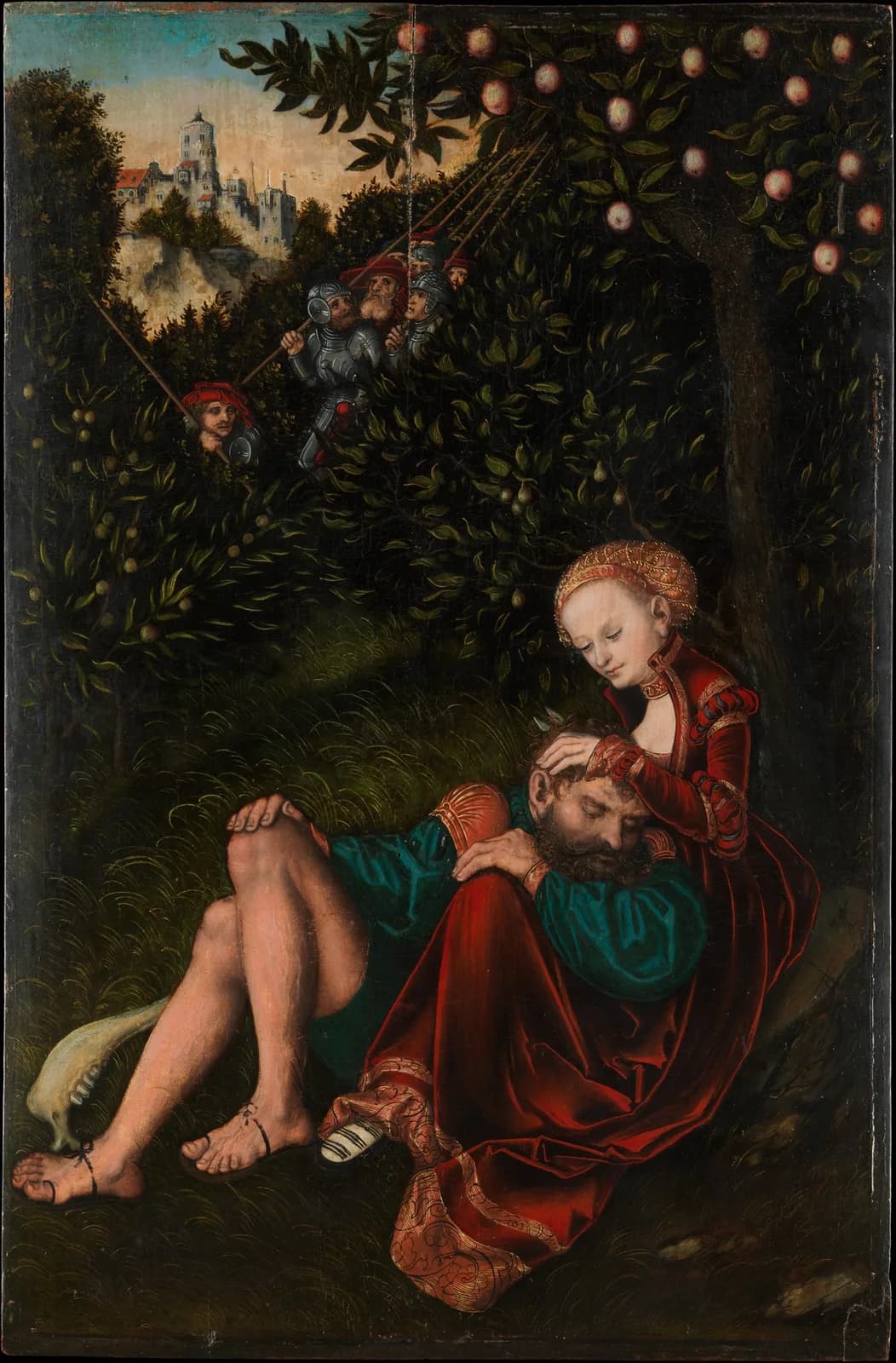
Delilah's pivotal decisions further illuminate her character. She agrees to the Philistine lords' proposal, choosing financial gain over loyalty to Samson, her lover (Judges 16:5). This choice is not one of impulsive greed but a calculated move that prioritizes her survival and prosperity. Her persistence in extracting Samson's secret, despite his initial deceptions, highlights her determination and strategic acumen (Judges 16:16). In contrast, Samson, a man of immense physical strength, repeatedly falls for Delilah's emotional manipulation, showcasing a vulnerability in his character. While Samson embodies raw power, Delilah represents the cunning and psychological strategy that can compromise even the mightiest of men. This interplay between strength and cunning serves to deepen the narrative, showing how Delilah's choices are driven by pragmatism rather than mere seduction.

Popular culture often flattens Delilah into the archetype of a temptress, an alluring woman who leads a man to his downfall. This misreading simplifies her role and overlooks her agency as a negotiator and strategist. In the biblical text, Delilah is not merely a passive instrument of Samson's demise but an active participant in a political game, where she directly negotiates with the Philistine powers. Her actions suggest a pragmatic survivor who, faced with limited options, chooses the path that best secures her future. By focusing solely on her seductive qualities, modern interpretations erase the complexity of her character and the calculated decisions she makes. Delilah's story, as captured in the text, is one of survival and agency, a narrative that challenges the simplistic portrayals often found in popular discourse.

The Significance of Delilah

Delilah's story in Judges 16 dramatically illustrates how divine gifts, when entrusted to human weakness and betrayal, can lead to downfall. The Hebrew term "בְּגִידָה" (begidah), meaning betrayal, captures the essence of Delilah's actions as she deceives her lover, Samson, ultimately leading to his capture and humiliation. In Judges 16:19, Delilah's betrayal is starkly depicted: "She made him sleep on her knees. And she called a man and had him shave off the seven locks of his head." This act of cutting Samson's hair, the secret of his strength, transforms her from his trusted confidante into the architect of his downfall. Her story underscores the vulnerability inherent in divine gifts when they are entwined with human frailties.

The narrative of Delilah explores several theological themes, including seduction, persistence, and avarice. Seduction plays a crucial role, as Delilah uses her charm to extract the secret of Samson's strength, shown in Judges 16:6 when she asks, "Please tell me where your great strength lies, and how you might be bound, that one could subdue you." Her persistent inquiries, as seen in Judges 16:16, demonstrate a relentless pursuit that eventually breaks Samson’s resolve: "And when she pressed him hard with her words day after day, and urged him, his soul was vexed to death." Her actions also reveal avarice; she is driven by the promise of monetary reward from the Philistine lords, as noted in Judges 16:5, where they offer her silver to betray Samson. These themes expose the complex interplay between human desires and divine mandates, leaving open questions about the vulnerability of faith when confronted with human nature's darker impulses.

Delilah, a Philistine from the valley of Sorek, represents the intricate interactions between Israel and its neighbors. Her role as a non-Israelite who dramatically influences the fate of one of Israel's judges highlights the broader narrative of Israel’s tumultuous relationship with surrounding nations. Delilah's actions underscore how external influences can penetrate and disrupt Israel’s divine mission, adding a layer of complexity to the biblical narrative. Her story concludes with a concrete image: Samson, shorn of his strength, is captured and blinded by the Philistines, a poignant reminder of how external threats and internal weaknesses can converge with devastating consequences.

The Legacy of Delilah

In Jewish tradition, Delilah is often cast in a shadow of suspicion and betrayal. Her narrative in the Book of Judges, particularly in Judges 16, is scrutinized for its portrayal of manipulation and deceit. The Talmud, notably in Sotah 9b, presents Delilah as a cautionary figure, a woman who wielded her allure to undermine Samson, Israel's powerful judge. Her actions are seen not just as a personal betrayal but as a national threat, contributing to the downfall of a leader who was divinely appointed. The Midrash adds layers to her story by suggesting that Delilah's motivations were driven by greed, highlighting the substantial bribe she received from the Philistine lords. Despite her notoriety, Delilah does not hold a significant place in Jewish liturgical practices, and she is more frequently invoked in discussions of morality and the dangers of succumbing to temptation.

In the Christian tradition, Delilah's narrative is similarly interpreted through a moralistic lens. Early Church Fathers like Augustine and Jerome used her story to illustrate the perils of carnal temptation, positioning Delilah as a symbol of the flesh's weakness. Augustine, in particular, saw in Delilah a reflection of the seductive powers that lead even the strongest astray. During the Reformation, theologians such as John Calvin emphasized her role in Samson's moral and physical downfall. Calvin warned against the seductive allure that leads individuals away from divine intention and into ruin. Unlike figures who are typologically linked to Christ or the Church, Delilah remains a cautionary tale without redemptive undertones. Her story serves as a backdrop for discussing the themes of betrayal and the destructive potential of human desires.

Beyond religious texts, Delilah's presence has permeated cultural expressions across centuries. In John Milton's "Samson Agonistes," she is portrayed as a complex character whose motivations are explored beyond simple treachery. Camille Saint-Saëns' opera "Samson et Dalila" brings her story to the stage, capturing the dramatic tension between love and betrayal. In popular culture, her name has become shorthand for a treacherous woman, encapsulated in songs like Tom Jones' "Delilah." The story's modern resonance lies in its exploration of trust and betrayal, universal themes that continue to captivate secular audiences. Delilah embodies the fear of deception by those closest to us, a narrative thread that remains relevant in an age where personal relationships are constantly scrutinized for authenticity and loyalty.