Bible study / Biblical figures / Dinah

Old Testament

Dinah

Patriarchal period (c. 1850 BC)

sexual violencehonor culturevengeancesilence of womenjustice

The Story of Dinah

Dinah, the only daughter of Jacob and Leah, lived in a patriarchal world where familial and tribal honor overshadowed individual voices. During the Patriarchal period, around 1850 BC, Dinah ventured out to visit the women of Shechem, a city in the land of Canaan (Genesis 34:1). This seemingly innocent outing marked the beginning of a series of tumultuous events. The ancient Near East was a place where social interactions were heavily dictated by honor and reputation, setting the stage for the dramatic narrative that followed Dinah's visit.

The rupture came swiftly. Shechem, the son of Hamor the Hivite, the prince of the land, saw Dinah, seized her, and assaulted her (Genesis 34:2). Despite this violent act, Shechem found himself drawn to Dinah and sought to marry her, asking his father to negotiate the marriage with Jacob's family (Genesis 34:3-4). The request for marriage, despite the assault, underscored the complex interplay of desire, power, and societal norms. Jacob, the patriarch, remained silent initially, while Dinah's brothers, particularly Simeon and Levi, devised a plan. They deceitfully agreed to the marriage on the condition that all the men of Shechem be circumcised, a seemingly insurmountable demand (Genesis 34:13).

The narrative took a dark turn as the men of Shechem complied, undergoing circumcision. As they recovered, Simeon and Levi unleashed their vengeance. They attacked the city, killing all the male inhabitants and taking the women and children captive, seeking to restore their family's honor through bloodshed (Genesis 34:25). The massacre highlighted the brutal reality of honor culture, where vengeance was sought at the expense of justice and peace. Jacob rebuked them, fearing that their actions would provoke retaliation from surrounding tribes, thus endangering their family's survival (Genesis 34:30).

The story of Dinah concludes with a stark reminder of the consequences of vengeance. Jacob's fears were well-founded; the violent reprisal by Simeon and Levi placed the entire family at risk, illustrating the precarious balance between honor and survival. Dinah herself fades from the narrative, her perspective notably absent, emphasizing the silence of women in the biblical text. She does not appear further in genealogies or the New Testament, leaving her story as a haunting fragment of patriarchal history, encapsulated in the family's struggle between justice and the perilous pursuit of honor.

Who Was Dinah

In the narrative of Dinah, the Hebrew term "dumiyyah" (דּוּמִיָּה), meaning silence, encapsulates her character and the constraints placed upon her. While this word does not explicitly appear in Genesis 34, it embodies the absence of Dinah’s voice throughout her story. Her experience begins with a simple act of curiosity; she ventures out "to see the daughters of the land" (Genesis 34:1). This decision, although seemingly benign, leads to her encounter with Shechem, a prince of the land, who sees her, seizes her, and violates her (Genesis 34:2). The narrative swiftly shifts to the reactions and decisions of the men around her, leaving Dinah voiceless and her perspective absent. Her silence, whether imposed or assumed, highlights the patriarchal constraints that defined ancient Israelite society.
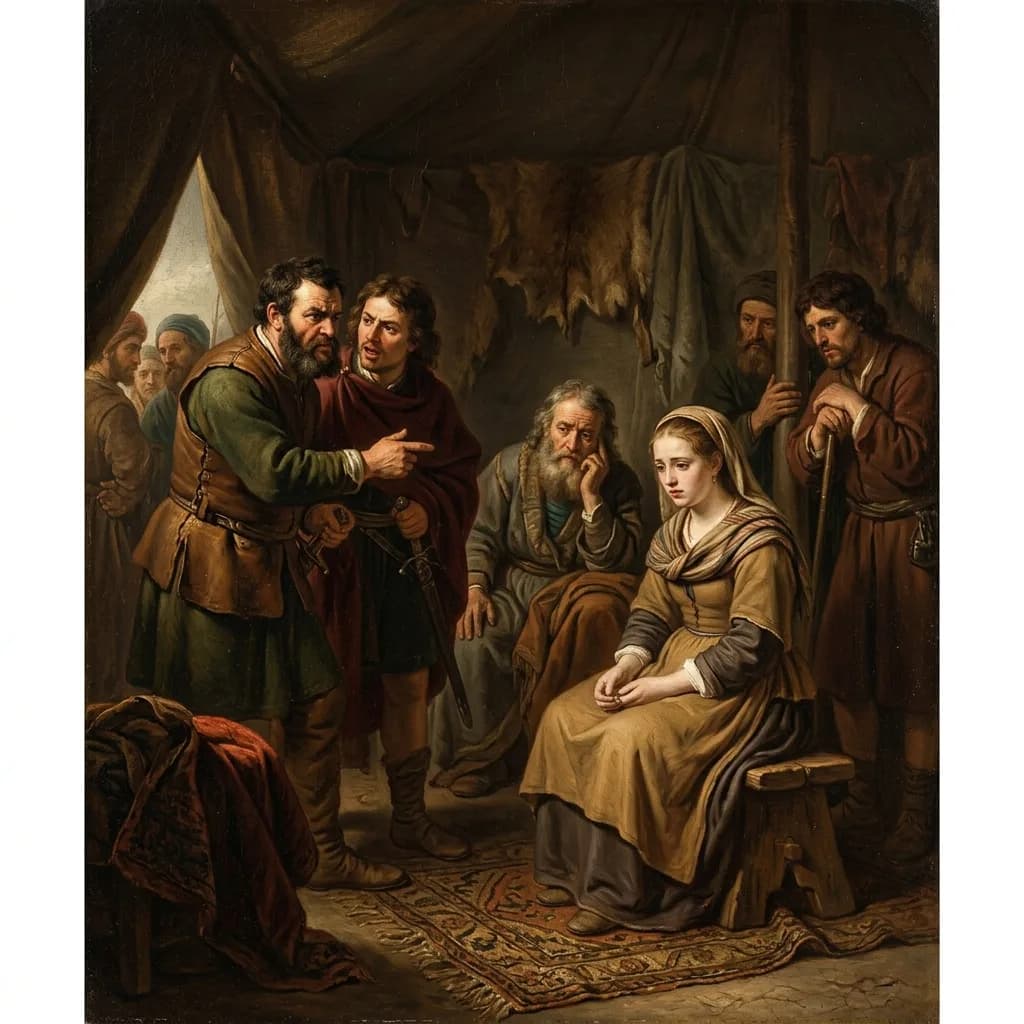
Dinah's choice to explore beyond her family circle reveals her curiosity, a trait that ultimately leads to her vulnerability. Her desire for social interaction stands out in a society where women’s movements were often restricted. In stark contrast, her brothers Simeon and Levi react with violent vengeance against Shechem and his city (Genesis 34:25-26). Their actions, driven by a perceived dishonor to their family, underscore the patriarchal control over Dinah's situation, reflecting a broader cultural prioritization of family honor over individual justice. Dinah's silence is juxtaposed with her brothers' loud and violent response, emphasizing her lack of agency in the narrative. The brothers' actions highlight the way men in her world assume control over women's issues, often without the consent or input of the women themselves.

Modern readings often paint Dinah as a passive victim, erasing the complexity of her situation. This simplification overlooks the systemic silencing embedded in her story. While Dinah herself does not speak, the narrative of Genesis 34 speaks volumes about the cultural dynamics of her time. Her experience is not merely about a personal tragedy but reflects broader themes of power, gender, and social norms in the patriarchal society of ancient Israel. The focus on her silence serves as a stark reminder of the voices that are left out in historical narratives, emphasizing the need to look beyond the surface to understand the full scope of her story.

The Significance of Dinah

The story of Dinah in Genesis 34 challenges the patriarchal structures by highlighting the absence of female agency and the consequences of male-driven vengeance and justice. Central to this narrative is the theme of injustice, encapsulated in the Hebrew term עָוֶל (avel). Dinah, the daughter of Jacob and Leah, becomes a silent figure in her own story, a victim whose voice is conspicuously absent from the text. When Shechem, the son of Hamor the Hivite, saw her, he seized and humiliated her, as stated in Genesis 34:2. This act of sexual violence sets off a chain of events dominated by male actors, raising questions about justice and retribution in a society where women's experiences are often marginalized.

The narrative delves into several interwoven themes, including sexual violence, honor culture, and vengeance. Dinah's assault by Shechem starkly portrays the vulnerability of women in patriarchal societies, emphasizing the severe implications of such acts. The response from her brothers, Simeon and Levi, reflects the honor-shame culture prevalent at the time. Their outrage at their sister's defilement, as seen in Genesis 34:7, prioritizes family honor over Dinah's personal agency or justice. Their subsequent violent retribution against Shechem and his city illustrates the destructive cycle of vengeance. Genesis 34:25-26 describes how Simeon and Levi, in an act of calculated violence, kill all the males of the city, complicating the morality of their actions and leaving open the question of whether their response truly constitutes justice.

While Dinah's story does not intersect directly with the gentile dimension or the Messianic line, it stands at a critical intersection of biblical narrative concerning societal norms and individual suffering. The absence of Dinah's voice, encapsulated in Genesis 34:5, where her father Jacob hears about the incident but remains silent until his sons return, underscores the marginalization of women. This silence is a powerful textual detail that reflects the broader societal dynamics of the time, where women's voices were often unheard, even in narratives that centered around their experiences. In this context, Dinah's story continues to provoke reflection on the themes of justice and the place of women within biblical histories.

The Legacy of Dinah

Dinah, the daughter of Jacob and Leah, occupies a complex space in Jewish tradition. Her story, found in Genesis 34, centers on her assault by Shechem, a Hivite prince. Despite the gravity of her experience, Dinah herself remains largely silent in the biblical text. The Talmud, specifically in Sanhedrin 21a, reflects on her silence as indicative of the societal norms that limited women's voices. Midrashic interpretations, such as those in Genesis Rabbah 80:11, delve into the familial and societal implications of her brothers' violent retaliation against Shechem and his city. These texts often focus on themes of family honor and the pursuit of justice, sometimes overshadowing Dinah's personal experience. While her story is not featured in Jewish liturgical readings, it is a significant topic in Torah study, where her narrative prompts discussions about gender, power, and the consequences of vengeance.

In Christian tradition, Dinah's story has been interpreted through various theological lenses, often emphasizing the actions of her brothers, Simeon and Levi, rather than Dinah herself. Church Fathers such as Augustine and Ambrose largely bypassed Dinah's plight, focusing instead on the moral implications of her brothers' violent response. During the Reformation, figures like John Calvin critiqued the moral failings of Jacob's sons, using the narrative to warn against the dangers of unchecked vengeance. Calvin's readings often cast Dinah's brothers as cautionary figures rather than exploring Dinah's own narrative. Such interpretations frequently sideline Dinah, treating her as a passive figure within a larger moral drama focused on male actions and decisions.

Beyond religious texts, Dinah's story has found a voice in modern literature and art, often reimagined with a focus on her perspective. Anita Diamant's novel "The Red Tent" presents Dinah's story from a feminist viewpoint, giving her agency and a voice often absent in traditional interpretations. This novel has brought new attention to Dinah, exploring themes of sisterhood and resilience. In art, James Tissot's painting "The Rape of Dinah" captures the emotional and moral complexities of her story, emphasizing the tragic and violent aspects that have long been central to her narrative. In contemporary discourse, Dinah's story resonates in discussions about sexual violence and the silencing of women's voices, touching on ongoing societal struggles with these issues. Her narrative highlights the enduring challenge of addressing gender-based violence and the importance of hearing and valuing women's experiences.