The Story of Jacob
Jacob's life unfolds around 1850 BC among the semi-nomadic tribes of Canaan and Mesopotamia. Born to Isaac and Rebekah, Jacob enters the world grasping the heel of his twin brother Esau, an image foreshadowing a life of struggle and ambition (Genesis 25:23-26). The prophecy that the older would serve the younger sets the stage for events shaping not just Jacob's destiny, but that of an entire nation. In this world of divine promises and familial strife, Jacob's cunning nature first appears as he persuades Esau to trade his birthright for a bowl of stew (Genesis 25:29-34).
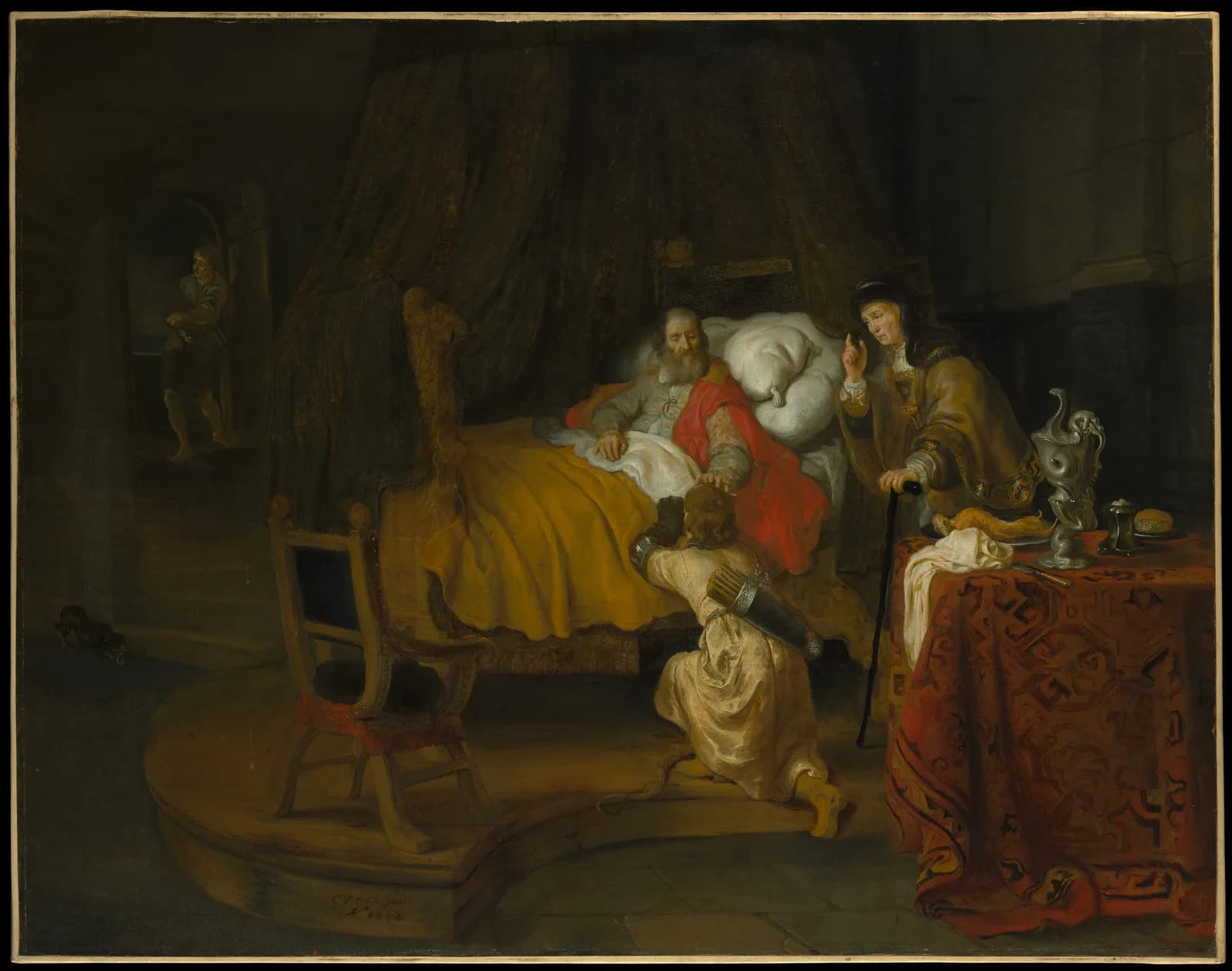
A critical moment in Jacob's journey occurs when he deceives his aging father, Isaac, to secure the blessing meant for Esau (Genesis 27:19-29). With his mother's encouragement, Jacob disguises himself using Esau's garments and the skins of young goats to mimic his brother's hairy arms. This act of deception sows discord within the family and forces Jacob to flee to his uncle Laban's house in Haran. Here, rivalry and trickery continue as Laban, both uncle and father-in-law, mirrors Jacob's deceitful tendencies by substituting Leah for Rachel on Jacob's wedding night (Genesis 29:23-25).
Jacob's life changes during his return journey to Canaan. In a nocturnal encounter at the ford of the Jabbok, Jacob wrestles with a mysterious divine being (Genesis 32:24-30). This struggle leaves him with a wrenched hip and a new name — Israel, meaning "he who strives with God." This moment symbolizes his complex relationship with God and his own identity. Upon reuniting with Esau, the brothers embrace in reconciliation (Genesis 33:4), suggesting that the cycle of conflict might not be unending.
Jacob's story extends beyond his lifetime, reaching into biblical history. As the father of twelve sons who become the progenitors of the tribes of Israel, his legacy is linked to the nation of Israel. In his later years, Jacob blesses his grandsons, Ephraim and Manasseh, again favoring the younger over the older (Genesis 48:14-20). Jacob's name appears in the genealogies of the New Testament, mentioned in Matthew 1:2 as an ancestor of Jesus, and his faith is commended in Hebrews 11:21. In the Hebrew narrative of Genesis, Jacob's character is captured in the word עָקֵב (aqeb), meaning "heel" or "supplanter." This term originates from Genesis 25:26, where Jacob is born grasping the heel of his twin brother Esau, foreshadowing the cunning and strategic moves that will define his life. Jacob, the son of Isaac and Rebekah, becomes a central figure in the biblical story, not because of his straightforwardness or honesty, but through his shrewdness and perseverance. His life is marked by a series of deceptions, most notably when he disguises himself to deceive his blind father, Isaac, into bestowing upon him the blessing meant for Esau (Genesis 27:18-29). Despite these morally ambiguous actions, Jacob is chosen by God to carry forward the covenant, suggesting a divine grace that transcends human merit.