Bible study / Biblical figures / Herodias

New Testament

Herodias

First century AD

vengeancemanipulationunlawful marriageabuse of powerorchestrated murder

The Story of Herodias

Herodias, an Idumean-Jewish noblewoman, lived in the tumultuous world of first-century Judea under Roman rule. She was initially married to Herod Philip, but she left him to marry his half-brother, Herod Antipas, the tetrarch of Galilee and Perea. This union, politically advantageous but religiously scandalous, violated Jewish law, as detailed in Mark 6:17-18. The marriage drew the sharp rebuke of John the Baptist, a prominent prophet who publicly denounced it as unlawful. This condemnation set the stage for the conflict that would follow, creating a fracture in the already unstable political and religious landscape.

Herodias's reaction to John's criticism was both personal and strategic. She harbored a deep grudge against him, as described in Mark 6:19, and sought an opportunity to silence him permanently. However, Herod Antipas, while willing to imprison John, hesitated to execute him due to John's considerable influence and popularity among the people. Herodias's determination did not waver; she awaited the right moment to act. The tension between Herodias's vengeful desires and Herod's cautious approach defined this period, showcasing her manipulative prowess and his political indecision.

The opportunity Herodias sought arrived during a lavish birthday banquet for Herod Antipas. Her daughter, Salome, performed a dance that so pleased Herod and his guests that he rashly promised her anything she desired, up to half his kingdom, as noted in Mark 6:22. Seizing the moment, Herodias instructed Salome to request the head of John the Baptist on a platter. This shocking demand, detailed in Mark 6:24-25, placed Herod in a precarious position. Though distressed by the request, he felt compelled to comply due to his public oath and the expectations of his guests. Thus, Herod reluctantly ordered John's execution, delivering Herodias the outcome she had long pursued.

The aftermath of John's execution reverberated far beyond Herodias's immediate satisfaction. John’s disciples retrieved his body and laid it in a tomb, allowing his martyrdom to galvanize his followers and amplify his message. The narrative irony of Herodias's actions lies in her attempt to silence a voice that, in death, only grew louder. Herodias’s involvement in this grim episode is recorded starkly in the Gospels of Matthew and Mark, marking her as a figure of both infamy and influence. The consequences of her orchestration reached into the annals of religious history, underscoring the enduring impact of John the Baptist's life and death.

Who Was Herodias

The Greek term "ἐπιβουλή" (epiboulē), meaning "plot" or "scheme," succinctly encapsulates the character of Herodias, as described in the Gospels of Matthew and Mark. This word appears in Mark 6:19, where Herodias harbors a grudge against John the Baptist, plotting his demise. Herodias, an Idumean-Jewish woman of notable ambition, navigates the complex political landscape of first-century Judea with strategic acumen. Her controversial marriage to Herod Antipas, her second husband and brother of her first husband, Philip, underscores her willingness to defy societal and religious conventions to secure her status. Herodias’s machinations culminate in her orchestration of John the Baptist's execution, demonstrating her manipulative prowess by instructing her daughter, Salome, to demand his head as a reward for her dance (Mark 6:24).
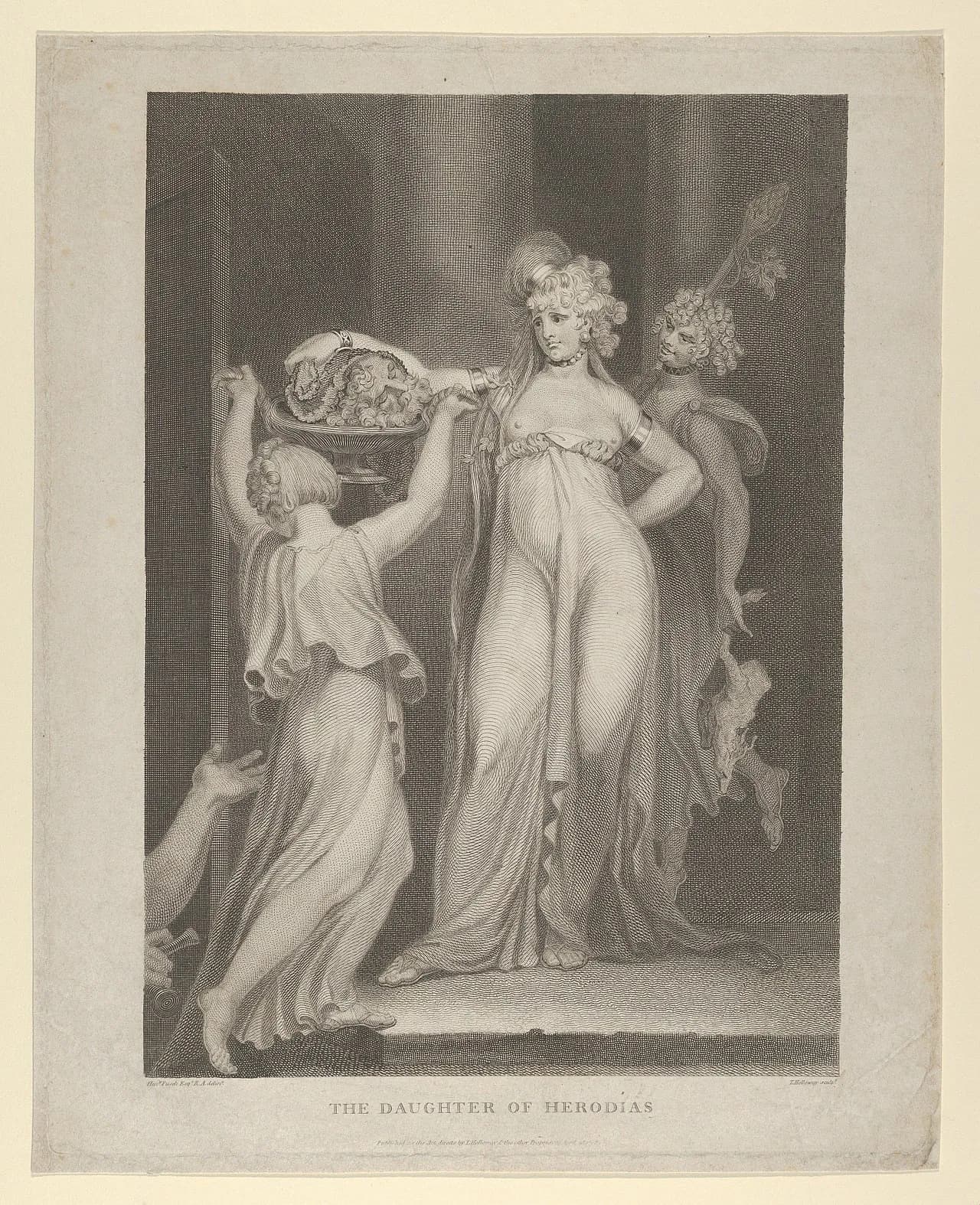
Herodias's key decisions reveal her as shrewd and relentless in pursuit of her goals. Choosing to marry Herod Antipas, despite the marriage being unlawful, highlights her ambition and disregard for traditional norms (Matthew 14:3-4). This decision sets the stage for her conflict with John the Baptist, who openly criticizes the union. Herodias's response to John's rebuke is not passive; she actively seeks his death, a choice that stands in stark contrast to Herod Antipas’s hesitant protection of John (Mark 6:19-20). Herodias uses Salome's performance at Herod's birthday feast to manipulate the tetrarch into fulfilling her lethal wish (Mark 6:24-25). In contrast, John the Baptist, her foil, embodies moral integrity and boldness, fearlessly condemning Herod and Herodias’s actions. This juxtaposition highlights Herodias’s willingness to sacrifice moral principles for power and revenge.

Modern and popular portrayals often reduce Herodias to a one-dimensional villain, overlooking the complexity of her motivations and actions within a patriarchal society. Common narratives tend to simplify her as merely vengeful, ignoring the agency and strategic thinking she exercises. The text offers a more nuanced portrayal, showing a woman who navigates the constraints of her environment with calculated decisions aimed at preserving her influence and authority. Herodias’s story, as presented in the biblical texts, challenges the simplistic villain archetype by revealing her as a figure who employs the limited tools at her disposal — manipulation and alliances — to exert power in a world dominated by men. This deeper reading acknowledges her as a person of agency, driven by both personal vendettas and a keen understanding of her precarious position in the royal hierarchy.

The Significance of Herodias

Herodias' story in the New Testament vividly illustrates the destructive power of personal vendettas against prophetic truth-telling, particularly through her role in the execution of John the Baptist, as captured in Mark 6:19-28. Herodias, the wife of Herod Antipas, harbored a deep grudge against John because he openly condemned her marriage to Herod, which was considered unlawful according to Jewish law (Mark 6:18). The Greek term ἐκδίκησις (ekdikēsis) encapsulates this theme of vengeance, as Herodias' desire for retribution ultimately led to John's death. This narrative starkly contrasts with biblical teachings that call for forgiveness and justice, as outlined in Matthew 5:38-39.

Several theological themes emerge from Herodias' actions, beginning with the issue of unlawful marriage. Her marriage to Herod Antipas was a point of contention because she had been married to his brother Philip, which violated Jewish customs. The text in Mark 6:17-18 underscores this breach of law, setting the stage for her animosity towards John the Baptist who dared to criticize their union. Another theme is manipulation, as Herodias cleverly orchestrated John's execution by using her daughter Salome as a pawn. Salome's dance pleased Herod so much that he promised her anything she wished, and, prompted by her mother, she asked for John the Baptist's head (Mark 6:24-25). Herodias' cunning is apparent, revealing her willingness to exploit others to fulfill her vengeful desires. Finally, her story highlights the abuse of power. Herodias leveraged her influence over Herod Antipas, a ruler torn between his fear of John’s prophetic influence and his wife's demands, to silence a voice of truth (Mark 6:19-20).

Herodias occupies a unique place in the Biblical narrative, intersecting with both Jewish and Roman worlds due to her Idumean/Jewish heritage and her role in the Herodian dynasty. While her actions lack a direct connection to the Messianic line, they highlight the volatile political and social environment of the time, where personal vendettas and power struggles often overshadowed spiritual truths. The text leaves us with a chilling detail: after Salome's request, John the Baptist was beheaded, and his head was brought on a platter to Herodias, a grim fulfillment of her long-standing grudge (Mark 6:27-28).

The Legacy of Herodias

Herodias finds little to no mention in Jewish tradition. She is absent from significant Jewish texts like the Talmud and Midrash, and her narrative lacks symbolic or liturgical significance within Judaism. Her story is primarily preserved in the Christian New Testament, specifically in the books of Matthew and Mark. The Jewish focus on scriptural figures often centers on those who played pivotal roles in the lineage and stories central to Jewish identity, such as the patriarchs, matriarchs, and key prophetic voices. Herodias, as a political figure within the Herodian dynasty, simply does not occupy a space in Jewish religious or cultural memory. Her lack of presence in Jewish liturgy and writings suggests that her story, involving the execution of John the Baptist, did not intersect with Jewish religious or cultural narratives in a meaningful way.

In Christian tradition, however, Herodias emerges as a potent symbol of vengeance and manipulation. Church Fathers like Jerome and Augustine condemned her for her role in the execution of John the Baptist, seeing her as a cautionary figure against moral corruption and the misuse of power. Jerome, in particular, criticized her for the unlawful marriage to Herod Antipas, which John the Baptist publicly denounced. During the Protestant Reformation, figures such as John Calvin highlighted Herodias in discussions about the dangers of unchecked power and immoral leadership. Her actions, as recounted in Mark 6:19, where she harbors a lethal grudge against John, serve as a narrative touchstone for the consequences of personal vendettas entwined with political machinations. Her story is often included in lectionary readings across various Christian traditions, particularly on the feast of the Passion of John the Baptist, observed on August 29.

Outside religious texts, Herodias has captured the imagination of artists and writers, finding a place in cultural works that extend beyond the biblical narrative. Oscar Wilde's play "Salome" dramatizes her manipulative nature, while visual artists like Titian and Gustave Moreau have explored her role in the beheading of John the Baptist, often emphasizing the themes of manipulation and vengeance. In modern times, Herodias touches a nerve as an archetype of destructive ambition and the darker facets of political power. Her story resonates in discussions of personal and political ethics, illustrating the enduring relevance of themes like manipulation and vengeance. These themes continue to captivate audiences, offering a lens through which to examine the complexities of human motivations and the consequences of unchecked desires.