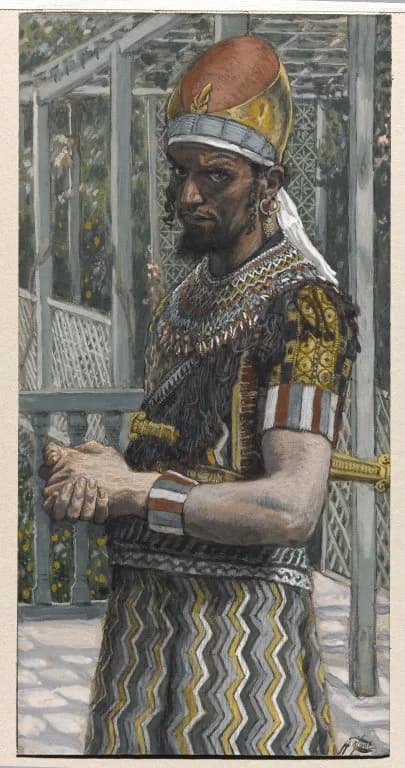
The Story of Herod Antipas
Herod Antipas, known primarily through the New Testament, ruled as tetrarch of Galilee and Perea during the early first century AD. His rule unfolded under the shadow of Roman occupation, where he balanced the demands of Roman overlords with the cultural and religious expectations of his Jewish subjects. This balancing act set the stage for his infamous encounter with John the Baptist. Herod’s marriage to Herodias, his brother Philip's wife, sparked controversy and moral outrage. John the Baptist openly condemned this union as unlawful, a rebuke that Herodias did not take lightly. Despite this condemnation, Herod found himself torn, intrigued by John's teachings yet unable to quell Herodias's vendetta (Mark 6:17-18).
A turning point in Herod Antipas's story came during a lavish birthday banquet. Herodias's daughter, Salome, performed a dance that delighted Herod and his guests, prompting Herod to make a reckless promise: he would grant her any wish, up to half his kingdom. Encouraged by her mother, Salome requested the head of John the Baptist (Mark 6:22-25). Herod faced a moral dilemma. Although he was troubled by the request, he felt compelled to honor his oath, a decision revealing his weakness and susceptibility to external pressures (Mark 6:26). The players in this drama — Herodias, Herodias's daughter, and John the Baptist — illustrate the destructive power of personal vendettas and the precariousness of political authority.
The situation took a definitive turn when Herod, despite his reluctance, ordered John's execution. The event highlighted the inherent instability of Herod's position, where maintaining honor before his guests outweighed any sense of divine judgment or personal conviction. This decision marked a transformation in Herod's narrative, showing his inability to uphold moral integrity in the face of societal expectations and personal weakness (Mark 6:27-28). The execution of John the Baptist not only silenced a powerful voice but also exposed the moral fragility of Herod's rule.
Herod's encounter with Jesus during the latter's trial further revealed his fleeting curiosity and ultimate failure to grasp deeper truths (Luke 23:8-9). Eager to witness a miracle, Herod found himself disappointed by Jesus's silence, eventually resorting to mockery. This encounter, coupled with his previous actions, painted a portrait of Herod as a ruler caught between the allure of power and the weight of ethical compromise. Though Herod Antipas does not appear in a genealogy, his presence in the Gospels of Matthew, Mark, and Luke remains a complex interplay of political machinations and personal failings in early first-century Judea. Herod Antipas, a tetrarch in the first century AD, is described by the Greek word "δειλιάω" (deiliaō), which means to be cowardly or fearful. This term, while not explicitly used to describe Antipas in the Gospels, captures his essence through his actions and decisions. In Matthew 14:9, he is depicted as a man who, despite his sorrow, capitulates to the demands of Herodias' daughter and orders the execution of John the Baptist. This act, driven by the pressure of oaths and social expectation, shows his fear of losing face rather than any genuine desire for justice or truth. Antipas' life as portrayed in the New Testament is marked by a series of such decisions, revealing a ruler troubled by his own conscience and easily influenced by those around him.