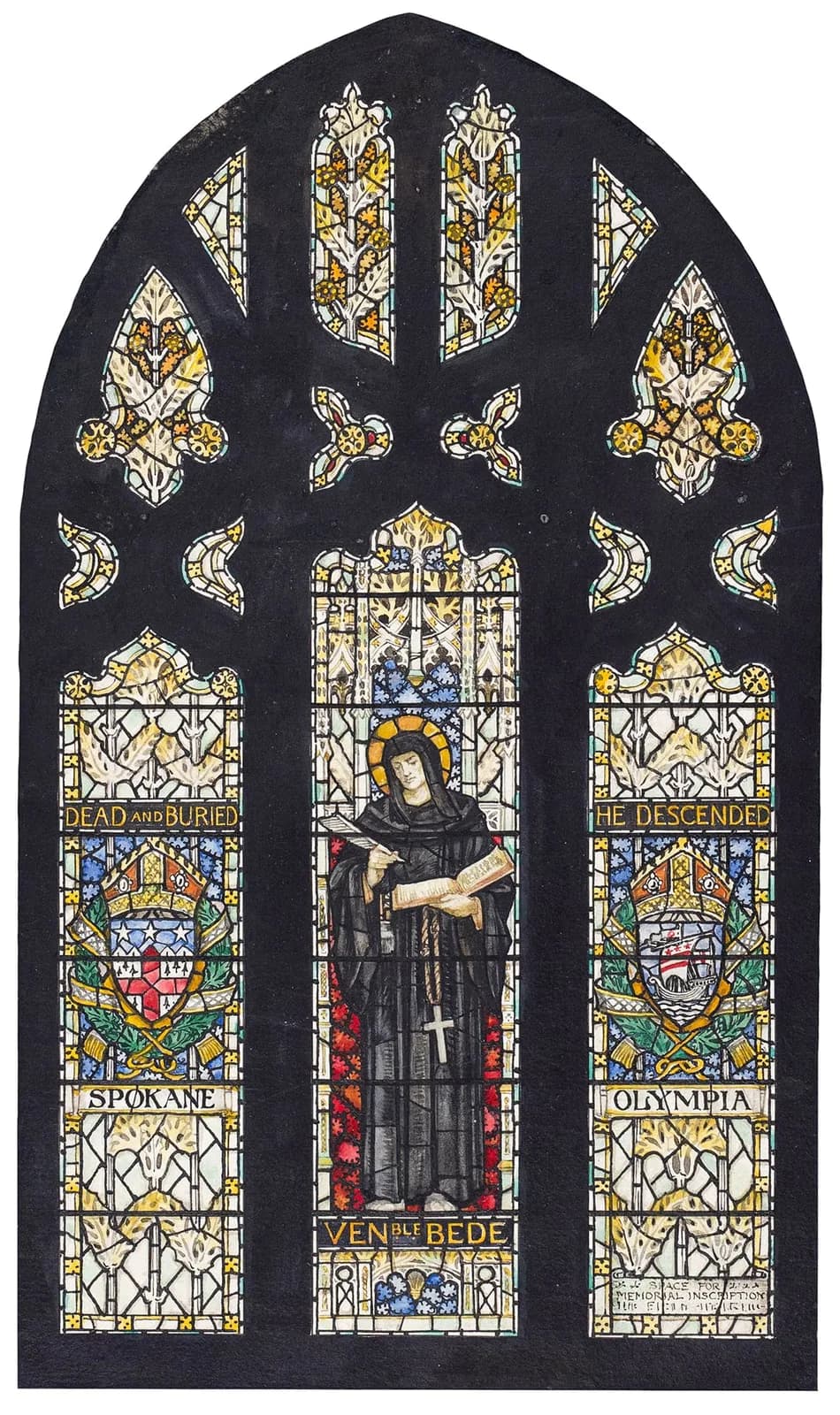
Bede the Venerable
theologianLate Patristic (5th-8th C) · c. 673-735 CE · Updated April 9, 2026
Biography
Bede the Venerable was a Benedictine monk and scholar at Wearmouth-Jarrow in Northumbria during the early medieval period, recognized as the greatest scholar of the early medieval West and a Doctor of the Church. Living in a time of religious and cultural transformation, Bede chronicled the Christianization of England. He is best known for his "Ecclesiastical History of the English People," completed in 731, which remains a cornerstone for understanding early English history and the growth of the Church.
Born around 673 CE, Bede spent his entire life in monastic seclusion at the twin monasteries of Wearmouth and Jarrow. These centers of learning and religious devotion provided him a stable environment for study and writing. Bede's commitment to scholarship and teaching was unwavering. By the time of his death in 735 CE, he had produced numerous works on theology, history, and science. He approached history with a critical eye, pioneering the practice of citing sources, which laid the groundwork for future historians.
Bede lived during a time when the Church in England faced significant theological disputes, such as the Easter dating controversy. This debate centered on whether to follow Roman or Celtic methods for calculating the date of Easter. Bede supported the Roman calculation, which was a step towards unifying the English Church with broader Christendom. He also played a role in developing the Anno Domini dating system, further integrating English Christianity into the universal Church. His historical writings contributed to a unified Christian identity, highlighting the importance of historical context in understanding theological issues.
How does a Christian community situated at the edge of the known world understand itself as part of the universal church — and how does history become a form of theology?
The ideas
Bede the Venerable dedicated his life to solving a profound problem: integrating the story of the English church into the grand tapestry of Christian history. He aimed to create a unified identity for the English church, linking it to the broader Christian world and divine providence. This quest was not merely about chronicling events but about understanding how local history connected to the universal church. Bede believed that by doing so, he could show that the English church played a vital role in God's plan, offering believers a sense of purpose and place within the Christian community.
Two of Bede's most important ideas were the Roman dating of Easter and the use of the Anno Domini system. The Easter controversy had long divided the Roman and Celtic traditions in Britain. By advocating for the Roman method, Bede helped unify the English church with Rome, resolving a major liturgical conflict. His promotion of the AD system, which counted years from the birth of Christ, further emphasized the centrality of Christ in history. This system provided a consistent framework for dating events, reinforcing the idea that all history revolved around the life of Christ. Both ideas emerged from Bede's desire to integrate the English church into the wider Christian world.
Beyond these, Bede's use of typological and allegorical interpretation of the Bible left a lasting impact. By reading the Old Testament as a foreshadowing of the New Testament, Bede underscored the Bible's unity and continuity. This approach, influenced by earlier Church Fathers, shaped medieval biblical interpretation. His "Ecclesiastical History of the English People," completed in 731, was groundbreaking. It combined historical narrative with theological insight, legitimizing church history as a field of study. Through these contributions, Bede provided a cohesive narrative that shaped a distinct English Christian identity amid political fragmentation.
Bede's signature argument was his view of history as part of God's providential plan. He saw the history of the English church as an integral piece of this divine design. By systematically citing sources and highlighting the providential nature of events, Bede established a model for writing church history that was both rigorous and reflective. This approach was compelling because it offered a way to see local events as part of a larger, meaningful story. It changed how history was recorded, showing that understanding the past was not just an academic exercise but a way to glimpse God's ongoing work in the world.
What changed
Before Bede the Venerable, Christian thought in the British Isles was a patchwork of regional practices and beliefs. The calculation of Easter exemplified this fragmentation, with Roman and Celtic traditions clashing. Without a unified method, Easter was celebrated on different dates, fueling ecclesiastical tensions. Historical recording lacked rigor. Many accounts were anecdotal, seldom citing sources or critically analyzing events. Theological interpretation of history hadn't matured into a disciplined field, leaving a gap in understanding how divine providence interwove with human events. Local dating systems further complicated matters, creating inconsistencies across regions.
Bede the Venerable transformed this landscape. He introduced a systematic approach to historical writing, meticulously citing sources and critically examining events. His "Ecclesiastical History of the English People" set new standards, laying the groundwork for future historians. Bede also tackled the Easter controversy, advocating for the Roman method of calculation. His influence helped unify the practice across the British Isles, reducing conflict and promoting ecclesiastical unity. Additionally, Bede popularized the Anno Domini dating system, offering a consistent chronological framework that replaced disparate local systems. His emphasis on typological and allegorical biblical interpretations enriched theological discourse, encouraging deeper exploration of scripture beyond literal readings.
Bede's influence extended well beyond his time. His systematic historical methodology became foundational for later historians like William of Malmesbury. The adoption of the Roman Easter calculation and the Anno Domini system standardized ecclesiastical practices, fostering a unified church. Theological movements that emphasize church unity and the integration of history and theology trace their roots to Bede's contributions. His legacy remains visible in the continued use of the AD system for dating years worldwide. Bede's work sculpted the contours of medieval exegesis and historical scholarship, leaving an indelible mark on the church's intellectual heritage.
Disputed legacy
Bede the Venerable, an influential monk of the early medieval period, made significant contributions to Christian history, but his work has drawn serious criticism in several areas. His support for the Roman calculation of Easter over the Celtic method brought about ecclesiastical conflict, dividing the British Isles and marginalizing Celtic Christian traditions. His historical writings, while pioneering, lacked critical analysis and showed a bias toward Roman ecclesiastical authority, a point that modern historians continue to critique. Furthermore, Bede's typological and allegorical interpretations of scripture imposed meanings that were not originally intended by the texts, which obscured their original context. Lastly, his role in forming an English Christian identity came at the cost of sidelining non-Roman Christian traditions.
The most contentious aspect of Bede's legacy lies in the Easter dating controversy. By advocating for the Roman method of calculating Easter, Bede contributed to deep divisions within the Christian community of the British Isles. Celtic Christians, who adhered to their traditional method, found themselves increasingly marginalized. The Synod of Whitby in 664, which Bede's writings later supported, marked a decisive moment of conflict. The decision to follow the Roman calculation not only alienated Celtic Christians but also paved the way for their cultural and religious practices to be overshadowed by Roman customs. This was a significant blow to the Celtic church and its followers, who saw their traditions being systematically eroded.
Some scholars argue that Bede's contributions must be understood within the context of his time, where efforts to unify the church were seen as essential. Yet, these defenses do not erase the fact that his decisions had lasting consequences for Christian diversity in the British Isles. Modern historians maintain that Bede's methodologies and interpretations remain flawed by contemporary standards. Despite his intentions to create cohesion, Bede's legacy in the Easter controversy remains a dark chapter in church history. Today, the decision at Whitby stands as a historical marker of the turning point where Roman ecclesiastical authority began to dominate the British Isles, overshadowing the rich tapestry of Celtic Christian practice.
Legacy
Bede the Venerable spent his life immersed in scholarship within the walls of the monastery at Jarrow. Until his death in 735 CE, he remained a respected figure, never facing condemnation. His works, particularly the 'Ecclesiastical History of the English People,' earned him a reputation as a trusted chronicler of both historical and theological matters. His contributions did not go unnoticed; his peers held him in high regard, and his legacy only grew stronger with time. In 1899, the Catholic Church honored him by declaring him a Doctor of the Church, solidifying his impact on Christian intellectual tradition.
The reach of Bede's teachings extended far beyond his monastery. His writings became essential reading in monastic communities across medieval Europe, influencing the intellectual revival known as the Carolingian Renaissance. Scholars and monks in places like Aachen and Tours found his work invaluable for understanding both English history and Christian doctrine. Bede's integration of historical narrative with theological reflection set a foundation for future generations, shaping the study of history and theology for centuries. His influence permeated monastic schools, which became centers of learning and preserved his insights for posterity.
Today, Bede's legacy endures in academic settings worldwide. His historical narratives and theological discussions are standard fare in courses on medieval history and theology. Beyond academia, the Anno Domini dating system he popularized continues to be a part of everyday life, used in both religious and secular contexts to mark the passage of time. His ability to bridge the sacred and the secular remains unmatched, ensuring that his work continues to inform and inspire. In libraries and classrooms, his name and contributions remain a testament to the enduring power of thoughtful scholarship.
Continue reading with a Scholar plan
Upgrade to ScholarCommon questions
- What is Bede the Venerable most known for in Christian history?
- Bede the Venerable is most known for his work 'Ecclesiastical History of the English People,' which is a key source for understanding early English Christianity and history. He is also recognized for popularizing the Anno Domini (AD) dating system, which became the standard for dating years in the Christian world.
- What were Bede the Venerable's most important works?
- Bede's most important works include 'Ecclesiastical History of the English People' (731), which chronicles the history of the Church in England, and 'On the Reckoning of Time' (725), which discusses the calculation of Easter and the calendar. He also wrote extensive commentaries on nearly every book of Scripture, contributing significantly to biblical scholarship.
- What were Bede the Venerable's most influential theological ideas?
- Bede's influential theological ideas include the use of typological and allegorical interpretation of Scripture, which sees events in the Old Testament as prefigurations of New Testament events. He also emphasized the importance of church history as a theological discipline and contributed to the formation of English Christian identity.
- What controversies did Bede the Venerable engage in — and what was at stake?
- Bede engaged in the controversy over the correct calculation of Easter, which was a significant issue in the early medieval Church. The stakes involved maintaining ecclesiastical unity and authority, as different regions followed different calendars, leading to disputes over the correct date for celebrating Easter.
- How did Bede the Venerable influence later Christianity — Catholic, Protestant, and beyond?
- Bede influenced later Christianity by providing a model for writing church history that integrated theological reflection. His works were used by both Catholic and Protestant reformers, and his Anno Domini dating system became the standard for Western chronology. His biblical commentaries also influenced theological education for centuries.
- What did Bede the Venerable get wrong, or what ideas have been seriously disputed?
- Some of Bede's historical accounts have been disputed due to their reliance on oral traditions and limited sources. Additionally, his calculations in 'On the Reckoning of Time' were later corrected as astronomical knowledge advanced, but his overall framework remained influential.
- Is Bede the Venerable considered a saint? By which traditions?
- Bede the Venerable is considered a saint in the Roman Catholic Church, which declared him a Doctor of the Church in 1899. He is also venerated in the Anglican Communion and the Eastern Orthodox Church, reflecting his broad influence across Christian traditions.
- Why does Bede the Venerable still matter today?
- Bede matters today because his works provide invaluable insights into early medieval history and the development of the English Church. His scholarly approach to history and theology set a standard for future generations, and his influence on the dating system continues to impact how we understand historical chronology.
- What is the most surprising or counterintuitive thing about Bede the Venerable?
- One surprising aspect of Bede is his ability to synthesize vast amounts of information from various sources, despite living in a relatively isolated monastic community. His work demonstrates a remarkable breadth of knowledge and intellectual curiosity for his time.
- What is the best place to start reading Bede the Venerable?
- The best place to start reading Bede is his 'Ecclesiastical History of the English People,' as it is his most famous work and provides a comprehensive view of early English Christianity. It is accessible to modern readers and offers insights into the historical and theological context of the period.