Monasticism
Ascetic practices · Updated August 15, 2026
Overview
The origins of Christian monasticism date to the 3rd century, when the first monks lived not in organized communities but as hermits in the remote deserts of Egypt. These early ascetics sought solitude in the wilderness to pursue a life of prayer and fasting, away from the cities of Roman Egypt. The most prominent of these pioneers was St. Anthony the Great, who is often credited as the father of Christian monasticism. Anthony withdrew into the desert around 270 AD and attracted followers who adopted his solitary way of life.
In the 4th century, the solitary life of hermits gave way to a communal form of living. This shift resulted from the efforts of St. Pachomius, who established the first known Christian monastery in Egypt at Tabennisi around 320 AD. Pachomius introduced a structured way of life where monks lived together, sharing resources and responsibilities while adhering to a common rule. This communal lifestyle provided a balance between solitude and fellowship, offering support and accountability to its members. From Egypt, Monasticism spread to Europe in the following century, where figures like St. Benedict of Nursia shaped its development. Benedict wrote the Benedictine Rule around 540 AD at Monte Cassino, and it became the governing text for Western monasticism, prescribing a daily schedule of prayer, manual labor, and communal living.
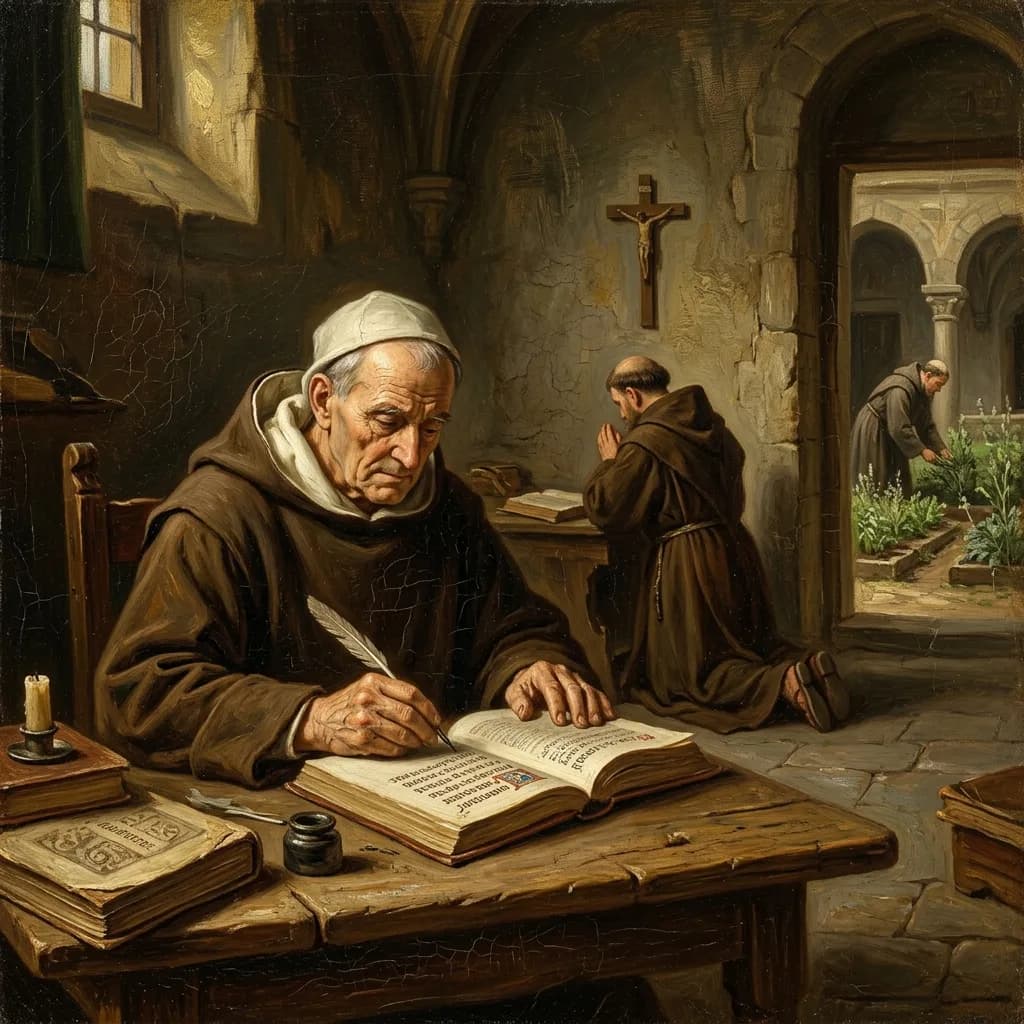
Today, monasticism persists as a practice within the Christian tradition across the globe, from the monasteries of Mount Athos in Greece to the Benedictine abbeys in Europe and the Americas. Monasteries function as centers of worship and scholarship, their libraries and archives preserving collections of biblical manuscripts, patristic writings, and medieval chronicles. While the number of monks and nuns has declined in recent decades, monastic communities continue to operate under their historical rules of prayer, work, and communal life.
Why Fighting Over Monasticism Was a Big Deal
Fighting over monasticism in early Christianity wasn't simply a debate about whether monks should live solitary or communal lives. At its heart, it was a power struggle over who held the ultimate authority in the rapidly evolving Christian landscape. Monasticism, with its emphasis on asceticism and spiritual purity, challenged the established church's control over religious life. Monks who retreated from the world to live lives of strict discipline threatened the church's influence, as they attracted followers and resources that could otherwise bolster the church's authority. The issue was not merely a matter of lifestyle; it was a question of who would guide the spiritual journey of the faithful and manage the wealth of the burgeoning Christian communities.
In 664 AD, the Synod of Whitby starkly illustrated this clash. On one side stood the monastic reformers, represented by figures like St. Benedict of Nursia, who advocated for a return to rigorous ascetic practices, emphasizing personal piety over institutional control. True Christian living, they argued, required renouncing worldly possessions and adhering to spiritual discipline. Opposing them were the ecclesiastical authorities, with leaders such as Pope Gregory I, who sought to maintain the church’s hierarchical control. These leaders feared that unchecked Monasticism could lead to fragmentation and diminish the church’s unified power. The synod, convened by King Oswiu of Northumbria, sided with the Roman practices championed by Bishop Wilfrid, sidelining the Celtic monastic traditions. This decision reinforced the church's authority over monastic communities, ensuring that they aligned with its doctrines and hierarchy.
Despite the outcome at Whitby, the underlying conflict between personal spiritual expression and institutional control was never fully resolved. This tension is an enduring feature of religious practice, manifesting in ongoing debates about the role of monasticism within the church. The desire for individual spiritual fulfillment often runs counter to the need for communal religious order, creating a dynamic push and pull that persists to this day. Even now, monasteries around the world continue to balance adhering to ancient traditions and adapting to contemporary challenges, symbolizing a conversation that has been ongoing since the earliest days of monasticism.
Continue reading with a Scholar plan
Upgrade to ScholarCommon questions
- What is monasticism and its purpose?
- Monasticism is a religious way of life where individuals live under vows of poverty, chastity, and obedience, often in a community, to pursue spiritual goals. Its purpose is to seek a deeper connection with God through prayer, meditation, and ascetic practices.
- How did monasticism start in Christianity?
- Christian monasticism began in the 3rd century with hermits like St. Anthony the Great, who sought solitude in the Egyptian desert for intense prayer and spiritual discipline. It evolved into communal living in the 4th century, thanks to St. Pachomius, who established the first known monastery.
- What are the main types of monasticism?
- The main types of monasticism are eremitic, where monks live as hermits, and cenobitic, where they live in a community under a common rule. Cenobitic monasticism became more prevalent due to its structured communal life.
- Why do monks and nuns take vows?
- Monks and nuns take vows of poverty, chastity, and obedience to dedicate their lives entirely to spiritual pursuits and to live in accordance with their religious community's rules. These vows help them focus on their faith and service to God.
- How does monastic life differ between religions?
- Monastic life varies between religions in practices, beliefs, and community structures. For example, Christian monastics often live in communal settings, while Buddhist monks may focus more on meditation and individual enlightenment.
- What role did monasticism play in the Middle Ages?
- In the Middle Ages, monasticism played a crucial role in preserving knowledge, culture, and education through the copying of manuscripts and maintaining libraries. Monasteries were also centers of agriculture, hospitality, and social services.
- Why do some monastic orders focus on silence?
- Some monastic orders focus on silence to foster contemplation, prayer, and a deeper connection with God. Silence is seen as a way to eliminate distractions and cultivate inner peace and spiritual awareness.
- How is a day structured in a monastery?
- A day in a monastery is typically structured around a schedule of prayer, work, and communal activities. Monks and nuns often follow a routine that includes several prayer services, meals, manual labor, study, and personal reflection.
- What is the difference between a monk and a friar?
- Monks typically live in a monastery and focus on prayer and work within their community, while friars are members of mendicant orders who live and work among the general public, often engaging in preaching and missionary work.
- Why do some monasteries produce goods like honey or beer?
- Monasteries produce goods like honey or beer as a means of financial support and self-sufficiency. These products are often made using traditional methods and help sustain the monastic community.
- How do monks and nuns support themselves financially?
- Monks and nuns support themselves through the production and sale of goods, such as food, crafts, or religious items, as well as through donations and the management of monastery-owned lands or properties.
- What is the significance of the monastic habit?
- The monastic habit is a simple, uniform garment that symbolizes a monk's or nun's commitment to their vows and religious life. It serves as a sign of humility, equality within the community, and separation from worldly concerns.
- Why did monasticism decline after the Reformation?
- Monasticism declined after the Reformation due to the Protestant critique of monastic vows and practices, leading to the dissolution of many monasteries. The movement emphasized direct personal faith over institutionalized religious life.
- How do modern monasteries adapt to contemporary society?
- Modern monasteries adapt by engaging with local communities, offering retreats, and using technology for outreach and education. They balance traditional practices with contemporary needs to remain relevant and sustainable.
- What is the process to become a monk or nun?
- To become a monk or nun, one typically undergoes a period of discernment and postulancy, followed by novitiate training. After this, they take temporary vows and, eventually, permanent vows, committing fully to monastic life.