Library
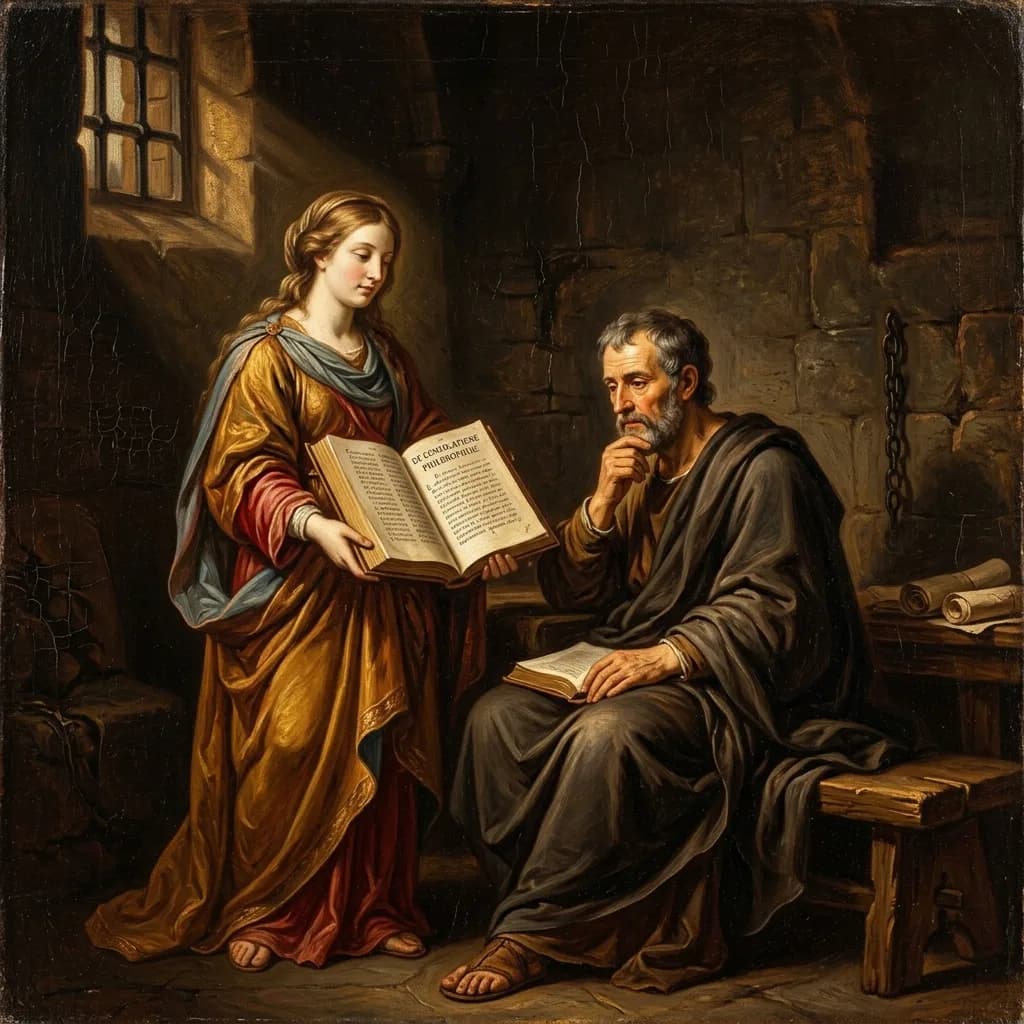
AI-generated illustration
Library
Late Patristic (5th-8th C) · c. 477-524 CE · Updated April 9, 2026
Boethius was a Roman senator, philosopher, and theologian in the early 6th century CE, known for his influential works written while imprisoned under the Ostrogothic king Theodoric the Great. He lived during a time of significant change in Italy, as the Western Roman Empire had collapsed and the Ostrogoths, a Germanic tribe, held power. Despite the political upheaval, Boethius dedicated himself to preserving the intellectual heritage of ancient Greece and Rome, bridging the gap between classical philosophy and the emerging Christian thought of his era.
Born around 477 CE, Boethius came from a prominent Roman family with a rich tradition of public service. He rose to the position of consul in 510 CE, demonstrating both his political acumen and his commitment to the Roman state. His execution in 524 CE marked a tragic end to a life devoted to learning and governance. While awaiting execution, he wrote "The Consolation of Philosophy," a dialogue that explores themes of fortune, suffering, and the pursuit of true happiness. This work became a cornerstone of medieval philosophical thought. Boethius also translated essential works of Aristotle and Porphyry into Latin, ensuring that Greek philosophy continued to influence the Western world.
The world Boethius inhabited was rife with theological and philosophical debates. Christians grappled with integrating Greek philosophical ideas into their faith, particularly concerning divine providence and human free will. In his theological writings, collectively known as "Opuscula Sacra," Boethius addressed these issues, including the eternity of God and the problem of evil. Yet, "The Consolation of Philosophy" contains no explicit Christian references, sparking controversy about its religious implications. This absence of Christian content in such a profound work highlighted the tension between his philosophical pursuits and the political-religious environment that ultimately led to his downfall. His execution underscores the perilous intersection of politics and philosophy in a world struggling to define its cultural and religious identity.
If God is good and all-knowing, why do the just suffer and the unjust prosper — and does providence leave room for genuine human freedom?
Boethius faced the profound challenge of reconciling divine providence with human free will. This question consumed him, especially as he pondered the injustices of his own life while imprisoned. How could a benevolent, all-knowing God allow for human suffering and apparent randomness? This dilemma drove him to explore the tension between an omnipotent deity and human autonomy, a core issue in Christian theology. Boethius sought answers that accounted for both divine oversight and the moral agency of individuals.
In his quest for understanding, Boethius developed several key ideas. He asserted that divine providence governs the universe, yet humans retain the freedom to make their own moral choices. This idea emerged from his confrontation with the philosophical traditions of Neoplatonism and Christianity. Another pivotal concept was the metaphor of the wheel of fortune, which turns unpredictably, bringing both good and bad fortune regardless of human merit. This imagery highlighted the ephemeral nature of worldly success and encouraged a focus on inner virtue. Additionally, Boethius distinguished between true happiness, found in the pursuit of divine good, and the false allure of material wealth and power. Influenced by Platonic thought, he promoted the belief that inner virtue leads to genuine fulfillment.
Beyond these ideas, Boethius made significant contributions through his efforts to transmit Greek philosophy to the Latin-speaking world. His translations and interpretations of Greek works formed a bridge between classical and medieval thought. Living during a time of cultural transition, he not only preserved ancient wisdom but also shaped medieval scholasticism and Christian theology. His seminal work, "The Consolation of Philosophy," written around 524 AD, became a cornerstone for later thinkers navigating the complexities of faith and reason.
Boethius's signature argument lay in the pursuit of aligning oneself with the divine order to transcend the fickleness of fortune. By focusing on eternal truths and the unchanging nature of the good, he argued that individuals could achieve inner peace, regardless of external circumstances. This perspective integrated philosophical reasoning with Christian faith, offering a powerful way to navigate life’s uncertainties. It shifted focus from transient, worldly measures of success to enduring spiritual values, influencing generations of thinkers to come.
Before Boethius, Christian thought primarily relied on the teachings of the early Church Fathers. They concentrated on defining core doctrines such as the nature of Christ and the Trinity. This left many questions dangling, especially regarding how Greek philosophy fit into Christian theology. Theological discourse often skirted around complex issues like divine providence and free will. Christians at the time viewed fortune as a random force, with little theological exploration of its role in human life. The problem of evil was mainly seen through the lens of moral failings rather than philosophical inquiry.
Boethius changed this landscape. He translated and interpreted Greek philosophical works, especially those of Aristotle and Porphyry, and integrated them into Christian thought. This made Greek philosophy accessible to the Latin-speaking world. In his work "The Consolation of Philosophy," Boethius tackled the problem of evil by questioning why the just suffer while the unjust prosper. He introduced the metaphor of the Wheel of Fortune, highlighting the fleeting nature of worldly success and failure. Boethius also proposed that divine providence and human free will could coexist, using the concept of God's eternal present to explain how God knows future events without determining them.
These shifts set the stage for the Scholastic movement, which sought to reconcile faith and reason. Boethius's ideas on divine providence and Free Will influenced medieval theological debates and thinkers like Thomas Aquinas. His exploration of the problem of evil laid a philosophical foundation for later treatments of theodicy. The Wheel of Fortune became a central theme in medieval literature and art, symbolizing life's unpredictability. Without Boethius, the intellectual landscape of the Middle Ages would look vastly different. By the time Dante wrote "The Divine Comedy," Boethius's influence was unmistakable, with his ideas woven into the fabric of Western thought.
Boethius's work, notably "The Consolation of Philosophy," stirs controversy due to its theological ambiguity. Critics argue that its lack of explicit Christian references casts doubt on his commitment to Christian doctrine. This omission puzzled medieval theologians and continues to fuel debates. His attempt to reconcile divine providence with human suffering also falls short. Boethius's solutions to the problem of evil are seen as simplistic, failing to capture the full complexity of the issue. Additionally, his translations of Greek philosophy were often inaccurate, leading to misunderstandings in medieval thought. His political actions further complicate his legacy. His alliances and maneuvers, seen as naive, may have directly contributed to his downfall.
Boethius's execution under Theodoric the Great marks the darkest chapter of his life. A Christian king ordered his death on charges of treason. This execution underscores the dangers of political entanglement and the precariousness of intellectual freedom. Boethius's philosophical contributions couldn't shield him from the volatile power struggles of his time. His tragic end serves as a stark reminder of the limits of philosophical influence when faced with political machinations.
Some modern scholars argue that Boethius intended to create a bridge between pagan and Christian thought, suggesting the lack of Christian content in "The Consolation" was strategic. They propose he sought a universal philosophical approach. Yet, this interpretation does not erase the criticisms. His theological ambiguity, inadequate handling of the problem of evil, and flawed translations remain points of contention. Despite these debates, Boethius's execution stands as an unchangeable fact, a testament to the perilous intersection of philosophy and politics.
Boethius faced execution in 524 CE after being accused of treason against Theodoric the Great, the Ostrogothic king. Despite his high status as a Roman senator and philosopher, political intrigue sealed his fate. His death marked the abrupt end of his political life, but not his intellectual influence. His most famous work, "The Consolation of Philosophy," written during his imprisonment, grappled with profound questions about fate, providence, and justice. This text, blending classical philosophy with Christian thought, laid the groundwork for his enduring legacy.
The teachings of Boethius found fertile ground in the Middle Ages, preserved by monastic scholars who valued his synthesis of ancient wisdom and Christian doctrine. His works became staples in medieval education, revered by intellectuals such as Thomas Aquinas. Aquinas integrated Boethius's ideas into Scholasticism, a method that dominated medieval universities. In monasteries and cathedral schools across Europe, from Paris to Oxford, his texts were studied rigorously. The influence of Boethian thought extended beyond religious contexts, impacting secular philosophy and laying the philosophical foundations for the Renaissance.
Today, Boethius's exploration of providence and free will continues to resonate, especially within Catholic theology. His "wheel of fortune" metaphor endures in literature and common speech, capturing life's unpredictable nature. The wheel spins, rising and falling, a vivid reminder of the capriciousness of fate. This metaphor finds its roots in Boethius's work and remains relevant, illustrating how his legacy persists in modern culture. His insights continue to provoke thought and discussion, demonstrating his lasting impact on both philosophy and everyday life.
Continue reading with a Scholar plan
Upgrade to ScholarAI-generated illustration