Library
Library
Early Church (2nd-3rd C) · c. 150-215 CE · Updated April 9, 2026
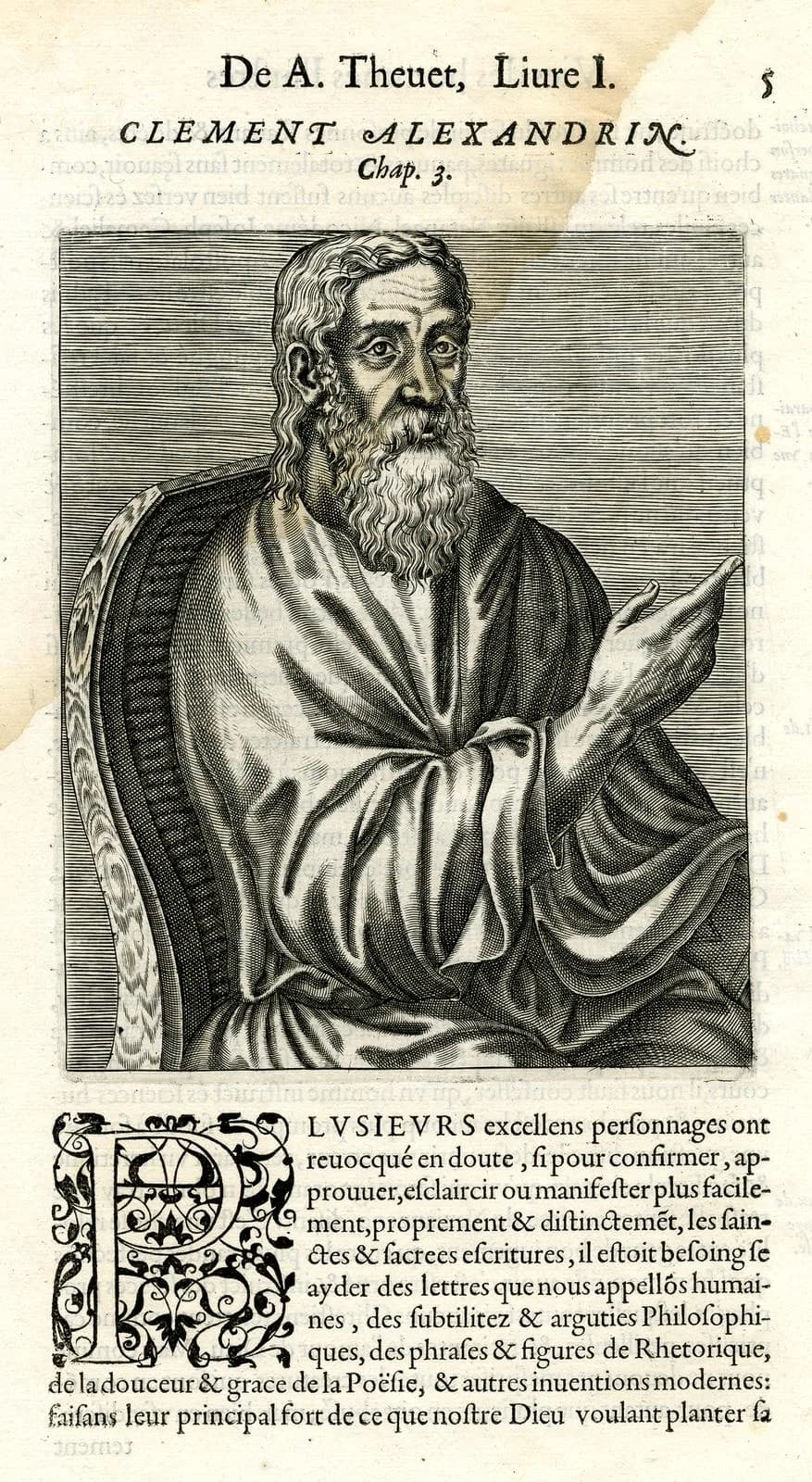
Clement of Alexandria was a Christian theologian and head of the Catechetical School of Alexandria in the late 2nd and early 3rd centuries CE, known for his systematic engagement with Greek philosophy. Operating in one of the most intellectually vibrant cities of the ancient world, Clement sought to harmonize Greek thought with Christian doctrine. As head of the Catechetical School, he played a crucial role in shaping early Christian education, promoting a faith that embraced reason and learning.
Born around 150 CE, Clement traveled extensively across the Mediterranean, seeking knowledge and spiritual insight. His journey eventually led him to Alexandria, where he took charge of the Catechetical School. Under his leadership, the school became a beacon of Christian thought. Clement authored several influential works, notably his trilogy on the Christian life: "Protrepticus," "Paedagogus," and "Stromata." These writings reflect his belief that Greek philosophy served as a precursor to Christian truth. This notion of philosophy as a "preparation for the gospel" challenged the boundaries between faith and reason.
Clement's world was one of theological flux and debate. Christianity was still carving out its identity amidst the dominant Greco-Roman culture, and Clement's positive view of Greek philosophy raised eyebrows. Some accused him of syncretism, blending Christian and pagan ideas too freely. His concept of the "true Gnostic," a spiritually enlightened Christian, echoed the ideas of Gnostic sects deemed heretical by the Church. Yet, despite these controversies, Clement avoided formal condemnation. His legacy remains a testament to the complex dance between faith and reason in early Christianity. Clement's name, notably absent from the Roman martyrology, reflects the ongoing tension his ideas stirred.
Is Greek philosophy a gift that prepares the mind for the gospel, or a corruption that must be kept out of Christian theology?
Clement of Alexandria faced the challenge of reconciling Christian faith with the intellectual rigor of Greek philosophy. Living in a time when Greek thought dominated intellectual circles, he saw the need to bridge the gap between faith and reason. His life's work centered on proving that Christianity was not only compatible with philosophy but enriched by it. Clement aimed to demonstrate that philosophical inquiry could serve as a tool to deepen one's understanding of the gospel, rather than threaten it. This was a bold endeavor in an era when many Christians viewed philosophy with suspicion.
Among Clement's most important ideas was the concept of the "Logos Spermatikos," which claimed that the divine Logos, or Word of God, had scattered seeds of truth throughout all human wisdom, including Greek philosophy. This meant that philosophical ideas could lead people closer to the truths of Christianity. He also redefined the notion of the "educated Christian 'gnostic'" to counteract Gnostic heresies. For Clement, true knowledge, or "gnosis," was not the hidden, elitist knowledge claimed by heretics but rather a deeper, virtuous understanding of faith accessible to all Christians. Another pivotal idea was his advocacy for the allegorical interpretation of Scripture, which allowed for a richer, more nuanced understanding of biblical texts by uncovering their deeper spiritual meanings.
Clement's contributions extend beyond these ideas. His works, such as "Stromata" and "Paedagogus," reflect his commitment to integrating philosophy with Christian doctrine. He argued that Greek philosophy was a divine gift preparing minds for the gospel, legitimizing its study among Christians. This position addressed the cultural tensions of his time, providing a framework for Christian intellectuals to engage with the surrounding philosophical environment without abandoning their faith.
Clement's signature argument rested on the claim that Greek philosophy was not an adversary but a precursor to Christian truth. By suggesting the Logos had disseminated fragments of truth across human wisdom, Clement offered a compelling framework for integrating philosophy into Christian theology. This reasoning transformed how Christians engaged with the intellectual traditions around them, allowing for a positive dialogue between faith and reason. Clement's work laid the groundwork for future theologians to explore philosophical insights without fearing a compromise of their beliefs, fundamentally altering the landscape of Christian thought.
Before Clement of Alexandria, Christian thought was largely defensive. Early Christians focused on defining themselves against both Judaism and the thriving pagan religions of the time. They guarded their faith against influences they deemed corrupting, such as Greek philosophy, which many early Church Fathers dismissed as a threat to Christian doctrine. Their main goal was to solidify the core tenets of Christianity and protect them from heretical movements like Gnosticism, which claimed secret, esoteric knowledge. Allegorical interpretations of Scripture existed but lacked systematic development. The dominant assumption was that Christianity needed to stand apart, pure and untainted by outside ideas.
Clement of Alexandria changed the game. He argued that Greek philosophy wasn't an enemy but a stepping stone to understanding Christian teachings. He saw it as a preparatory tool that contained hints of truth pointing toward the gospel. This bold stance helped integrate philosophical reasoning into the faith, something that would later influence theologians like Augustine and Aquinas. Clement also redefined the term "gnostic." Instead of heretical, he used it to describe an educated Christian who achieved deeper faith through knowledge. Finally, he championed allegorical interpretations of Scripture, urging believers to look beyond the literal text for deeper spiritual meanings. His ideas encouraged the church to embrace a broader intellectual landscape.
Clement's influence reached far beyond his own time. By integrating Greek philosophy into Christian theology, he laid the groundwork for the Scholastic movement, which sought to reconcile faith and reason. His allegorical approach to Scripture inspired the Alexandrian school and theologians like Origen and Augustine, who further developed Christian exegesis. Clement's ideas opened the door for philosophical inquiry within the church, impacting medieval and Renaissance theologians. Without Clement, the intellectual richness of Christian theology might have developed very differently. His legacy endures, as evidenced by the ongoing dialogue between faith and reason in theological studies today.
Clement of Alexandria, a key figure in early Christian thought, faced significant criticism on several fronts. His engagement with Greek philosophy marked him as a syncretist, blending Christian theology with pagan ideas. Tertullian and others saw this as a dilution of Christian purity, fearing it would compromise the distinctiveness of Christian teachings. His concept of the "true Gnostic" also stirred controversy. By using terminology closely associated with Gnostic heresy, he risked blurring the lines between orthodoxy and heresy. Additionally, Clement's allegorical interpretation of Scripture drew ire from those who preferred a literal approach. Critics argued that his method allowed for subjective readings, potentially undermining the authority of Scripture. These controversies possibly contributed to his omission from the Roman martyrology, signaling a lack of full acceptance by the Church.
The darkest chapter in Clement's legacy is his attempt to reconcile Christianity with Greek philosophy. Critics argued that this syncretism weakened the Church's ability to clearly define and defend its core doctrines against pagan influences. By accommodating external ideas, Clement risked creating a version of Christianity that compromised its theological integrity. This approach threatened to dilute the faith's distinctiveness, making it harder for the early Church to fend off competing ideologies. The consequence was a Christianity that some feared had lost its clear identity, leaving it vulnerable to further doctrinal challenges.
Despite these criticisms, some modern scholars argue that Clement's engagement with Greek philosophy was a strategic move. They contend it made Christianity more intellectually respectable and accessible to educated classes, aiding its spread and acceptance. Yet, the verdict remains mixed. His ideas still provoke debate about the balance between preserving core doctrines and engaging with broader intellectual currents. Clement's exclusion from the Roman martyrology stands as a concrete fact, a testament to the enduring skepticism his ideas faced within the Church.
Clement of Alexandria did not face formal condemnation during his lifetime, but his works didn't make it into the Roman martyrology, the official list of saints and martyrs honored by the Church. Despite this exclusion, Clement's influence did not fade away. He continued to shape Christian thought through his students and writings until his death around 215 CE. His direct pupils and followers maintained his legacy, ensuring that his ideas circulated within the early Christian communities. Clement lived in a time when the Church grappled with how to relate to the surrounding Greco-Roman culture, and his thoughts provided a framework for this engagement.
The Alexandrian School became the vehicle for Clement's teachings, with figures like Origen taking up his mantle. Origen, one of the most celebrated early Christian theologians, absorbed Clement's approach of harmonizing faith with reason. The Eastern Orthodox tradition, deeply rooted in the theological explorations of the early Church, carried forward Clement's influence. Early Christian humanists appreciated his attempts to blend Greek philosophy with Christian doctrine, setting the stage for future intellectual pursuits in theology. His work rippled through regions where these ideas held sway, particularly in Eastern Christianity and among thinkers who valued the integration of diverse sources of wisdom.
Today, Clement's approach resonates in modern Christian apologetics and theological discussions that engage with secular philosophy. His legacy shines in the Eastern Orthodox Church's emphasis on theosis, the process of becoming more like God through transformative knowledge and spiritual growth. This concept remains central to Orthodox theology. Clement's influence extends to the way contemporary theologians tackle the relationship between faith and reason, a testament to his enduring impact. In a world that still wrestles with similar questions, Clement's efforts to integrate different streams of thought continue to inspire and guide.
Continue reading with a Scholar plan
Upgrade to Scholar