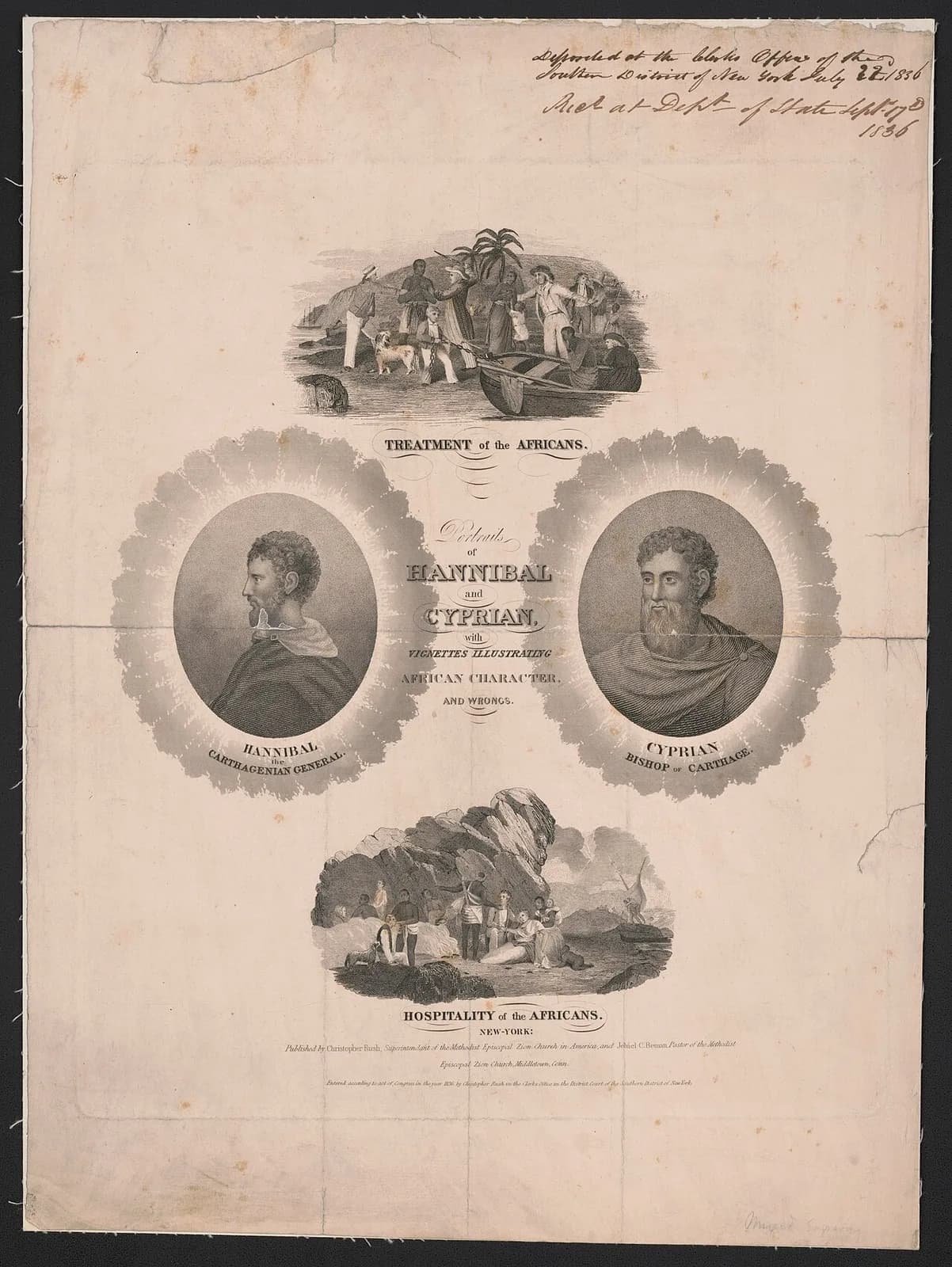
Cyprian of Carthage
defenderEarly Church (2nd-3rd C) · c. 200-258 CE · Updated April 9, 2026
Biography
Cyprian of Carthage was a bishop and martyr in the Early Church, serving as a dominant voice on ecclesiology in the 3rd-century Latin church. As Bishop of Carthage, a major center of early Christianity in North Africa, he confronted significant challenges both from within and outside the church. Known for his strong stance that "outside the church there is no salvation," Cyprian shaped the understanding of church unity at a time when Christianity was still solidifying its identity.
Born around 200 CE, Cyprian converted to Christianity later in life, quickly rising through the ranks to become Bishop of Carthage. His leadership coincided with the persecution of Christians under the Roman Emperor Decius. In 251 CE, Cyprian presided over the Synod of Carthage to address the lapsi, Christians who had renounced their faith under persecution but sought to return. In 258 CE, during the Valerian persecution, Cyprian chose martyrdom over recanting his faith, cementing his legacy as a steadfast defender of Christian principles.
Cyprian's era was rife with theological disputes and external pressures. The Novatianist schism and debates over the lapsi highlighted the struggle to maintain church unity while upholding moral standards. Cyprian's involvement in the rebaptism controversy, where he opposed accepting heretics without rebaptism, underscored the tension between purity and inclusivity in the church. His efforts to address these issues through synods and writings left a lasting impact on the church's structure and doctrine.
What constitutes the true church — and does schism place a community permanently outside salvation, regardless of the moral purity of its members?
The question
Cyprian faced a church in turmoil. Persecution had forced many believers to renounce their faith to save their lives, only to seek readmission once the danger passed. Cyprian saw the chaos and division this created. He believed the true church must remain unified, a single body committed to the teachings passed down from the apostles. This conviction drove him to confront the issue head-on. For him, the church was the vessel of salvation, and any rupture in its unity threatened its very foundation. He could not ignore the damage done by those who splintered away, even if they claimed to follow Christ with pure hearts.
The first horn of the dilemma demanded an unwavering commitment to unity and tradition. In this view, the church's integrity rested on its adherence to established doctrines and leaders. Schism, regardless of the reasons or the moral standing of those involved, placed individuals outside the realm of salvation. This approach required the church to draw firm boundaries, excluding those who broke away. The cost was high: it meant turning away from those who might be genuinely faithful but stood outside the institutional structure. Yet, for Cyprian, the price of compromise was too great. Salvation depended on being part of the one true church, and this could not be jeopardized.
The second horn offered a different perspective, one that prioritized the faith and morality of individuals over strict institutional boundaries. This position suggested that even those outside the formal church might still partake in Salvation if they maintained true faith. It allowed room for the lapsi, those who had lapsed, to return without being permanently ostracized. But the cost here was equally significant. It threatened to dilute the church's authority and open the floodgates to fragmentation. Without a clear structure, the church risked losing its identity and control. For those who championed unity like Cyprian, this was untenable.
Caught in this trap, Cyprian saw no easy solution. The stakes were high for ordinary believers. Would their prayers matter if uttered in a schismatic church? Were their sacraments valid? Could they hope for Salvation if they found themselves outside the accepted fold? For many, this wasn't just doctrinal hair-splitting. It affected daily life, shaping how they worshiped and lived their faith. Cyprian's insistence on unity and tradition aimed to offer clarity and certainty in a tumultuous time. Yet, it also forced a hard line that left little room for those outside the church's visible structure. In his quest to safeguard the church's integrity, he grappled with the eternal question of what it truly meant to belong to the body of Christ.
The orthodox answer
Cyprian of Carthage taught that the true church is a single, unified body of believers. He insisted that salvation could only be found within this unified church. For Cyprian, any group breaking away from the church, regardless of how morally upright its members might be, severed its connection to salvation. Schism, he believed, was a grave error that placed a community outside the possibility of Salvation.
Cyprian's reasoning was rooted in the belief that the church is the body of Christ, the sole vessel of Salvation. He argued that Christ established one church, and any division from it was a division from Christ himself. In his treatise "On the Unity of the Church," he cited scriptures to reinforce his position. He referred to John 10:16 to emphasize the unity under one shepherd, Christ. Ephesians 4:4-6 supported his claim of one body, one faith, and one baptism, where schism disrupts this unity. Matthew 16:18 underscored the notion of a singular, invincible church founded on Peter, which schismatics break away from.
Cyprian's teaching resonated with many church leaders and communities who prioritized ecclesiastical unity and authority. His clear framework for understanding the church's role in Salvation gained traction, especially during times of turbulence and division. His ideas spread widely among those seeking to maintain church cohesion. By the time of his death, Cyprian's views on church unity had become a cornerstone for many, influencing church policies long after his era.
The counterargument
Cyprian of Carthage made a bold case for the unity of the church as essential for salvation. He argued that the church is the sole vessel of salvation, and schism, regardless of the moral standing of its members, severs individuals from the body of Christ. In his work "De Unitate Ecclesiae," Cyprian famously wrote, "He can no longer have God for his Father, who has not the Church for his mother." This statement encapsulates his belief that the church's authority and unity are divinely instituted. Therefore, any separation from it equates to a separation from God Himself. The heretical groups of his time, like the Novatianists, claimed moral superiority but failed to address Cyprian's core argument: if Salvation exists outside the church, they implicitly deny the church's unique role in God's plan.
Cyprian anchored his argument in scripture, using passages that underscored the necessity of unity. He pointed to John 10:16, where Jesus speaks of one flock under one shepherd, emphasizing that unity under one church is a divine mandate. Matthew 16:18 was crucial for Cyprian, as he argued that the church was founded on Peter, symbolizing unity and authority. This foundation, he insisted, schismatics undermine by their very existence. Ephesians 4:4-5 further reinforced his stance, highlighting the one body, one Spirit, one faith, and one baptism. By claiming a separate path to Salvation, the Novatianists contradicted their assertion of being the true church. Cyprian exposed this contradiction, showing their position as inherently flawed and divisive.
Cyprian's unwavering defense of church unity came at a great personal cost. During the Decian persecution, he faced exile as his influence posed a threat to Roman authority. The pressure to abandon his theological stance did not waver his resolve. His commitment ultimately led to his martyrdom in 258 CE when he was executed for refusing to renounce his faith. Cyprian's life ended in sacrifice, but his legacy endured. His arguments for the unity of the church left a lasting mark on Christian thought, reinforcing the idea that there can be no Salvation outside the church.
The resolution
In 251 CE, Cyprian of Carthage called the Synod of Carthage, gathering bishops from across North Africa to address a pressing issue: the fate of Christians who had lapsed during persecution. Roman authorities, eager for stability, watched closely. They understood that a unified church would be easier to manage. The bishops faced a critical question: Could those who abandoned their faith in the face of persecution rejoin the church, and under what conditions? This meeting wasn't just about theology; it was about maintaining order and unity in a community that was growing in influence and complexity.
Cyprian argued passionately for the church's power to forgive and restore those who had lapsed. He insisted that maintaining unity was paramount and labeled groups like the Novatianists as schismatics. The Novatianists, led by Novatian from Rome, believed that the lapsed were beyond forgiveness and could not be readmitted. Cyprian and his supporters countered this by emphasizing that salvation lay within the church's embrace, not outside it. The synod's decision affirmed the church's authority to readmit the lapsed after they completed a prescribed penance, thereby rejecting the Novatianist insistence on exclusion and condemning their break from church unity.
Despite the synod's decision, the issue of how to handle the lapsed remained unsettled. The Novatianist schism did not dissolve; instead, it solidified into a separate community that persisted for centuries, challenging the main church's stance. Debates over penance and the church's authority continued, reflecting deeper tensions about individual conscience and the nature of forgiveness. The broader discussion over church authority and moral purity did not conclude until much later, as these themes reemerged in various forms throughout church history.
Legacy
Cyprian of Carthage met his end in 258 CE, executed during the fierce Valerian persecution. He stood firm in his beliefs, particularly on the importance of church unity and the idea that true Christians must belong to the true church. His death did not silence his teachings. Instead, they gained traction as the church grappled with internal divisions, like the Novatianist schism, which challenged the church's approach to those who renounced their faith under persecution, known as the lapsi. Cyprian insisted that the church must remain united and that those outside its fold could not claim salvation.
Cyprian's views on church unity rippled through the Western Church, leaving a lasting mark. His insistence that "outside the church there is no salvation" became a cornerstone for later theological debates. Augustine, a towering figure in early Christianity, drew on Cyprian's thoughts in his confrontations with Donatism, a movement that questioned the integrity of the church. Cyprian's influence extended to the decisions of church councils, which sought to address schisms and maintain ecclesiastical unity, reinforcing the idea that the church must be one body.
Today, Cyprian's teachings remain visible, especially in the Roman Catholic Church's doctrine that Salvation is found within the church. This belief, known as "extra Ecclesiam nulla salus," reflects Cyprian's enduring impact. Beyond Catholicism, discussions about church authority and unity in Orthodox and some Protestant circles still echo Cyprian's legacy. His thoughts continue to spark dialogue and shape beliefs about the role and boundaries of the church in the modern world, highlighting his lasting influence on Christian thought and practice.
Continue reading with a Scholar plan
Upgrade to ScholarCommon questions
- What did Cyprian of Carthage actually believe about Christ — and why?
- Cyprian of Carthage believed in the divinity of Christ and His role as the head of the Church. He emphasized the unity of the Church under Christ as essential for salvation, reflecting his belief that Christ's authority was manifest through the Church's hierarchy. This belief was rooted in his understanding of the Church as the body of Christ, where unity and adherence to ecclesiastical authority were paramount.
- What heresy was Cyprian of Carthage defending against, and what was at stake?
- Cyprian defended against the Novatianist schism, which arose from disagreements over how to treat Christians who had lapsed during persecution. The Novatianists advocated for a strict approach, refusing to readmit the lapsi into the Church. At stake was the unity of the Church and the authority of its leaders to offer forgiveness and reconciliation.
- What was Cyprian of Carthage's decisive argument for the orthodox position?
- Cyprian's decisive argument was that the Church is the sole vessel of salvation, encapsulated in his phrase 'outside the church there is no salvation.' He argued that the Church, as the body of Christ, had the authority to forgive sins and restore the lapsi, emphasizing the importance of unity and the bishop's role in maintaining ecclesiastical order.
- How many times was Cyprian of Carthage exiled or condemned — and by whom?
- Cyprian was exiled once by the Roman authorities during the persecution of Christians under Emperor Valerian in 257 CE. He was later condemned to death by the Roman proconsul Galerius Maximus in 258 CE, leading to his martyrdom.
- Who were Cyprian of Carthage's main opponents, and how did they fight back?
- Cyprian's main opponents were the Novatianists, led by Novatian, who became an antipope in Rome. They fought back by establishing a rival church that refused to accept the lapsi and challenged the authority of bishops like Cyprian who advocated for their reconciliation.
- What happened at the council Cyprian of Carthage attended or influenced?
- At the Synod of Carthage in 251 CE, Cyprian played a key role in addressing the issue of the lapsi, advocating for their readmission into the Church after appropriate penance. The council upheld the authority of bishops to forgive sins, reinforcing the unity and authority of the Church against the Novatianist position.
- What did Cyprian of Carthage write, and is any of it still read?
- Cyprian wrote numerous letters and treatises, including 'On the Unity of the Church' and 'On the Lapsed.' These works are still read today for their insights into early Christian ecclesiology and the challenges of maintaining church unity in times of persecution.
- Is Cyprian of Carthage considered a saint? By which traditions?
- Cyprian of Carthage is considered a saint by both the Roman Catholic Church and the Eastern Orthodox Church. His feast day is celebrated on September 16th in the Western tradition and on August 31st in the Eastern tradition.
- Why did Cyprian of Carthage refuse to compromise even when it cost everything?
- Cyprian refused to compromise because he believed that the unity and authority of the Church were divinely ordained and essential for salvation. His commitment to these principles was so strong that he was willing to face exile and martyrdom rather than betray his convictions.
- Why does Cyprian of Carthage still matter to Christians today?
- Cyprian matters today because his teachings on church unity and authority continue to influence Christian ecclesiology. His insistence on the importance of a unified Church under episcopal leadership remains relevant in discussions about church governance and the nature of Christian community.
- What is the most surprising or counterintuitive thing about Cyprian of Carthage?
- One surprising aspect of Cyprian's life is that he was a relatively late convert to Christianity, only becoming a Christian around 246 CE, yet he quickly rose to prominence as a bishop and theological leader. This rapid ascent underscores his intellectual and spiritual impact on the early Church.