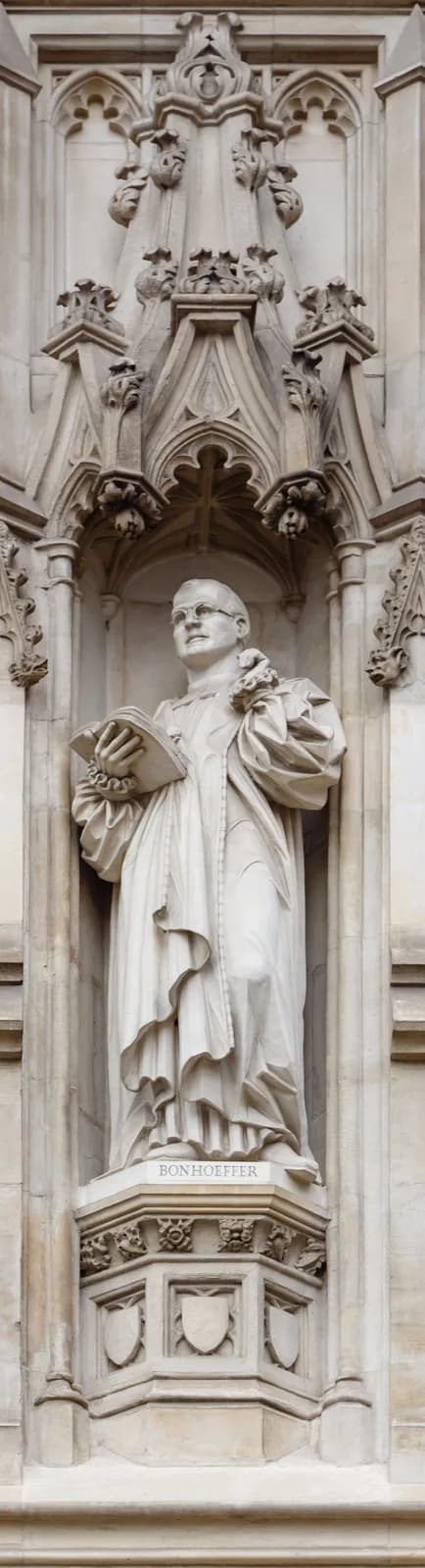
Dietrich Bonhoeffer
theologianModern (17th C+) · 1906-1945 CE · Updated April 9, 2026
Biography
Dietrich Bonhoeffer was a German Lutheran pastor and theologian, active during the early to mid-20th century, known for his leadership in the Confessing Church and his resistance against the Nazi regime. As the Nazi government attempted to control the German church, Bonhoeffer became a leading voice of opposition, advocating for a Christianity that stood firm against state interference. His courageous stance against tyranny led him to become a central figure in the Confessing Church, a movement that resisted the Nazi-influenced German Christian movement.
Born on February 4, 1906, in Breslau, Germany, Bonhoeffer studied theology at the University of Tübingen and later at the University of Berlin, where he completed his doctoral thesis. He wrote influential works such as "The Cost of Discipleship" and "Life Together," which explored the demands of following Christ in a hostile world. In 1943, the Gestapo arrested him for his involvement in a plot to assassinate Adolf Hitler. Despite imprisonment, Bonhoeffer continued to write, producing "Letters and Papers from Prison," a collection published after his death. On April 9, 1945, the Nazis executed Bonhoeffer at Flossenbürg concentration camp, just weeks before the end of World War II.
Bonhoeffer lived during a period when Nazi ideology infiltrated every aspect of German life, challenging Christians to confront profound ethical and theological dilemmas. The Confessing Church emerged as a response to state control over religious institutions, advocating for the church's independence and moral authority. Bonhoeffer's ideas of "religionless Christianity" and the moral necessity of resisting evil grew from this turbulent time. His life ended in resistance, a testament to his belief that faith demanded action against injustice.
When the state becomes demonic, what does Christian faithfulness require — and does resistance to radical evil justify actions that contradict one's own theological convictions?
The ideas
Dietrich Bonhoeffer grappled with a profound question: How should Christians live faithfully in a world beset by evil? This question took on urgency as the Nazi regime rose to power, presenting a stark moral crisis. Bonhoeffer saw the German church capitulating to Hitler, compromising its values for political gain. In response, he sought to articulate a theology of action, one that demanded true discipleship and a courageous stand against tyranny. His work was not theoretical; it was a call to live out faith amidst oppression and injustice, to confront evil head-on, even at great personal cost.
Among Bonhoeffer's most influential ideas was the distinction between "cheap grace" and "costly grace." He criticized the church for offering forgiveness without requiring true repentance or discipleship. Cheap Grace, he argued, was Grace without the cross, without real transformation. In contrast, costly Grace demanded obedience and sacrifice, mirroring the sacrifice of Jesus. This idea was a direct challenge to the complacent church under Nazi rule. Another critical concept was his call to discipleship as a call to die. Bonhoeffer insisted that following Christ could mean literal death, reflecting his own willingness to face martyrdom. These ideas took shape amid the backdrop of Hitler's rise and the historical examples of early Christian martyrs.
Bonhoeffer also introduced the notion of "religionless Christianity," which emerged during his imprisonment. He envisioned a faith that transcended traditional religious rituals, focusing instead on living authentically in the world. This idea arose from his critique of the church's failure to oppose Nazi ideology. Additionally, he redefined the church's mission as being for others, particularly the oppressed. This concept, born from his work with the Confessing Church, emphasized social justice and active engagement against injustice. His belief in responsible action against radical evil led him to participate in the plot to assassinate Hitler, demonstrating his commitment to confronting moral failure.
Bonhoeffer's signature argument centered on the cost of true Christian discipleship. He contended that genuine faith required confronting evil and injustice, necessitating concrete actions that could involve great personal risk. This argument was compelling because it challenged Christians to embody their beliefs, refusing to remain passive in the face of radical evil. Bonhoeffer's insistence on costly grace and responsible action changed how many viewed the role of faith in public life. It demanded that Christians not only believe but act, reshaping the church's response to tyranny and injustice in the modern world.
What changed
Before Dietrich Bonhoeffer, Christian thought in Germany largely accepted the state's authority without much resistance. Lutheran doctrines, particularly the idea of two kingdoms, often encouraged Christians to separate their religious convictions from political actions. This led to a church that was unsure how to handle the moral challenges posed by rising totalitarian regimes. Many theologians hesitated to oppose state overreach, leaving the church grappling with its place in an increasingly secular world. Grace was often viewed as a comforting assurance of salvation, with little emphasis on the demands that faith might place on a believer's life.
Dietrich Bonhoeffer changed this landscape by challenging the prevailing assumptions about grace and the role of the church in society. He introduced the concept of "costly Grace," arguing that true Grace demands active discipleship and sacrifice. Bonhoeffer insisted that Grace was not a free pass but a call to action and transformation. He also proposed "religionless Christianity," urging believers to engage with the world through practical and ethical living rather than just religious rituals. Bonhoeffer redefined the church as a community of believers united in mutual support and action, rather than a distant institution. He argued for Christian resistance to evil, even if it required breaking from traditional ethical norms, thereby forcing Christians to confront their role in opposing injustice.
The impact of Bonhoeffer's ideas reverberated far beyond his time. Liberation theology, which emphasizes social justice and political activism, draws heavily from his thoughts. His focus on community and discipleship has influenced the emerging church movement, which seeks to create more relational and less hierarchical structures. Theologians like Jürgen Moltmann and Stanley Hauerwas have expanded on his concepts of costly grace and the church's societal role, driving ongoing discussions on ethics and community. Without Bonhoeffer, these movements and ideas might lack their current depth and reach. In 1945, the Nazis executed Bonhoeffer, but his legacy continues to challenge and inspire Christian thought worldwide.
Disputed legacy
Dietrich Bonhoeffer's legacy contains several contentious ideas, each sparking debate and division. His concept of "religionless Christianity" confounds many, as it appears to strip Christianity of its traditional structures and doctrines. Critics argue that this idea dilutes the faith, leaving it vulnerable to secular interpretations that undermine its core tenets. Additionally, his distinction between "cheap grace" and "costly grace" faces criticism for its simplicity. This dichotomy risks invalidating the personal struggles people face on their spiritual journeys, offering little room for nuance or complexity. Furthermore, Bonhoeffer's vision of the church as a tightly knit community draws fire for potentially fostering exclusivity, overlooking the church's broader role in engaging with society.
The darkest chapter in Bonhoeffer's legacy remains his involvement in the plot to assassinate Adolf Hitler. This act starkly contrasts with his teachings on non-violence and Christian pacifism. Bonhoeffer's participation in such a violent conspiracy complicates his ethical stance, raising thorny questions about whether moral ends justify violent means within the framework of Christian doctrine. His decision to engage in this plot challenges the integrity of his teachings and leaves a stain that cannot easily be erased. The consequences of his actions reverberate through theological circles, casting a long shadow over his contributions to Christian ethics.
Despite the intense criticism, some argue that Bonhoeffer's actions during Nazi Germany were a form of ethical responsibility in the face of extreme evil. These defenders claim that the context necessitated drastic measures, suggesting his involvement was a morally justified response to an unparalleled crisis. Yet, this defense does not fully resolve the ethical conundrum his actions present. His idea of "religionless Christianity" and the dichotomy of Grace still face substantial pushback and debate. Bonhoeffer's life and work remain a complex tapestry of bold ideas and controversial actions, the implications of which continue to provoke discussion today. The fact remains: his legacy is as divisive as it is influential.
Legacy
Dietrich Bonhoeffer faced execution on April 9, 1945, at Flossenbürg concentration camp, a grim conclusion to his resistance against the Nazi regime. Arrested in 1943 for his involvement in a plot to assassinate Adolf Hitler, Bonhoeffer spent two years in prison, where he wrote extensively. His letters and papers, smuggled out by friends, became the foundation for his posthumous influence. The Nazis hanged him just weeks before Germany's surrender, but his ideas survived. His execution aimed to silence him, yet it amplified his voice across decades.
After his death, Bonhoeffer's teachings gained traction through the Confessing Church, a group already resisting Nazi interference in German Protestantism. His ideas on costly grace, which emphasizes true discipleship over superficial belief, inspired liberation theologians in Latin America, where the poor and oppressed sought solace in a faith demanding social justice. In South Africa, his thoughts on responsible action influenced anti-apartheid activists, intertwining faith with the struggle for equality. His writings found a place in Christian ethics, shaping discussions on how faith intersects with political and social responsibilities.
Today, Bonhoeffer's legacy thrives in discussions on Christian ethics and social justice within mainline Protestant churches. His notion of 'religionless Christianity' challenges both believers and secular thinkers to reconsider religion's role in a world that often sidelines it. His ideas continue to fuel debates on how faith can address societal issues. Princeton Theological Seminary, among other institutions, regularly hosts seminars analyzing his work, ensuring his thoughts remain accessible and relevant. Bonhoeffer's life and teachings endure as a beacon for those intertwining faith with action in the modern world.
Continue reading with a Scholar plan
Upgrade to ScholarCommon questions
- What is Dietrich Bonhoeffer most known for in Christian history?
- Dietrich Bonhoeffer is most known for his resistance to the Nazi regime and his theological writings that challenged the church to stand against injustice. He was a key figure in the Confessing Church, which opposed the Nazi-influenced German Christian movement. Bonhoeffer was executed in 1945 for his involvement in a plot to assassinate Adolf Hitler.
- What were Dietrich Bonhoeffer's most important works?
- Dietrich Bonhoeffer's most important works include 'The Cost of Discipleship' (1937), which critiques 'cheap grace' and calls for genuine Christian commitment, 'Life Together' (1939), which explores Christian community, and 'Letters and Papers from Prison' (published posthumously in 1951), which contains his reflections during imprisonment.
- What were Dietrich Bonhoeffer's most influential theological ideas?
- Bonhoeffer's influential ideas include the distinction between 'cheap grace' and 'costly grace,' emphasizing the true cost of following Christ. He also proposed the concept of 'religionless Christianity,' suggesting that the church should focus on serving others rather than maintaining religious institutions. His ideas on responsible action in the face of evil and the church as a community of believers have also been significant.
- What controversies did Dietrich Bonhoeffer engage in — and what was at stake?
- Bonhoeffer was involved in controversies regarding the church's role in Nazi Germany, particularly through his leadership in the Confessing Church, which opposed the Nazi-aligned German Christians. The stakes were high as it involved the church's complicity or resistance to the regime's atrocities. His participation in the plot to assassinate Hitler also sparked ethical debates about violence and Christian responsibility.
- How did Dietrich Bonhoeffer influence later Christianity — Catholic, Protestant, and beyond?
- Bonhoeffer's ideas have influenced both Protestant and Catholic thought, particularly in discussions on ethics, discipleship, and the role of the church in society. His concept of 'religionless Christianity' has resonated with those seeking a more authentic faith experience. Liberation theologians and social justice advocates have also drawn on his emphasis on responsible action against injustice.
- What did Dietrich Bonhoeffer get wrong, or what ideas have been seriously disputed?
- Some have disputed Bonhoeffer's idea of 'religionless Christianity,' arguing it could lead to a secularization of faith. His involvement in the plot to kill Hitler has also been controversial, with debates about whether it was consistent with Christian ethics. Despite these disputes, his overall impact on theology remains significant.
- Is Dietrich Bonhoeffer considered a saint? By which traditions?
- Dietrich Bonhoeffer is not officially canonized as a saint in any major Christian tradition. However, he is widely regarded as a martyr and a modern-day saint by many Protestants and some Catholics, particularly for his courageous stand against the Nazi regime.
- Why does Dietrich Bonhoeffer still matter today?
- Bonhoeffer remains relevant for his insights into the cost of true discipleship and the church's role in confronting injustice. His life and writings challenge Christians to live out their faith authentically and courageously in the face of societal and political pressures. His ideas continue to inspire those seeking to integrate faith with social justice.
- What is the most surprising or counterintuitive thing about Dietrich Bonhoeffer?
- One surprising aspect of Bonhoeffer's life is his involvement in the plot to assassinate Hitler, which contrasts with his Christian teachings on peace and nonviolence. This decision reflects the complexity of his ethical considerations and the extreme circumstances he faced.
- What is the best place to start reading Dietrich Bonhoeffer?
- A good starting point for reading Bonhoeffer is 'The Cost of Discipleship,' which introduces his key ideas on grace and discipleship. For those interested in his reflections during imprisonment, 'Letters and Papers from Prison' provides personal insights into his theological and ethical thinking.