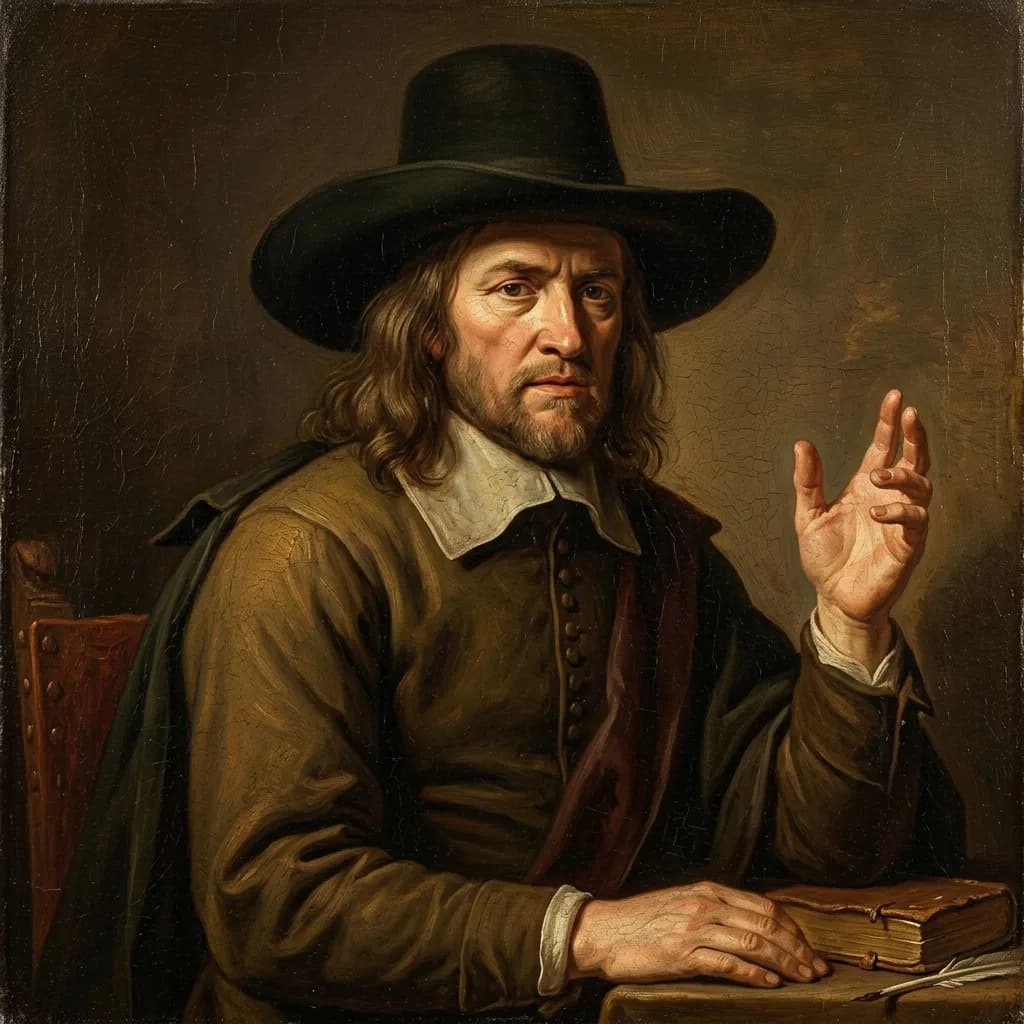
George Fox
theologianModern (17th C+) · 1624-1691 CE · Updated April 9, 2026
Biography
George Fox was an English itinerant preacher and the founder of the Religious Society of Friends, commonly known as Quakers, in the 17th century. Born in 1624 in Drayton-in-the-Clay, Leicestershire, England, Fox emerged as a radical religious reformer during a time of great upheaval and transformation in England. He is best known for his emphasis on the Inner Light, a direct and personal experience of God that bypassed traditional religious authorities.
Fox's life was marked by fervent preaching and repeated confrontations with the law. He founded the Quakers, a group that rejected established church practices and embraced equality and pacifism. His advocacy for spiritual experience over external authorities like Scripture or clergy often led to conflict. Fox was imprisoned eight times on charges ranging from blasphemy to disturbing the peace. His writings, including his posthumously published Journal and The Great Mystery of the Great Whore Unfolded, capture his uncompromising vision and the challenges he faced.
Fox lived during the English Civil War and a period ripe with dissenting religious movements. Traditional religious structures faced scrutiny, which allowed Fox's ideas to take root among those disillusioned with church hierarchies. His promotion of radical equality before God challenged societal norms, making his message both compelling and controversial. By the time of his death in 1691, Fox had laid the foundation for a movement that would endure long after his passing.
Does the direct experience of the Inner Light make Scripture, clergy, and sacrament unnecessary — and what happens to Christian community when every believer is their own authority?
The ideas
George Fox grappled with the question of how people could experience God directly without the mediation of established religious structures. Living in 17th-century England, Fox found himself disillusioned with the Church of England and its hierarchy, which he saw as a barrier between individuals and the divine. He believed that the rituals and dogma of the Church did not foster genuine spiritual experiences. Instead, Fox sought a more personal and immediate connection to God, one that did not rely on priests or sacraments. His life’s work revolved around the idea that every person could find God within themselves, without intermediaries.
Fox's most significant ideas revolved around the concept of the "Inner Light." He claimed that every individual has an inherent, direct connection to the divine presence of Christ within their soul. This belief emerged from his own spiritual revelations and dissatisfaction with the Church's hierarchy. It democratized spiritual authority by suggesting that individuals do not need clergy or sacraments to experience God. Another key idea was that inner spiritual experience alone suffices for understanding and living out one's faith. This challenged the Church's reliance on Scripture and clergy as the main sources of religious authority. Fox's encounters with religious authorities and personal revelations led him to prioritize personal experience over institutional doctrine.
Fox also contributed significantly to the notion of radical equality before God. He argued that all people are equal in the eyes of God, regardless of their social status, gender, or education. This revolutionary idea emerged from his belief in the Inner Light, which negated social distinctions. His advocacy for pacifism, rooted in his interpretation of Jesus' teachings, set Quakers apart from other religious groups. Fox insisted that Christians should live peacefully and reject violence, a stance that often led to persecution. He also opposed oath-taking, arguing that a Christian's word should be trustworthy without such formalities, drawing from Jesus’ teachings in the Sermon on the Mount.
Fox's signature argument rested on the Inner Light as a sufficient guide for faith and practice, rendering traditional religious authorities unnecessary. This radical egalitarianism challenged the Church's control over spiritual life, proposing a community where each believer held their spiritual authority. It was compelling because it offered an alternative to a rigidly hierarchical society and religious system, empowering individuals to find truth within themselves. This argument reshaped Christian community and practice, laying the groundwork for the Quaker movement and influencing broader social reforms.
What changed
Before George Fox, the Christian landscape was defined by rigid structures and external authorities. The Church, Scripture, and clergy held sway over believers, dictating the terms of faith and practice. Sacraments were indispensable, seen as necessary channels of divine grace. The Church's hierarchy placed clergy above laypeople, reinforcing a top-down approach to spiritual matters. Personal experience in faith remained a murky area, overshadowed by the weight of tradition and institutional authority. Questions about the individual's direct relationship with God lingered unanswered, leaving believers dependent on established religious intermediaries.
George Fox shattered these norms by introducing revolutionary ideas that altered the course of Christianity. He preached the existence of an "Inner Light," a direct line to God's guidance within every individual, bypassing the need for clergy or sacraments. This democratized spirituality, empowering believers to rely on personal divine insight. Fox also dismantled the traditional religious hierarchy, asserting that all people are equal before God, regardless of social status or gender. His rejection of violence and oaths further marked a departure from accepted norms, advocating for pacifism and unwavering truthfulness. These shifts challenged the Church to reconsider its stance on authority, equality, and the nature of spiritual practice.
The impact of George Fox's ideas rippled through history, birthing the Religious Society of Friends, or Quakers, known for their steadfast commitment to equality and peace. His emphasis on personal spiritual experience laid the groundwork for later movements like Evangelicalism and Pentecostalism, which prize direct encounters with the divine. Fox's vision also sparked broader debates about religious authority and individual conscience, influencing modern theological discussions. Today, Quakers continue to embody his principles, with their advocacy for social justice and pacifism serving as a testament to Fox's enduring legacy.
Disputed legacy
George Fox, the founder of the Quakers, challenged the religious and social norms of his time, causing significant upheaval. His emphasis on the Inner Light as a direct, personal divine connection devalued the authority of Scripture for many traditional Christians. Anglican clergy and other Protestant groups saw this as a threat to the Bible's role as the ultimate guide. His radical views on equality disrupted the social order, leading to resistance from the English government and social elites. Fox believed in pacifism, which clashed with military and political leaders during times of conflict, marking him as unpatriotic. His refusal to take oaths in court posed a direct challenge to legal authority, creating complications in the judicial system and obstructing justice.
Fox's most contentious impact came from his outright rejection of traditional religious authority. This stance led to repeated imprisonments and societal backlash. By dismissing established structures, Fox directly challenged the status quo, resulting in friction within communities and with authorities. His ideas incited social and religious unrest, as they undermined the foundations of both church and state. The English government, feeling threatened by the potential for chaos, took steps to suppress his influence, viewing his teachings as a catalyst for disorder.
Some modern scholars argue that Fox anticipated contemporary movements that prioritize personal spirituality over institutional religion. They suggest that he was ahead of his time rather than fundamentally flawed. Despite this modern rehabilitation, the criticisms of his time remain largely valid. His devaluation of Scripture, disruption of social norms, impractical pacifism, and legal defiance continue to stand as points of contention. The fact remains: Fox's ideas provoked significant conflict and resistance in 17th-century England, with repercussions that echoed far beyond his lifetime.
Legacy
George Fox faced relentless opposition and imprisonment, yet he remained undeterred. After repeated condemnations, he continued preaching and organizing the Quaker movement. His unwavering commitment to the idea of the Inner Light, which holds that divine insight resides within every person, and his belief in radical equality, set the foundation for the Quakers. Despite the hardships, Fox's teachings gained traction. By the time of his death in 1691, he left behind a resilient community of Friends devoted to these transformative principles.
Fox's ideas lived on through the Religious Society of Friends, which flourished in England and the American colonies. The Quaker movement became a force for social reform. In the 18th and 19th centuries, Quakers played a pivotal role in the abolition of slavery and the promotion of pacifism. Their influence extended beyond their communities, inspiring broader societal changes. Figures like William Penn and John Woolman championed these causes, spreading the Quaker ethos across Europe and North America. The movement's commitment to equality and peace resonated, leaving a lasting impact on social reform efforts.
Today, the legacy of George Fox remains vibrant. Quaker communities continue to uphold the principles of the Inner Light and radical equality. They actively advocate for social justice and peace, engaging in movements that promote equality and nonviolence. The influence of these ideas is evident in organizations like the American Friends Service Committee, which works for humanitarian causes worldwide. George Fox's vision endures, not only within Quaker circles but also in the ongoing global efforts toward a more just and peaceful world.
Continue reading with a Scholar plan
Upgrade to ScholarCommon questions
- What is George Fox most known for in Christian history?
- George Fox is most known for founding the Religious Society of Friends, commonly known as the Quakers, in the mid-17th century. His emphasis on the Inner Light, or the direct experience of God within each person, was revolutionary and challenged the established religious norms of his time.
- What were George Fox's most important works?
- George Fox's most important works include his 'Journal,' published posthumously in 1694, which details his spiritual journey and the early years of the Quaker movement. Another significant work is 'The Great Mystery of the Great Whore Unfolded' (1659), where he critiques the established church, and his epistles, which were later collected in 'Works' (1831).
- What were George Fox's most influential theological ideas?
- Fox's most influential theological ideas include the concept of the Inner Light, which posits that every person has a direct connection to Christ. He also advocated for the sufficiency of inner spiritual experience over external religious authorities, radical equality before God, pacifism, and the refusal to take oaths.
- What controversies did George Fox engage in — and what was at stake?
- George Fox engaged in controversies with the established Church of England and other religious authorities, challenging their reliance on formal rituals and hierarchical structures. At stake was the authority of traditional religious institutions versus the Quaker emphasis on personal spiritual experience and equality.
- How did George Fox influence later Christianity — Catholic, Protestant, and beyond?
- George Fox's ideas influenced later Christian movements by promoting the concepts of spiritual egalitarianism and pacifism, which resonated with various Protestant groups. His emphasis on personal spiritual experience also found echoes in later evangelical and charismatic movements, though his direct influence on Catholicism was limited.
- What did George Fox get wrong, or what ideas have been seriously disputed?
- Some critics argue that Fox underestimated the value of traditional church structures and sacraments, which they believe provide necessary community and guidance. His radical ideas about equality and the Inner Light were also seen as threatening to social and religious order, leading to significant opposition.
- Is George Fox considered a saint? By which traditions?
- George Fox is not officially considered a saint by any major Christian tradition. The Quakers, who do not have a formal process for canonization, honor him as a foundational figure but do not use the term 'saint' in the traditional sense.
- Why does George Fox still matter today?
- George Fox matters today because his ideas about equality, pacifism, and the Inner Light continue to influence modern Quaker practices and inspire movements for social justice and peace. His emphasis on personal spiritual experience resonates with contemporary seekers of spiritual authenticity.
- What is the most surprising or counterintuitive thing about George Fox?
- One surprising aspect of George Fox is his ability to attract a diverse following despite his radical ideas, which often put him at odds with the authorities. His message of equality and direct spiritual experience appealed to people across different social classes and backgrounds.
- What is the best place to start reading George Fox?
- The best place to start reading George Fox is his 'Journal,' which provides insight into his spiritual journey and the early development of the Quaker movement. It offers a firsthand account of his experiences and the challenges he faced in spreading his message.