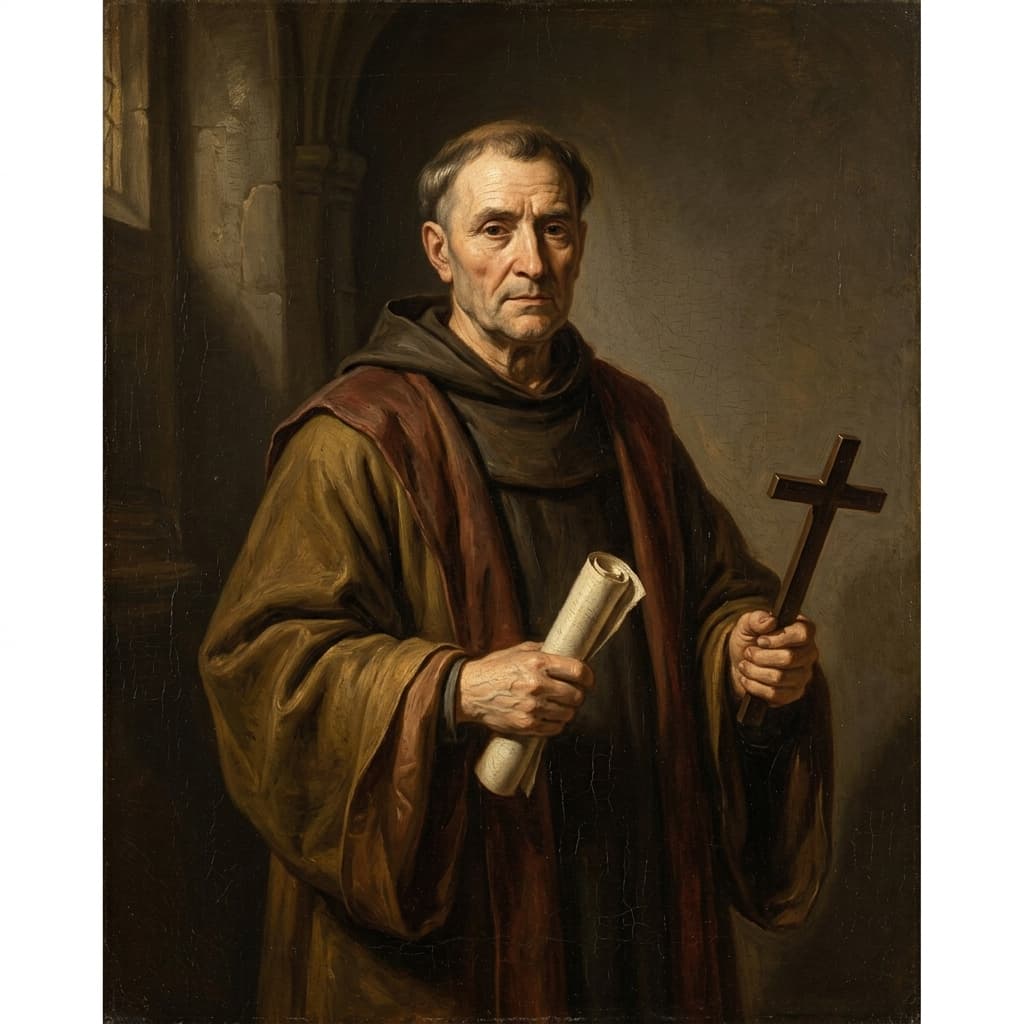
Priscillian
hereticPost-Nicene Patristic (4th-5th C) · c. 340-385 CE · Updated April 20, 2026
Biography
Priscillian was a bishop of Ávila in Spain during the Post-Nicene Patristic era, known for being the first Christian heretic executed by a Christian emperor. His life spanned a tumultuous period in church history as Christianity sought to define its core beliefs and practices. He became a controversial figure due to his teachings and the subsequent reaction from both church authorities and the Roman state.
Born around 340 CE, Priscillian rose to prominence as a charismatic leader advocating for ascetic practices, which emphasized strict self-discipline and avoidance of indulgence. As bishop, he attracted followers who were drawn to his teachings on the divine nature of the soul and the idea that the body was a mere prison for the spirit. His use of apocryphal texts and suspected ties to Manichaean dualism alarmed church leaders. These concerns led to his condemnation at the Synod of Zaragoza in 380 CE. Despite this, his influence persisted, which ultimately led to his trial and execution under Emperor Maximus at Trier in 385 CE.
Priscillian's era was marked by a church eager to consolidate its authority and suppress divergent beliefs. As Christianity became intertwined with the Roman state, deviations from established doctrine were not just religious issues but political ones. The secretive nature of Priscillian's practices and the perceived threat they posed to both ecclesiastical and imperial unity made him a target. His execution underscored the growing entanglement of church and state, illustrating the lengths to which authorities would go to maintain religious conformity. This was the first instance of the state executing a Christian for heresy, setting a grim precedent for future religious conflicts.
Does the state have the right to execute a Christian for heresy — and when asceticism and secret teaching cross into heresy, who has the authority to judge?
The question
Priscillian stood at the crossroads of a turbulent religious landscape. He observed the surge of ascetic practices and secret teachings, which he believed could deepen spiritual life by stripping away worldly distractions. Yet, these practices, cloaked in mystery and discipline, increasingly attracted suspicion from church authorities who feared deviation from established doctrines. Priscillian saw his approach as a way to return to a purer, more authentic Christian faith, one that challenged the complacency he perceived in the institutional church. He acted from a sincere belief that true faith required a radical commitment, one that might look different from the mainstream but was no less valid.
When the state assumes the right to execute a Christian for heresy, it places itself as the ultimate judge of theological truth. This position demands that the state become a guardian of religious and social order, using execution as a means to enforce orthodoxy. Such power risks the abuse of authority, suppressing alternative religious expressions and silencing dissent. The church loses its independence, becoming a tool of state control rather than a spiritual community. Heretics are not debated within the church; they are condemned by the sword, leading to a chilling effect on theological exploration.
If only the church holds the authority to judge heresy, the state relinquishes its role in religious enforcement, allowing spiritual matters to remain within ecclesiastical hands. This preserves the church’s doctrinal autonomy and protects religious diversity, but it comes at the cost of the state’s ability to maintain religious uniformity. Without state intervention, perceived disorder and heretical influence may grow, as the church relies solely on its own disciplinary measures. Ecclesiastical discipline replaces execution, but the challenge remains: how to maintain unity without the threat of state-backed enforcement.
The entanglement of church and state interests created an inescapable trap. Both sought to preserve religious purity and uphold authority, yet neither could fully separate theological judgment from political enforcement. This dual commitment meant that ordinary believers faced the harsh reality of navigating their faith under the shadow of potential persecution. For them, the stakes were not theoretical but tangible, affecting their daily worship and community life. They lived with the constant tension between the freedom to pursue a sincere faith and the fear of retribution from either church or state.
The teaching
Priscillian taught that the soul is a divine, pre-existent entity trapped in the corrupt confines of the physical body. He argued that the state had no right to execute Christians for heresy, as spiritual truths transcended earthly authority. Priscillian believed that true enlightenment required extreme asceticism, viewing the body as a prison for the spirit. He encouraged the use of apocryphal texts and secret gatherings to explore spiritual truths beyond the established church doctrine. This approach challenged the church's authority, suggesting that spiritual purity and liberation depended on rejecting worldly pleasures.
Priscillian's logic stemmed from his belief in the soul's divine nature and the corrupt material world. He interpreted John 8:32 to support his pursuit of hidden spiritual truths through secret teachings. He saw 1 Corinthians 6:19 as a call to asceticism, advocating for bodily purification to honor its divine essence. Matthew 6:22 became, for him, an allegory for spiritual insight, achievable through rigorous ascetic practices. In his "Liber Apologeticus," Priscillian defended his teachings against heresy accusations, arguing for the legitimacy of his practices and insights, emphasizing that spiritual enlightenment transcended established church norms.
Priscillian's teachings resonated with those disillusioned by the institutional church, particularly those seeking a personal and mystical divine connection. His emphasis on asceticism and secret knowledge attracted followers who felt marginalized by mainstream Christianity. His ideas spread throughout the Roman Empire, especially in Hispania and Gaul, drawing a devoted following. This movement endured despite Priscillian's execution for heresy in 385 CE, illustrating the enduring appeal of his teachings to those seeking spiritual depth beyond institutional confines.
The counterargument
The decisive argument against Priscillian hinged on his promotion of secretive practices and reliance on apocryphal texts, which directly challenged the Church's authority and unity. His teachings encouraged private, hidden gatherings and the study of texts not approved by ecclesiastical authority. This secrecy was seen as undermining the communal and open nature of Christian worship. Bishop Ithacius of Ossonoba led the charge against Priscillian, presenting his arguments at the Synod of Zaragoza in 380 CE. He contended that Priscillian's teachings fostered dualism and secretive behavior, opposing the Church's role as the guardian of Christian truth and threatening the cohesion of the Christian community.
Priscillian cited several biblical texts to support his views, but orthodox responses systematically dismantled his interpretations. He claimed John 8:32 endorsed secret knowledge as the path to spiritual freedom. The orthodox rebuttal pointed to this truth as the public revelation of Christ, meant for all believers through the Church. Priscillian also invoked 1 Corinthians 2:7 to justify hidden wisdom, but the Church argued this referred to the mystery of Christ's salvation, now openly revealed. In citing Colossians 2:8, Priscillian warned against human traditions, but the Church countered that this passage denounced philosophies opposing Christ, not apostolic traditions. Furthermore, Priscillian's belief in the pre-existent soul clashed with his ascetic view of the body as a prison, contradicting the Christian doctrine of bodily resurrection and, by extension, the hope of salvation through Christ.
Confronting Priscillian's views required the Church to assert its authority more strongly in defining and interpreting doctrine. This stance risked alienating those who valued personal spiritual experiences, creating a tension between ecclesiastical authority and individual conscience. The Church had to navigate how to respect personal faith while maintaining doctrinal unity. This balance remains a challenge, as evidenced by the enduring complexities of faith and authority in religious communities.
The resolution
In 380 CE, the Synod of Zaragoza convened in Spain, drawing local bishops and clergy to address the controversial teachings of Priscillian. The Spanish bishops organized this gathering to scrutinize Priscillian's ideas, which included rigorous ascetic practices, reliance on apocryphal texts, and secretive meetings that alarmed the orthodox Christian community. Political power loomed large in this ecclesiastical debate, with Emperor Maximus eager to impose imperial authority over religious matters. Beyond theological concerns, the synod grappled with maintaining unity within the empire, as Priscillian's teachings threatened to fragment Christian orthodoxy. The stakes extended beyond doctrine, touching on the empire's stability and the church's influence.
At the heart of the debate lay accusations of Manichaean dualism and astrology within Priscillian's teachings. His assertion of the soul's pre-existence and divinity clashed with established Christian beliefs about the nature of the soul and body. This theological tug-of-war hinged on precise language that would either validate or condemn his views. The synod ultimately denounced Priscillian's teachings as heretical, particularly targeting his dualistic approach and the use of non-canonical writings. This condemnation set a significant precedent, as Emperor Maximus's execution of Priscillian marked the first instance of a Christian ruler executing a heretic, thereby intertwining state power with doctrinal enforcement.
Despite the Synod of Zaragoza's decisive actions, the resolution failed to extinguish the broader controversy surrounding state involvement in heresy prosecutions. The question of whether the state should wield such power remained unresolved, fueling debates for centuries. Priscillianism's influence lingered, with its ideas seeping into later movements like the Cathars. The church continued to grapple with the acceptable boundaries of asceticism and the use of apocryphal texts. These discussions persisted well beyond the synod, echoing through church councils and theological debates. Priscillianism's impact was felt long after the synod's conclusion, illustrating the enduring complexity of heretical disputes in Christian history.
Legacy
Priscillian, a charismatic Christian leader from the Iberian Peninsula, faced condemnation at the Synod of Zaragoza in 380 CE for his unorthodox beliefs. Five years later, Emperor Maximus ordered his execution in Trier, marking a grim milestone as the first recorded execution of a Christian on charges of heresy. This act ignited a fierce debate among church leaders about whether the state should wield such power over religious affairs. Some bishops were appalled by the use of capital punishment for doctrinal disputes, arguing that spiritual matters should remain distinct from the state's heavy hand.
Priscillian's death did not silence his teachings. His followers, known as Priscillianists, clung to his ideas, particularly in the Iberian Peninsula where they maintained secret gatherings and embraced ascetic lifestyles. These communities kept his vision alive, blending it with elements of Gnostic and dualistic thought that also questioned the material world's value. Over time, his influence seeped into various religious movements, suggesting a legacy that persisted despite the church's efforts to stamp it out.
Today, echoes of Priscillian's emphasis on asceticism and the divine nature of the soul appear in modern spiritual movements that stress the separation of spirit and body. His story also resonates in ongoing debates about religious freedom and the separation of church and state. A concrete legacy remains: the enduring discussion on whether governments should involve themselves in religious doctrine. This debate shapes how societies navigate the delicate balance between faith and governance, reflecting a conflict that began with Priscillian's execution over 1,600 years ago.
Continue reading with a Scholar plan
Upgrade to ScholarCommon questions
- Why was Priscillianism considered dangerous?
- Priscillianism was considered dangerous because it promoted extreme ascetic practices and was suspected of incorporating Manichaean dualism, which contradicted orthodox Christian teachings. The movement's use of apocryphal texts and secret gatherings raised suspicions of heretical activities and undermined ecclesiastical authority.
- What exactly did Priscillian teach?
- Priscillian taught that the soul is divine and pre-existent, viewing the body as a prison for the spirit. He advocated for extreme asceticism, including fasting and celibacy, and was accused of incorporating astrology and dualistic ideas into his teachings.
- Why did Priscillianism spread so widely?
- Priscillianism spread widely due to its appeal to those seeking a more rigorous spiritual discipline and its charismatic leadership under Priscillian. The movement's emphasis on personal piety and secretive gatherings also attracted followers dissatisfied with the established church.
- Who opposed Priscillian, and what was their argument?
- Priscillian was opposed by bishops such as Ithacius of Ossonoba, who argued that his teachings were heretical and undermined church authority. They accused him of promoting dualism, using non-canonical texts, and engaging in practices that were contrary to orthodox Christianity.
- Was Priscillian excommunicated, exiled, or executed?
- Priscillian was executed in 385 CE by order of Emperor Maximus at Trier, making him the first Christian heretic to be executed by a Christian emperor.
- Which council condemned Priscillianism, and what did it decide?
- The Synod of Zaragoza in 380 CE condemned Priscillianism, deciding that its teachings were heretical and that its followers should be excommunicated if they did not renounce their beliefs.
- Did Priscillian ever recant?
- Priscillian did not recant his beliefs, maintaining his teachings and practices until his execution.
- What is the difference between Priscillianism and orthodox Christianity?
- Priscillianism differed from orthodox Christianity in its emphasis on extreme asceticism, belief in the pre-existence of the soul, and the view of the body as a prison. It also incorporated elements of astrology and dualism, which were not part of orthodox teachings.
- Are there modern versions of Priscillianism?
- There are no direct modern versions of Priscillianism, but some of its ideas, such as ascetic practices and dualistic views, can be found in various spiritual movements and sects.
- Is there anything Priscillian got right?
- Priscillian's emphasis on personal piety and spiritual discipline resonated with many seeking a deeper religious experience. His critique of ecclesiastical corruption and call for reform were concerns shared by later reformers.
- Why does Priscillianism still matter today?
- Priscillianism matters today as an early example of the tensions between institutional authority and individual spiritual expression. It highlights the challenges of defining orthodoxy and the consequences of religious dissent.
- Why did Priscillian sincerely believe his position was correct? What was he actually defending — and why did he see the alternatives as worse?
- Priscillian believed his position was correct because he saw it as a return to a purer, more authentic form of Christianity focused on personal holiness and spiritual enlightenment. He was defending a vision of Christianity that prioritized inner transformation over institutional conformity, viewing the alternatives as spiritually lax and morally compromised.