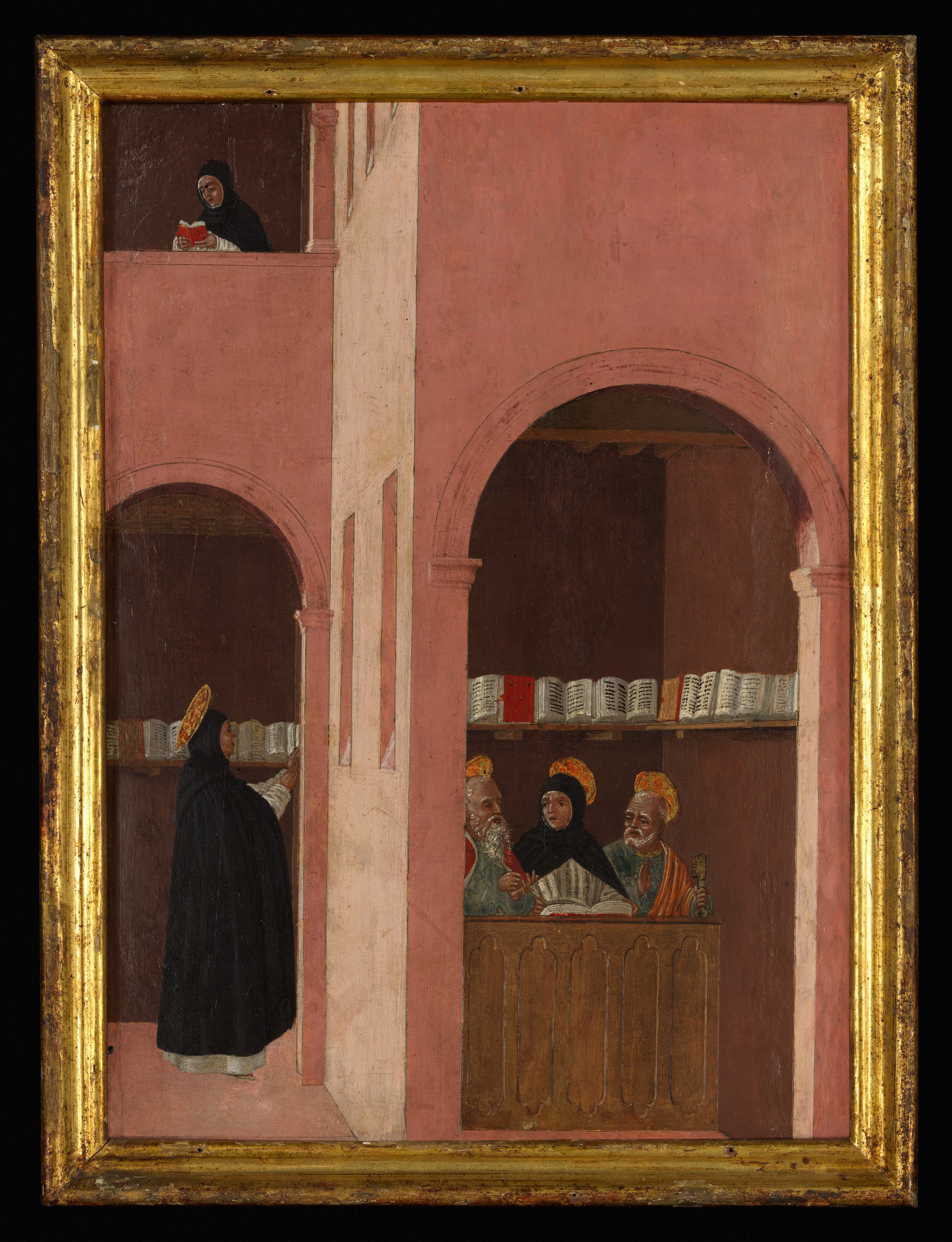
Thomas Aquinas
theologianMedieval (9th-15th C) · c. 1225-1274 CE · Updated April 8, 2026
Biography
Thomas Aquinas was a Dominican friar and theologian who lived in 13th-century Europe, primarily in Paris and Naples. He is renowned as one of the most systematic theologians in Christian history. Aquinas is best known for his efforts to harmonize faith and reason, particularly through his integration of Aristotelian philosophy with Christian doctrine. His work laid the foundation for much of Western thought, influencing theology, philosophy, and ethics.
Born around 1225 in Roccasecca, Italy, into a noble family, Thomas Aquinas chose an intellectual path that defied his family's expectations. He studied at the University of Naples, where he encountered the works of Aristotle, and later joined the Dominican Order despite his family's resistance. Aquinas's teaching career took him to the University of Paris and back to Naples, where he developed his theological synthesis. His major works, "Summa Theologica" and "Summa Contra Gentiles," continue to be foundational texts in Christian theology. However, not all his ideas were accepted without controversy. In 1277, some of his teachings faced condemnation by the Bishop of Paris for their Aristotelian influence.
Aquinas lived during a time when the rediscovery of Aristotle's works was reshaping European intellectual life. This led to intense debates about the relationship between faith and reason. Scholars like Aquinas attempted to reconcile Christian doctrine with Aristotelian philosophy, sparking theological controversies. The period also saw tensions between religious orders such as the Dominicans and Franciscans and between traditional Augustinian theology and emerging scholastic approaches. Despite the controversies, Aquinas's influence endured, and he was canonized in 1323, later being declared a Doctor of the Church.
Can the existence and nature of God be known by unaided human reason — and if so, what remains for faith to add that reason cannot supply?
The ideas
Thomas Aquinas dedicated his life to reconciling the perceived conflict between faith and reason, a pressing issue in the 13th century. He sought to demonstrate that these two ways of knowing were not at odds but rather complementary. At a time when Aristotle's works were being rediscovered and causing tension between traditional Christian teachings and new philosophical ideas, Aquinas aimed to integrate them into a unified framework. His central question was how human beings, with their capacity for reason, could understand divine truths that seemed beyond human comprehension.
Among Aquinas's most important ideas was the notion that faith and reason, though distinct, work in harmony to reveal truth. By synthesizing Aristotelian philosophy with Christian doctrine, he argued that reason could lead one to many religious truths, though some mysteries of faith remained accessible only through divine revelation. Another significant concept was his theory of natural law, which posited that moral principles are inherent in human nature and can be discerned through reason. This idea built upon Aristotle and laid the foundation for later developments in moral and legal philosophy. Additionally, Aquinas tackled the theological debates about the Eucharist, using Aristotelian metaphysics to clarify the Church's understanding of transubstantiation, where the bread and wine of the sacrament become the body and blood of Christ in substance, though not in appearance.
Aquinas also made significant contributions to metaphysics with his distinction between essence and existence. He explained that in everything except God, what something is (its essence) and that it is (its existence) are different. This distinction helped clarify why contingent beings rely on something else for their existence, unlike God, who exists necessarily. His work in this area drew on Islamic and Jewish philosophers, such as Avicenna and Maimonides, and enriched medieval metaphysical discussions.
The Five Ways stand as Aquinas's signature argument, offering five logical proofs for God's existence. These include the arguments of the Unmoved Mover and the First Cause, which contend that there must be an initial source of motion and causation that itself is uncaused. By using observation and reason, Aquinas provided a rational basis for belief in God that appealed to both believers and skeptics. The compelling nature of these arguments lay in their ability to bridge the gap between empirical inquiry and theological belief, making them a cornerstone of not just Aquinas's work but of Western theological thought.
What changed
Before Thomas Aquinas, Christian thought was dominated by the teachings of Augustine, who placed faith above reason, often casting them as opposing forces. The integration of reason into faith-based discussions was limited and viewed with suspicion. This atmosphere left many theological questions unresolved, especially those concerning the relationship between God and creation. Aristotelian philosophy, with its emphasis on reason and empirical observation, was largely unincorporated into Christian theology. Debates about the nature of the Eucharist and the existence of God lacked a systematic philosophical foundation, creating a fragmented theological landscape.
Thomas Aquinas revolutionized Christian theology by integrating Aristotelian philosophy with Christian doctrine. He demonstrated that faith and reason could complement each other rather than exist in conflict. By synthesizing these ideas, Aquinas developed the Five Ways, a set of arguments providing a rational basis for God's existence, accessible through natural reason. His work on the analogy of being offered a sophisticated understanding of how God relates to creation, moving beyond simplistic explanations. Aquinas also clarified the doctrine of transubstantiation, using Aristotelian concepts of substance and accidents to articulate a philosophical explanation for the Eucharist. These contributions forced the church to reconsider previous assumptions and adopt a more integrated approach to theology.
The impact of Aquinas's work extended far beyond his lifetime, laying the groundwork for later Scholasticism and influencing theologians like Duns Scotus and William of Ockham. His ideas gave rise to Thomism, a dominant school of thought within Catholic theology. The Council of Trent relied heavily on Aquinas's teachings to articulate Catholic doctrine during the Reformation. Today, his influence persists in modern Catholic teaching and philosophy. A testament to his enduring legacy, Aquinas's writings remain central to the curriculum in many Catholic seminaries worldwide.
Disputed legacy
Thomas Aquinas's integration of Aristotelian philosophy into Christian theology sparked significant controversy. His use of Aristotle was perceived as a threat to traditional Christian doctrines by figures such as the Bishop of Paris, who condemned his works in 1277. Critics, including the Augustinians and Franciscans, believed that Aquinas's Aristotelianism undermined the transcendence of God and the primacy of divine revelation. His concept of natural law was also contentious. Reformers like Martin Luther and John Calvin criticized it for relying too heavily on human reason, which they argued was tainted by sin. Furthermore, Aquinas's explanation of the Eucharist as transubstantiation was seen by Protestant reformers as overly philosophical, complicating the straightforward biblical narrative of the Lord's Supper. His synthesis of faith and reason faced criticism for potentially diluting the mystery and uniqueness of faith, with modern philosophers and theologians expressing concern that it reduced faith to an extension of rational thought.
The condemnation of Aquinas's works in 1277 by the Bishop of Paris stands as the darkest chapter in his legacy. This event was a profound challenge to his orthodoxy, as it included accusations of heresy. The condemnation highlighted the tension between Aquinas's philosophical approach and traditional Christian teachings. It cast doubt on his contributions and forced a reevaluation of his ideas. This condemnation had lasting repercussions, as it limited the acceptance and study of his works in certain theological circles for centuries.
In the 19th and 20th centuries, the Catholic Church rehabilitated Aquinas's reputation, particularly through Pope Leo XIII's encyclical "Aeterni Patris," which re-emphasized his importance in Christian theology. The Church argued that his synthesis of faith and reason was a profound contribution, countering previous criticisms. However, many modern theologians and philosophers still argue that his reliance on human reason and philosophical complexity detracts from core Christian teachings. The lasting impact of the 1277 condemnation shows that, despite his rehabilitation, the criticisms of Aquinas's work continue to provoke debate in theological circles today.
Legacy
Thomas Aquinas died in 1274, and just three years later, his teachings faced opposition when the Bishop of Paris condemned several of his propositions in 1277. Despite this setback, his works did not fade into obscurity. Instead, his writings continued to be studied, debated, and gradually accepted within academic and ecclesiastical circles. By 1323, Aquinas's intellectual contributions were recognized officially when he was canonized as a saint. This marked a significant turnaround from the earlier condemnation. In 1567, the Church further acknowledged his profound impact by declaring him a Doctor of the Church, a title given to saints recognized for their significant influence on theology.
Aquinas's teachings were preserved and disseminated largely through the efforts of the Dominican Order, to which he belonged. They were instrumental in promoting his synthesis of faith and reason, which became a cornerstone of Scholasticism. This philosophical and theological movement dominated medieval universities and shaped the intellectual landscape of the time. During the Counter-Reformation, the Catholic Church embraced Aquinas’s ideas to combat Protestant reformers. In 1879, Pope Leo XIII's encyclical 'Aeterni Patris' called for a revival of Thomistic philosophy, cementing Aquinas’s role in the foundation of Catholic education and doctrine.
Today, the legacy of Thomas Aquinas is evident in the Catholic Church's teachings, particularly those articulated during the Second Vatican Council in the 1960s. His exploration of natural law and ethics continues to influence discussions on morality, both within and outside religious contexts. Aquinas's work remains a staple in Catholic seminaries and universities worldwide, where students engage with his insights on human nature and divine law. His influence endures, shaping contemporary debates on moral and ethical issues.
Continue reading with a Scholar plan
Upgrade to ScholarCommon questions
- What is Thomas Aquinas most known for in Christian history?
- Thomas Aquinas is most known for his synthesis of Aristotelian philosophy with Christian theology, creating a comprehensive system that addressed both faith and reason. His work laid the foundation for much of Western Christian thought, particularly through his monumental work, the Summa Theologica.
- What were Thomas Aquinas's most important works?
- Thomas Aquinas's most important works include the Summa Theologica, an extensive theological compendium, and the Summa Contra Gentiles, a work aimed at defending the Christian faith against non-believers. He also wrote numerous commentaries on Aristotle and the Sentences of Peter Lombard, as well as various Disputed Questions.
- What were Thomas Aquinas's most influential theological ideas?
- Aquinas's most influential ideas include the Five Ways, which are arguments for the existence of God, and the concept of natural law, which posits that moral principles are inherent in human nature. He also developed the doctrine of transubstantiation, explaining the change of bread and wine into the body and blood of Christ during the Eucharist.
- What controversies did Thomas Aquinas engage in — and what was at stake?
- Aquinas engaged in controversies over the integration of Aristotelian philosophy into Christian theology, which some viewed as a threat to traditional Christian teachings. The stakes involved the acceptance of reason and empirical observation as valid tools for understanding divine truths, which was contentious in a period dominated by Platonic thought.
- How did Thomas Aquinas influence later Christianity — Catholic, Protestant, and beyond?
- Aquinas's work became foundational for Catholic theology, particularly after his canonization and the endorsement of his teachings by the Church. His emphasis on reason influenced Protestant reformers like Martin Luther and John Calvin, who engaged with his ideas even as they critiqued them. His thought also impacted secular philosophy, contributing to the development of Western intellectual traditions.
- What did Thomas Aquinas get wrong, or what ideas have been seriously disputed?
- Some of Aquinas's ideas, such as his views on women and certain aspects of his natural law theory, have been criticized or rejected in modern times. His reliance on Aristotelian science, which has since been superseded, also limits the applicability of some of his arguments.
- Is Thomas Aquinas considered a saint? By which traditions?
- Thomas Aquinas is considered a saint in the Roman Catholic Church, having been canonized by Pope John XXII in 1323. He is also recognized as a Doctor of the Church, a title given to saints who have made significant contributions to theology or doctrine.
- Why does Thomas Aquinas still matter today?
- Thomas Aquinas remains relevant today for his rigorous approach to theology and philosophy, which continues to influence Christian thought and education. His integration of faith and reason provides a framework for addressing contemporary issues in ethics, science, and religion.
- What is the most surprising or counterintuitive thing about Thomas Aquinas?
- One surprising aspect of Aquinas is his ability to harmonize seemingly opposing ideas, such as faith and reason, or divine revelation and empirical observation. This approach was counterintuitive in his time, as it challenged the prevailing view that faith and reason were incompatible.
- What is the best place to start reading Thomas Aquinas?
- The best place to start reading Thomas Aquinas is with the Summa Theologica, particularly the first part, which addresses the existence and nature of God. For those new to his work, secondary sources or abridged versions can provide helpful context and explanation.