Library
Library
Medieval (9th-15th C) · c. 1287-1347 CE · Updated April 8, 2026
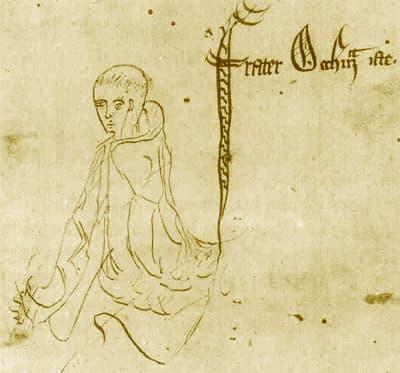
William of Ockham was a Franciscan friar and philosopher-theologian active in Oxford and Munich during the late 13th and early 14th centuries, known for founding Nominalism. He challenged the dominant philosophical and theological ideas of his time, particularly those surrounding the nature of universals. His ideas left a lasting impact on the development of medieval thought and the eventual transition toward more modern philosophical approaches.
William was born around 1287 in Ockham, Surrey, England. He studied and taught at the University of Oxford, where he earned the nickname "the Venerable Inceptor" due to his reputation as a pioneering thinker. Among his major works are "Summa of Logic," "Quodlibetal Questions," and "Dialogue," which reflect his keen interest in logic and philosophy. His career took a contentious turn when he defended the Franciscan view of poverty, leading to his excommunication by Pope John XXII. William relocated to Munich, where he continued his intellectual pursuits until his death in 1347.
William's era was marked by significant theological and political tensions within the Catholic Church. The rise of scholasticism and the questioning of established doctrines created a backdrop for his Nominalist ideas, which disputed the prevailing Realist views that universals had an independent existence. This period also saw intense conflicts between the papacy and secular authorities, which were epitomized by his disputes with Pope John XXII. These controversies opened debates about the limits of papal power and church authority, providing fertile ground for William's challenging ideas. Despite the controversies, William of Ockham's thoughts on universals and church authority persisted, influencing future generations.
If universal concepts (like 'human nature' or 'justice') are just names we give to similar individuals, what does that mean for natural law, the sacraments, and theological argument?
William of Ockham tackled a fundamental question that perplexed many thinkers of his time: the nature of universals. He questioned whether concepts like "goodness" or "humanity" existed independently of the individual objects and people that exhibit these qualities. For Ockham, this was not just an abstract philosophical puzzle but a challenge to the prevailing understanding of how reality is structured. He sought to simplify the complex and often speculative nature of Scholastic philosophy by questioning its foundational assumptions about the existence of universal entities.
Ockham's most influential idea was Nominalism. He argued that universals are not real entities but merely names we assign to categories of similar things. This was a direct response to the Realist position, which maintained that universals had an independent existence. Ockham found this unnecessary and overly complex, leading him to develop what is now known as Ockham's Razor: the principle that the simplest explanation is preferable. He was also critical of attempts to rationalize theology, asserting that reason and faith occupy separate realms and that theological truths cannot be fully grasped by human logic alone.
Beyond these philosophical contributions, Ockham also had significant theological and political ideas. He emphasized the absolute freedom and will of God, arguing that God's actions are not confined by human notions of logic or morality. This view, known as voluntarism, challenged the deterministic tendencies of Scholastic thought. Politically, Ockham advocated for conciliarism, the belief that church councils could overrule the pope, especially during the Western Schism when papal authority was in question. His works, such as "Summa Logicae" and "Dialogus," reflect these ideas and were written amidst his conflicts with Pope John XXII and his defense of Franciscan ideals of poverty.
Ockham's signature argument — the idea that universals are merely mental constructs — was groundbreaking. This assertion undermined the Realist stance that had dominated medieval thought and shifted the philosophical focus toward a more empirical approach. By insisting that universals are just names, Ockham laid the groundwork for a less metaphysical and more practical engagement with the world. This change in perspective not only influenced later medieval thinkers but also set the stage for the intellectual shifts that accompanied the Reformation and the rise of modern science.
Before William of Ockham, Scholasticism dominated Christian thought, blending Aristotelian philosophy with Christian theology to create a cohesive intellectual framework. Scholars engaged in complex debates that often revolved around the nature of universal concepts, which they believed existed independently of the human mind. This view, known as Realism, held that abstract entities like "goodness" or "beauty" were real and could be studied much like physical objects. Theologians and philosophers used intricate arguments to reconcile faith with reason, treating them as intertwined paths to understanding divine truths. The Pope wielded significant authority, seen as the ultimate arbiter in both spiritual and temporal matters.
William of Ockham challenged these foundational assumptions, reshaping medieval thought. He introduced Nominalism, arguing that universal concepts are merely names or mental constructs without any reality outside the mind. This shift undermined the prevailing Realism and laid the groundwork for skeptical approaches to philosophy. Ockham also articulated what became known as Ockham's Razor, a principle advocating for the simplest explanations, which discouraged the multiplication of unnecessary entities in arguments. This approach forced theologians and philosophers to reconsider their methods. Furthermore, Ockham asserted that faith and reason should remain separate, suggesting that theological truths depend on faith alone and cannot be proven through philosophical means. He also contested the Pope's supreme authority, advocating for the power of church councils and limiting papal influence.
The ripple effects of Ockham's ideas were profound. His Nominalism paved the way for later philosophical movements like empiricism and skepticism, influencing thinkers such as David Hume and John Locke. Ockham's challenge to papal authority foreshadowed the Protestant Reformation, which emphasized individual faith and questioned centralized church power. This laid the groundwork for conciliarism, a movement advocating for the authority of church councils over the Pope. The separation of faith and reason anticipated the Enlightenment's emphasis on reason and contributed to the rise of modern secularism. Without Ockham, the intellectual landscape of the West might have remained more closely tethered to medieval scholastic traditions, hindering the development of modern philosophical and theological thought.
William of Ockham's ideas have sparked considerable debate and criticism over the centuries, particularly in four key areas. His embrace of nominalism, which denies the objective existence of universals, has been accused of undermining the reality of abstract concepts like justice or human nature. This stance drew sharp objections from realists like Thomas Aquinas, who believed in the objective reality of such universals. Critics argue that nominalism contributed to a breakdown in the synthesis of faith and reason, paving the way for modern skepticism. Ockham's Razor, a principle advocating for simplicity, can be misapplied to oversimplify complex theological and philosophical issues, leading to reductionism. His radical separation of reason and faith challenged the integration of philosophical reasoning with theological doctrine, a move that later contributed to significant divisions during the Reformation. Furthermore, his political theology, which supported conciliarism and challenged papal authority, threatened the centralized power of the Church, destabilizing traditional structures and sparking conflicts.
Ockham's confrontation with Pope John XXII marked the darkest chapter of his life. Defending the Franciscan ideal of poverty, Ockham fiercely opposed the Pope's stance, leading to his excommunication. This conflict with ecclesiastical authority highlighted the tension between his theological positions and established Church doctrine. The consequences were severe, not only personally for Ockham, who lived the rest of his life in exile, but also for the Church, as it exemplified the broader struggle between emerging theological ideas and the established ecclesiastical hierarchy. This confrontation is often seen as a pivotal moment in the decline of papal influence and the rise of alternative theological perspectives.
Despite these criticisms, some modern scholars argue that Ockham's ideas laid important groundwork for scientific inquiry. His emphasis on individual experience and empirical observation is seen by some as a precursor to the scientific method, suggesting that his nominalism and separation of reason and faith might have contributed positively to modern thought. However, many criticisms still stand, particularly regarding his challenge to the traditional synthesis of faith and reason. Ockham's Razor continues to be a valuable yet potentially misleading tool in philosophical discussions. While Ockham's contributions to thought are acknowledged, the verdict on his ideas remains mixed. His excommunication, a concrete fact, underscores the lasting impact of his contentious relationship with the Church.
After his excommunication, William of Ockham sought refuge in Munich under the protection of Emperor Louis IV. There, he continued to write and develop his ideas until his death in 1347. Despite his prolific output and the influence of his work, Ockham was never formally rehabilitated by the Church. His controversial stance on the separation of church and state and his ideas on poverty and ecclesiastical authority kept him at odds with the religious establishment. Ockham's life in Munich was marked by ongoing intellectual activity, and he maintained a correspondence with other thinkers of his time, further spreading his ideas despite his exile.
Ockham's teachings on Nominalism, the idea that universals are not real entities but merely names we use, influenced later medieval thinkers significantly. This philosophical perspective laid the groundwork for the via moderna, a movement that questioned traditional scholasticism and emphasized individual experience and empirical evidence. Ockham's ideas also resonated with reformers who sought to challenge church doctrine, impacting figures like Martin Luther during the Protestant Reformation. His emphasis on the limitations of human reason in matters of faith encouraged a critical approach to theology that reverberated across Europe, particularly in academic circles in England and the universities of Paris and Oxford.
Today, William of Ockham's legacy endures most famously through the principle known as Ockham's razor. This methodological tool advocates for simplicity, asserting that the simplest explanation is often the correct one. Ockham's razor remains a foundational concept in scientific inquiry and philosophical reasoning, promoting clarity and parsimony in theory development. His ideas on the separation of reason and faith continue to influence contemporary philosophical and theological debates, particularly in discussions surrounding the philosophy of religion and secular humanism. Ockham's insistence on distinguishing between what can be known through logic and what must be accepted on faith persists as a critical perspective in modern discourse.
Continue reading with a Scholar plan
Upgrade to Scholar