Library
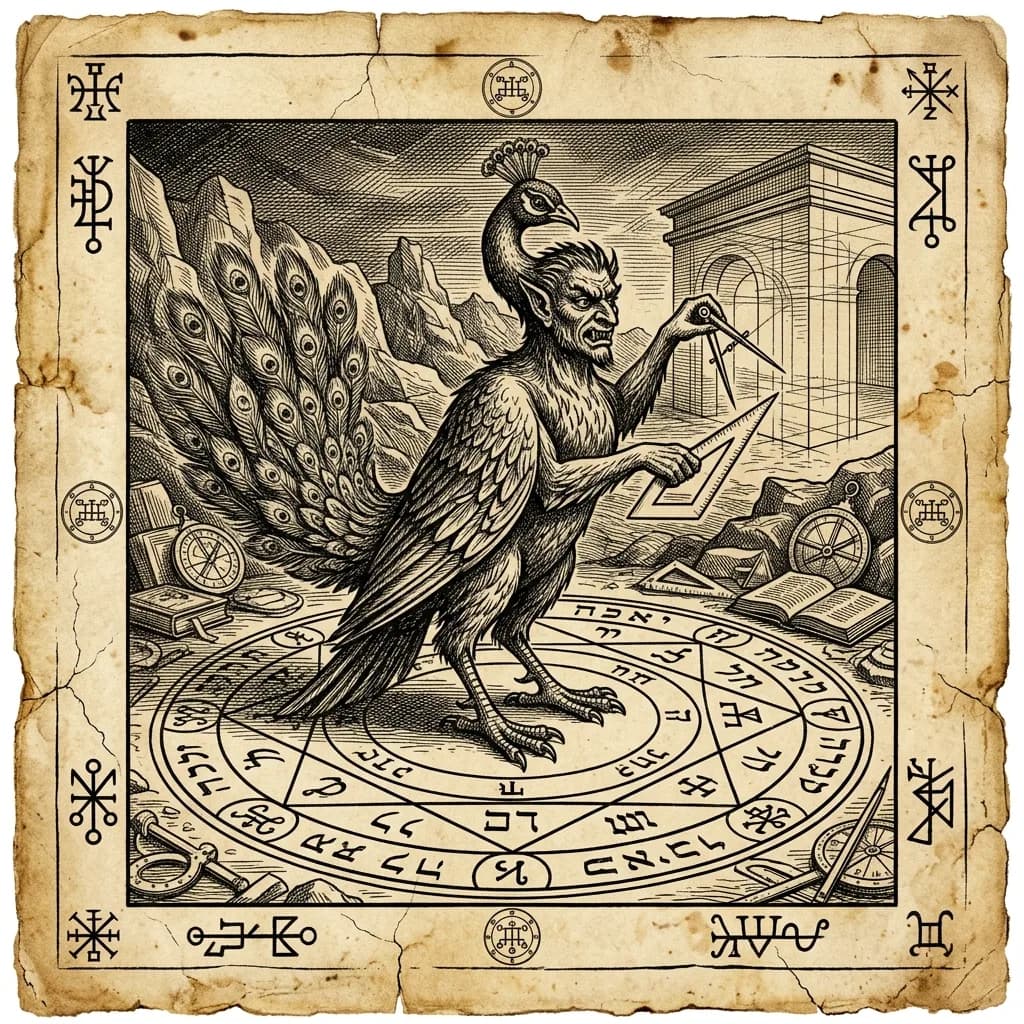
Andrealphus
MarquisSpirit #65 of the Ars Goetia · 30 legions
Description
Andrealphus holds the rank of Marquis and commands thirty legions of spirits. He appears first as a peacock crying out with a great noise. Upon command he takes human form. He teaches geometry perfectly, with all its parts. He makes men cunning in astronomy. He can transform men into the likeness of a bird - this transformation includes himself.
Symbolic interpretation
To teach geometry perfectly, with all its parts, is to transmit not a subject but a mode of cognition. Geometry is the discipline of exact spatial relationship - the study of how points, lines, planes, and solids stand in fixed proportion to one another. To teach it perfectly means to install in the student a capacity for rigorous positional thinking: the ability to perceive how any element occupies space relative to every other element, without distortion or approximation. The operative mechanism is precision itself - not as a style of mind but as a structural tool for mapping the world. What the student gains is the ability to see form as relationship, to read any configuration of matter as a set of ratios and angles that can be calculated, verified, and reproduced. This produces in the person a kind of spatial sovereignty: they are no longer subject to the vagueness of perception but can impose measurement on what they encounter. That capacity is foundational to architecture, navigation, land division, and any domain where the stakes of being wrong about space are absolute.
To make men cunning in astronomy is to grant access to a different order of pattern - not the small geometry of terrestrial surfaces but the vast geometry of celestial motion. Cunning here is the operative word: this is not passive knowledge but operative skill, the ability to read the sky as a functional system and extract from it what is needed. Astronomy at its root is the discipline of tracking bodies that move in cycles too large and slow for any single life to verify experimentally - it demands the integration of inherited observation with present calculation. What Andrealphus installs is the capacity to work within that inherited structure, to use the accumulated data of celestial position as a live instrument for orientation in time and space. The person who becomes cunning in astronomy acquires a navigational intelligence that operates across enormous scale - they can locate themselves not just in a field or a city but within the year, the era, the cycle. That scale-shift in self-location is cognitively transformative.
The power to transform men into the likeness of a bird - and to undergo that transformation himself - is the capacity to shift the positional frame entirely. A bird does not merely travel between points; it moves in three dimensions through a medium that ground-bound creatures cannot enter. Transformation into bird-form reorganizes the subject's relationship to space itself: elevation becomes accessible, distance is recalibrated, the grid of the earth becomes visible as pattern rather than obstacle. That Andrealphus shares in this transformation is structurally significant - the power is not something held over others but a common state the spirit can enter alongside them. This symmetry means the transformation is not domination but passage into a shared perceptual mode, a renegotiation of scale and vantage that the spirit participates in rather than merely administers.
The initial appearance as a peacock crying out with a great noise reads as a precise functional signal. The peacock's defining visual attribute is its display - a radial geometry of eyes and iridescent arcs, the body reorganized into a pattern of overwhelming, symmetrical complexity. Before Andrealphus takes human form and teaches, he demonstrates: he presents a living geometrical structure, a system of radiating proportion that is immediately visible to anyone who looks. The great noise compounds this - it is a sensory claim on attention, a demand to be perceived before instruction begins. The peacock form is not ornamental vanity but an announcement of method: this spirit works through the organization of visual and spatial information into patterns that compel attention. The transition to human form upon command signals that the full display is a threshold state, not a permanent condition - once the relationship is established, the complexity resolves into workable human scale.
Archetype
Andrealphus derives as Pisces - Mutable Water - and the case rests on where those two mechanisms actually appear in the operation. The Water element follows from Diffuse expression meeting Collective orientation: there is no singular, nameable confrontation in what Andrealphus does. A student does not receive a discrete intervention - they are gradually reorganized into a different cognitive mode. The teaching of geometry "perfectly, with all its parts" is total permeation of a perceptual framework; the cunning in astronomy installs not a fact but a structural relationship to inherited, accumulated pattern. Both are mechanisms that saturate the subject rather than strike them. And they operate on whoever occupies the student position - there is no targeting of a specific bond or person; the force runs on the collective of those who enter the instructional relationship. That is Water by derivation: ambient, accumulative, no front door. The Mutable posture is visible in what the force actually does with information: it does not initiate a new state by rupture, nor does it hold a fixed position against change. It reads and transmits - it bridges the student from one perceptual register to another, from ground-level spatial vagueness to geometric sovereignty, from local scale to astronomical scale, from terrestrial orientation to aerial vantage. The bird transformation is the clearest case: it does not create a new world or defend an existing one; it renegotiates the frame entirely, moving the subject fluidly through registers of scale and vantage. Mutable does not hold territory - it passes through and reorganizes the traveler. Pisces, as Mutable Water, names the operator whose mechanism is diffuse saturation of a collective through fluid permeation of cognitive frames, which is precisely the structural form of Andrealphus's transmission.