Library
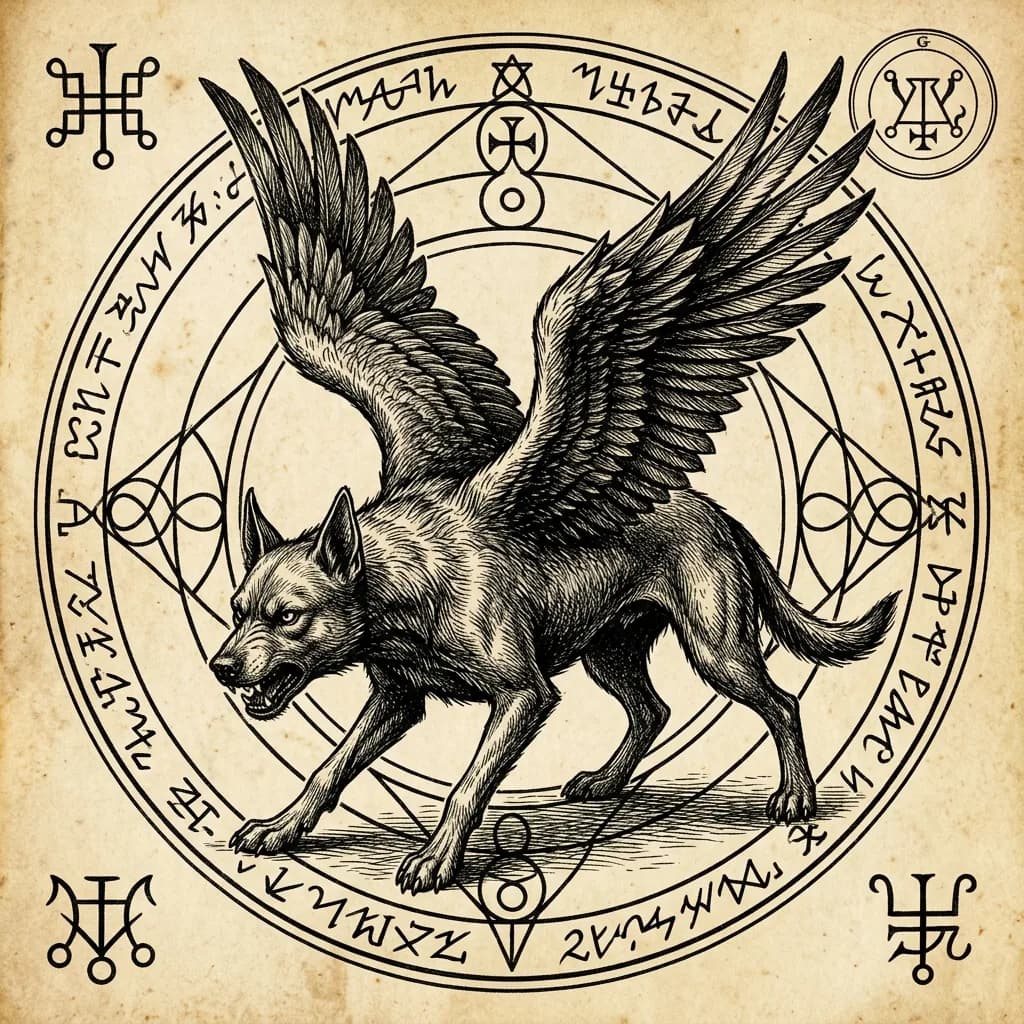
Glasya-Labolas
PresidentSpirit #25 of the Ars Goetia · 36 legions
Description
Glasya-Labolas holds the dual rank of Great President and Earl. He commands thirty-six legions of spirits. He appears as a dog with the wings of a gryphon - low to the ground, mobile, built for speed, capable of flight when it serves him. He teaches all arts and sciences instantly. He is the author of bloodshed and manslaughter. He makes men loved or hated by all. That last power is the operative one - not loved, not hated, loved or hated. The distinction is immaterial. The charge is the product.
Symbolic interpretation
The power to teach all arts and sciences instantly is not a pedagogical function - it is a compression of process. Normal acquisition of knowledge requires time, repetition, error, and correction. The operative mechanism here bypasses all of that: the structure of a discipline enters the mind fully formed, without the friction that ordinarily shapes a practitioner's relationship to their own limits. What this produces in the recipient is a person who possesses capability without the earned humility that builds around gradual mastery. They know how to do the thing, but they have no scar tissue from not knowing. The consequence is a competence that arrives unmoored - powerful, accurate, and without the internal governor that struggle installs.
To be the author of bloodshed and manslaughter is to be the originating force behind violent death - not the instrument, but the cause that precedes and enables the act. An author writes the conditions; the characters do what the conditions demand. The operative mechanism is the arrangement of circumstances such that killing becomes the logical outcome - grievance loaded to a point of discharge, proximity established, restraint dissolved. What this produces is violence that feels, from inside the event, inevitable. The participants experience themselves as responding rather than choosing. That feeling of inevitability is precisely what authorship manufactures. The act arrives as conclusion, not decision.
The power to make men loved or hated by all is a charge applied to social perception - a force that polarizes the way a target is received by everyone around them. The mechanism is not persuasion or reputation management but something more total: the wholesale orientation of collective affect toward a single person, in whichever direction serves. What the target experiences is the withdrawal of ambivalence. People who encounter them do not weigh or qualify - they feel strongly, immediately, and without independent cause. To be loved by all locks a person inside unanimous warmth they did not earn and cannot verify. To be hated by all seals them in a consensus of rejection with no visible origin. Both conditions isolate. The charge removes the middle ground in which ordinary social life is conducted, and leaves only intensity.
The appearance of a dog with the wings of a gryphon describes a mechanism built from two distinct operational modes fused into One Body. The dog is a ground-level creature - oriented by scent, tracking through contact and proximity, loyal to hierarchy, built to follow a trail to its end. The gryphon's wings are not ornamental: they represent the capacity to exit the terrain entirely and operate from elevation, seeing the full pattern of what the dog nose-follows. Glasya-Labolas does not choose between these modes - he carries both simultaneously. He works close to the earth, through human relationships and the lived social surface, but he can lift above it and read the whole field. This describes a spirit that operates through the intimate and the immediate while maintaining the strategic overview that makes intimate operations decisive. The combination is not contradiction; it is the specific advantage of an intelligence that knows when to track and when to fly.
Archetype
Glasya-Labolas derives as Capricorn - Cardinal Earth - and the case for this rests on where each axis is actually visible in the mechanism of his operation. The Earth element emerges from the combination of Diffuse expression and Individual orientation: his powers do not announce themselves as interventions. There is no declared moment when the target becomes loved or hated by all - the condition simply obtains, already saturated into the social environment before anyone notices its origin. Likewise, the instant transmission of all arts and sciences does not arrive as a discrete event with a traceable cause; it enters the recipient as if it had always been there, bypassing the visible process that would make it legible as an external act. This is Diffuse operation at work - not loud, not frontal, but ambient and already inside the structure before it can be identified. The Individual orientation is equally specific: each instance of the love-hate charge is targeted to a particular person, polarizing how that one target is received; thousands of such operations may run simultaneously, but each is a separate, precisely aimed mechanism. The Cardinal modality names the posture: Glasya-Labolas does not maintain states, he breaks them open and installs new ones. The target's social position was one thing; now it is irreversibly another. The competence of the arts-and-sciences recipient was absent; now it is present, fully structured, with no transitional state in between. These are founding acts - conditions brought into existence that did not previously exist - which places the operative posture squarely in Cardinal. The resulting sign is Capricorn, which names the operator that initiates new material conditions through ambient, individual-targeted saturation rather than through visible confrontation. The specific mechanical claim follows directly: Glasya-Labolas's authorship of bloodshed is Cardinal Earth in its clearest form - the arrangement of circumstances into a new ground-state from which violence becomes the logical outcome, installed so thoroughly into the terrain that participants experience it as inevitability rather than as an intervention they could have identified and contested.