Library
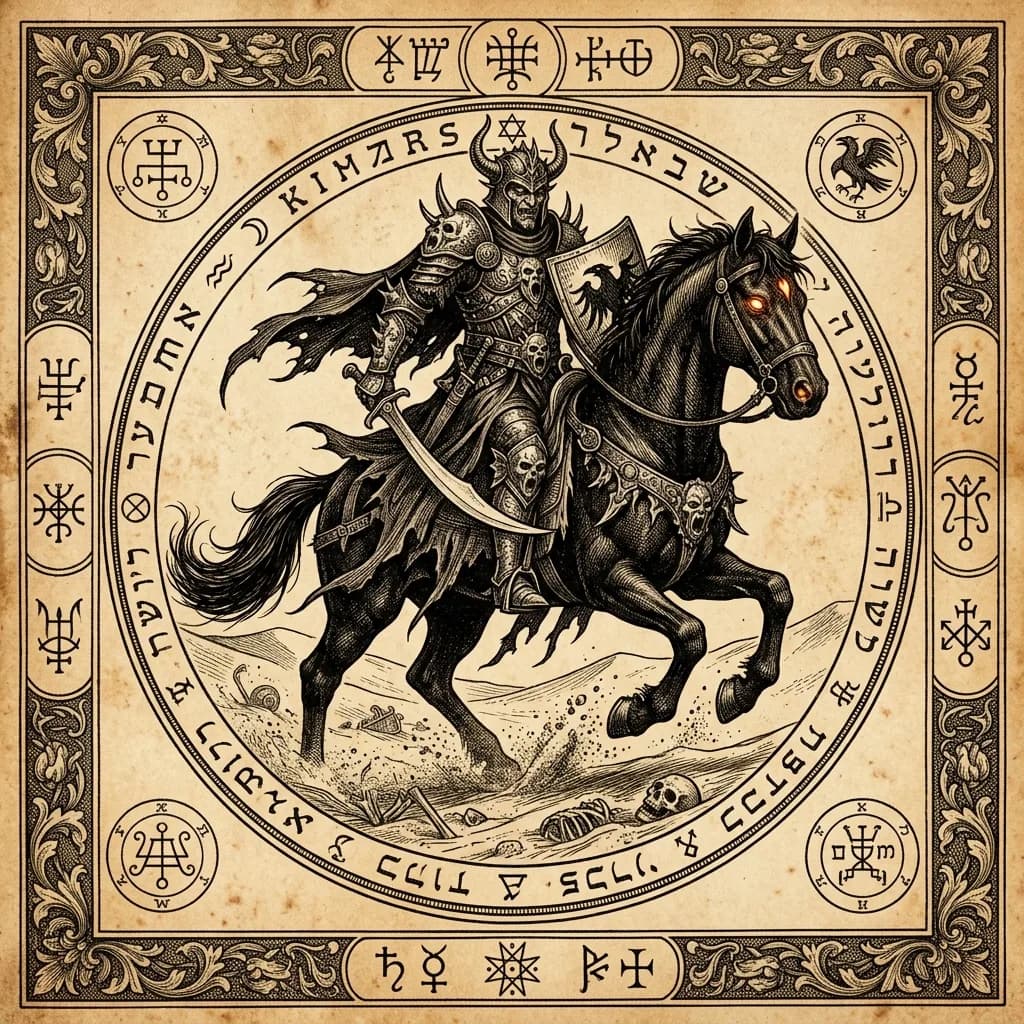
Kimaris
MarquisSpirit #66 of the Ars Goetia · 20 legions
Description
Kimaris holds the rank of Marquis and commands twenty legions of spirits. He appears as a valiant warrior riding a black horse. He teaches grammar, rhetoric, and logic perfectly. He can find lost and hidden things in sandy places.
Symbolic interpretation
The capacity to teach grammar, rhetoric, and logic perfectly is not merely instructional competence - it is the transmission of the three foundational arts of the classical trivium, the entire structural apparatus through which the human mind organizes, argues, and persuades. Grammar is the architecture of meaning: the rules that determine how signs cohere into statements. Rhetoric is the engineering of persuasion: how assembled meaning moves an audience toward action or belief. Logic is the calculus of consequence: how conclusions follow necessarily from premises. To teach all three perfectly is to hand a person complete sovereignty over language as a system. What this produces in the recipient is not merely literacy or eloquence but structural mastery - the ability to construct arguments that cannot be easily refused, to organize thought so precisely that ambiguity collapses, and to move others through language as through machinery. The person who has internalized these three arts does not simply communicate; they command the field of discourse entirely.
The power to find lost and hidden things in sandy places operates as a precision locating function applied to a specific and meaningful terrain. Sand is the medium of dispersal - it covers, shifts, and obscures without the permanence of burial in earth or the deliberate concealment of locked chambers. Things lost in sand are lost through entropy and time rather than intention: they sink, they drift, they become indistinguishable from the substrate. To locate the hidden in this environment is to perceive signal within noise, to distinguish object from undifferentiated matter at granular scale. What this produces is the recovery of what was believed irrecoverable - not the dramatic retrieval of locked treasure but the patient reconstruction of what erosion and scatter had effectively erased. The practical consequence is a restoration of continuity: what was functionally gone returns to legible existence, and the chain of possession or knowledge resumes as though the interruption had never occurred.
The appearance as a valiant warrior riding a black horse encodes a specific operational mode. The warrior signals disciplined, organized force - not chaos or destruction, but structured agency aimed at an objective. Valor in particular marks the capacity to act under resistance, to press forward where lesser force retreats. The black horse is not an aesthetic flourish: black in this symbolic register marks what absorbs rather than reflects, what moves through darkness as native territory rather than as obstacle. Together, the image describes a spirit that deploys its capacities as directed campaigns - the transmission of the trivium is not casual teaching but systematic conquest of the student's cognitive terrain, and the recovery of hidden objects is not passive sensing but active pursuit across difficult ground. This is a spirit that moves with purpose and does not stop when the path becomes obscure.
Archetype
Kimaris derives as Pisces - Mutable Water - and the case rests on showing where mutability and water each operate mechanically, not metaphorically. The Diffuse à — Collective combination produces Water: Kimaris's force has no single point of entry and runs on whoever occupies the relevant position in a discourse community rather than targeting any specific individual. The trivium is not delivered as a discrete intervention but absorbed as a restructuring of how a mind processes language - grammar, rhetoric, and logic work cumulatively and invisibly, each layer modifying the substrate on which the next operates, until mastery has accumulated without any single transferable moment that could be identified as the teaching. No student notices the field shifting; they simply find that they now think differently. That is the Water mechanism: force that operates through atmosphere and permeation rather than confrontation. The Mutable posture then operates perpendicular to this: Kimaris does not initiate a new cognitive order (Cardinal) or hold an established one in place (Fixed) - he reads terrain and moves through it. The perfect transmission of the trivium is precisely the act of a reader: Kimaris locates the precise gaps in a mind's structural capacity and flows through them, carrying grammar into where syntax was absent, rhetoric into where persuasion was clumsy, logic into where inference was loose. The same posture governs the recovery function - finding the lost in sandy places requires reading a granular, shifting, undifferentiated medium to locate signal, not imposing structure onto it or fixing it in place. The Mutable force does not stabilize the sand; it reads through the dispersion. The mechanical claim that results: Kimaris's power is maximally effective precisely where the recipient cannot identify what is being transmitted, because the Water medium ensures absorption precedes recognition, and the Mutable posture ensures Kimaris has already read and moved through the gap before resistance could form.