Library
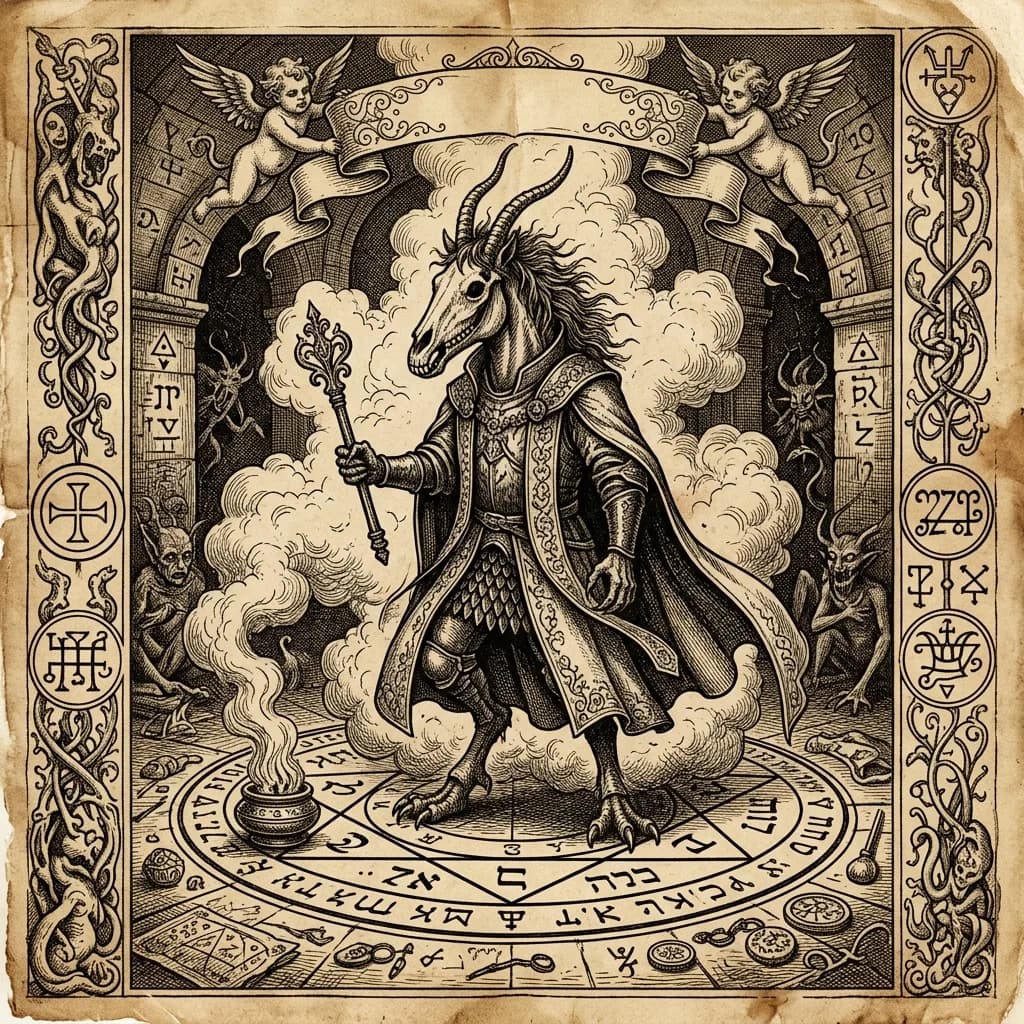
Orobas
PrinceSpirit #55 of the Ars Goetia · 20 legions
Description
Orobas is the 55th spirit, a great Prince. He appears first as a horse, then takes human form at request. He gives true answers. He gives dignities, prelacies, and the favor of friends and foes. He will not suffer any spirit to tempt the operator who invoked him. He is described as faithful. He governs 20 legions of spirits.
Symbolic interpretation
The capacity to give true answers is the structural capacity of reliable epistemic access - the ability to receive accurate information about past, present, and future without distortion, flattery, or misdirection. The operative mechanism is disclosure without agenda: Orobas does not frame truth to serve himself, which distinguishes him categorically from spirits who answer in technically accurate but functionally misleading terms. What this produces in the operator is orientation. A person with accurate information about their situation can calibrate action correctly; they are no longer navigating by false maps. This is consequential because most forms of social, political, and personal failure originate not in lack of effort but in miscalibrated understanding of what is actually true.
The power to give dignities, prelacies, and the favor of friends and foes is the capacity to alter social positioning - to raise a person's standing within institutional hierarchies and to shift the affective relationship that others hold toward them, regardless of prior alignment. The operative mechanism is double: institutional elevation (dignities, prelacies) and relational conversion (the favor of foes). These are not the same thing, and their conjunction is significant. Institutional advancement grants formal power; relational conversion grants informal power. Together they produce an individual who is elevated both in rank and in the felt goodwill of those around them. For a target, this means that opposition dissolves and hierarchy opens - two of the most durable forms of resistance to a person's goals are removed simultaneously.
The refusal to allow any spirit to tempt the operator is a capacity for spiritual jurisdiction - specifically, the authority to enforce a protected field around the person who has invoked Orobas. The operative mechanism is one of dominion over other entities: Orobas, as a Prince commanding 20 legions, has the rank and force to prohibit interference from subordinate or rival spirits. This is not merely a passive quality but an active enforcement of zone control. What this produces in the operator is security of attention - the ability to pursue their work, their questions, and their plans without the corruption or distraction introduced by competing spiritual pressures. The practical consequence is that the operator's capacity to reason and act remains uncontaminated for the duration of the relationship.
Faithfulness as a named attribute is not a personality trait but a structural commitment: a description of how Orobas relates to obligation over time. The operative mechanism is consistency between initial terms and ongoing behavior - Orobas does not defect from the relationship, does not turn against the operator, and does not introduce conditions that were not part of the original invocation. What this produces is trust that compounds. The person who invokes Orobas can build on prior exchanges without recalculating risk at each encounter. This is rare among spirits and marks Orobas as a figure defined by long-term relational stability rather than transactional unpredictability.
The initial form of a horse and the commanded form of a human being describe a specific sequence of revelation. A horse is pure capacity without negotiation - strength, speed, and will organized entirely around movement and function. It does not interpret; it executes. The human form, requested into existence by the operator, is the form of dialogue, reason, and exchange. This transformation is not cosmetic. It maps the operational logic of the relationship: Orobas arrives as raw, unharnessed power and becomes intelligible, responsive, and communicative only when the operator actively requests it. The mechanism encoded in the appearance is that access to Orobas's intelligence and counsel requires the invocant to take initiative. The power is present from the first moment, but its directed, articulate form waits to be summoned into expression.
Archetype
Orobas derives as Aquarius - Fixed Air - and the case rests on where each of those mechanical properties actually appears in his operation. The Air element follows from the combination of Direct expression and Collective orientation: Orobas's mechanisms are nameable and locatable (true answers, dignities, prelacies, the favor of friends and foes, the prohibition on spiritual interference - each is a specific, contestable act), yet they run on whoever occupies the relevant position within a hierarchy or relational field, not on a targeted personal bond. The operator receiving true answers, elevated standing, and cleared opposition is the current occupant of an invocant role, not a singular individual tracked by personal signature. That is the Air medium: structured, legible, positional. The Fixed modality appears in the holding functions: Orobas does not initiate a new state and then withdraw - he sustains the protected field around the operator, enforces ongoing jurisdiction against interfering spirits, and maintains the committed relational terms across repeated encounters. His faithfulness is not a virtue in the personality sense but a description of Fixed-mode operation: the state established at invocation is held, not renegotiated, not eroded by defection. The dignities and prelacies he grants are themselves fixed-register goods - formal institutional positions that persist structurally rather than requiring constant renewal. Where a Cardinal operator would break open access to a hierarchy and leave, Orobas holds the operator within elevated standing over time. The derived sign, Aquarius, names a mechanism that operates through legible, positional, system-level structure maintained by holding force - and the prohibition on spiritual temptation is the clearest instance: it is not an act that happens once but a zone that Orobas sustains by rank, enforcing a stable protected field as a continuous output rather than a discrete intervention.
In popular culture
Orobas appears in Demon: The Fallen, a tabletop role-playing game published by White Wolf Publishing, where he functions as a specific character within the game's mythology and narrative structure. He also appears as a named demon character in the anime series Welcome to Demon School! Iruma-kun, broadcast on NHK.