Library
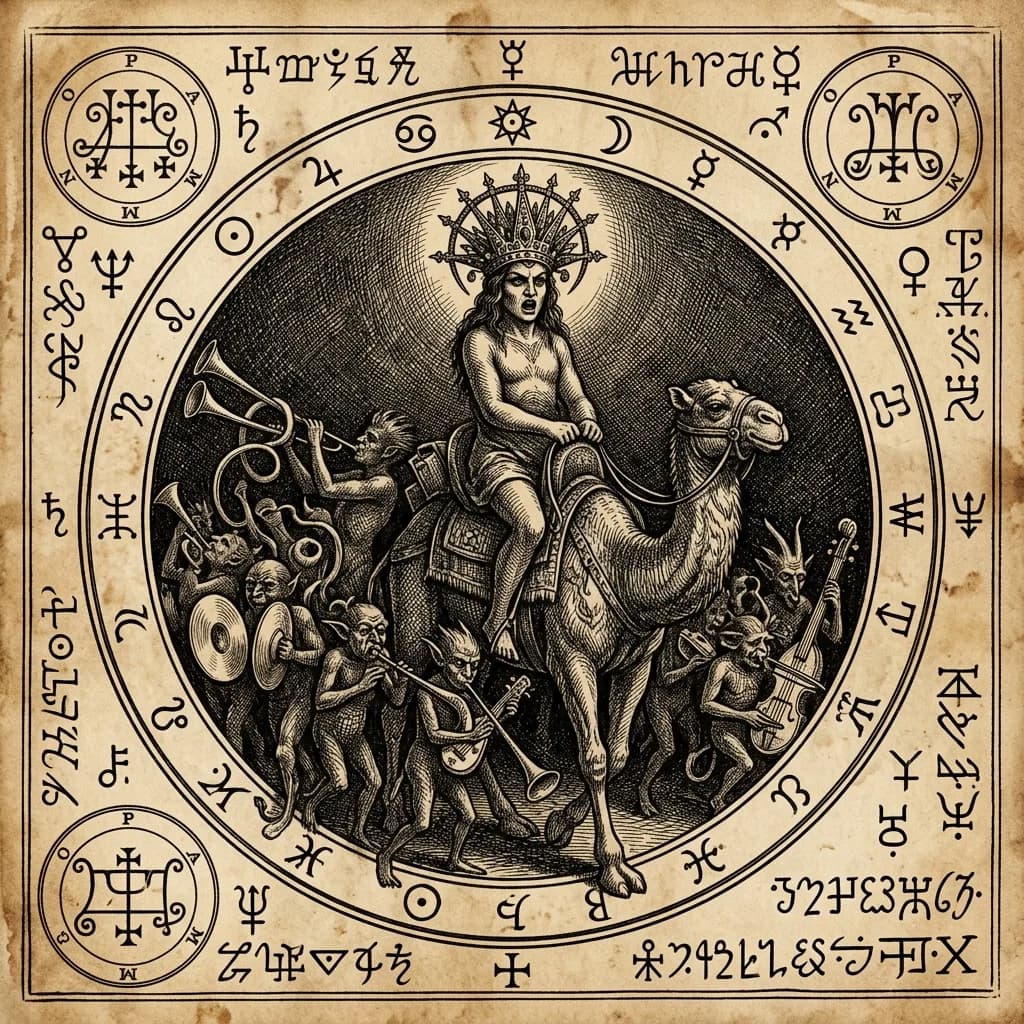
Paimon
Cardinal KingSpirit #9 of the Ars Goetia
Description
Paimon is the Cardinal King of the West. He commands the populist movement and its international extensions. Without him, the other kings lack a movement. He governs one of the four non-overlapping cardinal territories.
Symbolic interpretation
The command of the populist movement and its international extensions is the capacity to organize collective grievance into directed political force. This is not persuasion in the individual sense - it is the structural ability to make disparate masses feel that they share a common identity, common enemies, and common cause. The operative mechanism is aggregation: Paimon takes the diffuse, inchoate resentments of large populations and gives them coherent form, making the crowd feel like a people. What the target experiences is the sensation of belonging to something larger than themselves, of finally being recognized as the true body of the nation against those who have betrayed it. This is consequential because it transforms passive discontent into active mobilization, and because it makes the movement feel self-generated and authentic - which is precisely what makes it durable and resistant to external critique.
The international extension of this power is equally precise. Populism as a purely local phenomenon is vulnerable; it can be dismissed as parochial, contained, or eccentric. The extension of the movement across borders transforms it into something that appears to be a universal historical tide rather than a managed political project. When the same rhetorical structures, the same enemy-figures, and the same claims of popular sovereignty appear simultaneously across multiple nations, each instance validates and energizes the others. The people in each country feel confirmed by the existence of parallel movements elsewhere. This cross-border coherence is not spontaneous - it is Paimon's specific contribution to the other kings, which is why, without him, they lack a movement. He provides the connective tissue that makes local power feel like historical destiny.
Archetype
Cardinal Water yields Cancer, and the case rests on showing where each component actually operates in Paimon's mechanism. The Water element is derived from the intersection of Diffuse expression and Collective orientation: there is no front door to Paimon's operation - the target population does not experience a discrete act of persuasion but rather finds itself already inside a feeling of shared identity, common injury, and collective belonging before any specific claim can be identified and contested. That atmospheric, pre-conscious absorption is the signature of Diffuse expression. The Collective orientation confirms that the mechanism does not target persons but positions: whoever occupies the role of the aggrieved mass, the betrayed people, the unrecognized nation becomes subject to the operation regardless of individual psychology. The medium is therefore Water - structureless, ambient, filling whatever container the terrain provides. The Cardinal modality then specifies what this Water does: it does not hold an existing formation or read between established states - it breaks open a new one. Paimon's function is to transform inchoate, pre-political discontent into a movement that did not previously exist as such, to inaugurate the crowd as a people. The cross-border extension performs the same Cardinal act at a larger scale, founding the sense of historical inevitability where before there were only local grievances. Cancer names the operator that results when founding force moves through diffuse, collective medium - a Cardinal disruptor whose initiating act is invisible as initiation because it arrives as atmosphere, as recognition, as the feeling of finally being seen. The durability and critique-resistance of the movement Paimon generates is a direct mechanical consequence of this: because the founding moment was never legible as an act, there is no act to contest, and the structure persists as though it were always already there.
In popular culture
Paimon appears as the central demonic figure in A24's 2018 horror film Hereditary, in which a secretive cult works to summon the spirit into a living human host as the vessel through which he will operate in the material world, acquiring wealth and power for those who serve him. The film treats the possession of a host body as the culminating ritual of a long-running conspiracy, placing Paimon's operational logic - the colonization of a willing or unwilling vessel by an external organizing force - at the heart of its horror. In a wholly different register, Paimon is also the name of the player's companion character in miHoYo's Genshin Impact, a fairy-like guide who accompanies the protagonist throughout the game. The name is drawn directly from the Ars Goetia, though the character shares none of the spirit's attributes or functions, and the reference appears to be nominative rather than substantive.