Library
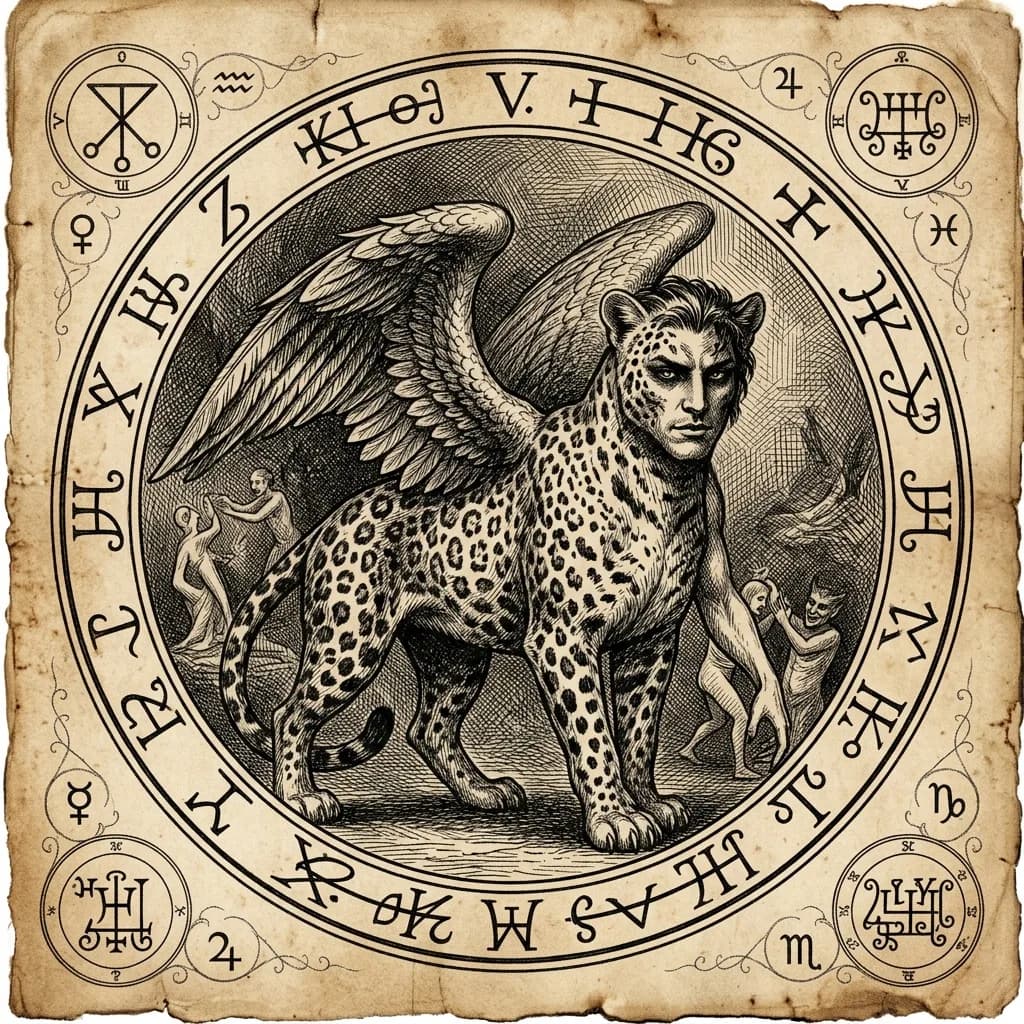
Sitri
PrinceSpirit #12 of the Ars Goetia · 60 legions
Description
Sitri is the 12th spirit, a great Prince. He appears first as a leopard with griffin's wings - dangerous, fast, elevated. He transforms into a beautiful man only when commanded. He inflames men with love of women and vice versa. He causes people to show themselves naked. He discloses the secrets of women while laughing at them. He governs 60 legions of spirits.
Symbolic interpretation
The power to inflame men with love of women - and vice versa - is the capacity to activate desire as a compulsive force rather than a chosen orientation. The operative mechanism here is not seduction from the outside but ignition from within: Sitri does not introduce a new object of desire so much as he turns up the intensity on the existing circuit of attraction until it overrides judgment, restraint, and self-governance. What this produces in those it acts on is a state of erotic obsession in which the boundary between wanting and needing collapses. The person under this influence does not experience desire as one factor among many - they experience it as the total frame. The consequence is not merely romantic pursuit but the wholesale reorganization of priorities around a single drive, which makes the person structurally vulnerable: predictable, readable, and controllable by whoever understands what they want.
The power to cause people to show themselves naked is not simply about physical exposure - it is the destruction of the boundary between the private self and the public one. The operative mechanism is the removal of the social and psychological armor that individuals construct to manage how they are perceived: the clothing, the persona, the careful presentation. When that armor comes off involuntarily, what is exposed is not just a body but the entire system of concealment a person has built around their vulnerabilities, appetites, and shame. What the target experiences is a specific kind of helplessness - not physical constraint but social and psychological nakedness, the condition of being seen without consent. This is consequential because concealment is not vanity; it is a form of power. To be stripped of it is to be rendered available for judgment, manipulation, and exploitation by those who retain their own protective covering.
The power to disclose the secrets of women while laughing at them compounds exposure with contempt. The operative mechanism is a two-stage action: first, the extraction of hidden information - private knowledge, vulnerabilities, desires, transgressions - and second, its reframing through mockery, which transforms revelation into humiliation. The laughter is not incidental; it is structural. It signals that the disclosure is not neutral intelligence but weaponized intimacy, the conversion of trust into spectacle. What this produces is the experience of betrayal-as-entertainment: the person whose secrets are disclosed finds not only that their privacy has been violated but that the violation is being performed for an audience that finds it amusing. The effect is the permanent destabilization of the victim's social position and their faith in the safety of intimacy itself.
The initial form - a leopard with griffin's wings - encodes the operational logic of Sitri before any relational mask is applied. The leopard is a predator built for speed, stealth, and decisive close-range force; it does not chase at length but closes distance suddenly and lethally. The griffin's wings add vertical mobility and elevation, the capacity to approach from angles that ground-level defense cannot anticipate. Together, these features describe a force that is both swift and elevated - one that operates above normal relational terrain and strikes before the target has registered the approach. The commanded form, a beautiful man revealed only when compelled, is itself a disclosure about the nature of attraction as instrument: beauty here is not a natural state but a tactical deployment, a form adopted under specific conditions to achieve a specific effect. The beauty is a mechanism, not an identity. That it must be commanded into appearance signals that the seductive face of this force is secondary to the predatory one - the leopard comes first; the beautiful man is the mask it wears when useful.
Archetype
Sitri derives as Libra - Cardinal Air - and the case is mechanical, not atmospheric. The Air element follows from Direct expression operating at Collective orientation: Sitri does not work through slow accumulation or intimate one-to-one bonding but through the relational field itself, the circuit of attraction that structures how bodies and persons are oriented toward each other across a population of potential pairs. His operation names a specific act - inflaming desire, causing nakedness, disclosing secrets - each of which is a locatable intervention with a legible before and after, which is what Direct expression means in practice. The Cardinal modality is visible in the architecture of each power: Sitri does not maintain existing states of desire or read and interpret erotic terrain - he breaks open new conditions. The person who was exercising judgment is now in obsession; the person who was clothed in social armor is now exposed; the secret that was held is now disclosed. Each of these is a founding event, a rupture that produces a state which did not previously exist and which cannot be simply reversed. The Collective orientation means the mechanism runs on whoever occupies the relevant relational positions - not on a specific targeted individual by virtue of their particularity, but on the structure of desire itself as a field-level phenomenon, which is why his power over love is bidirectional and his power over disclosure is systematic rather than personal. Libra as derived sign names an operator that initiates through the relational field - and Sitri's specific mechanical contribution is that every initiation he performs removes some form of protective covering, making the disruption he creates the permanent condition the target must now navigate from.