Library
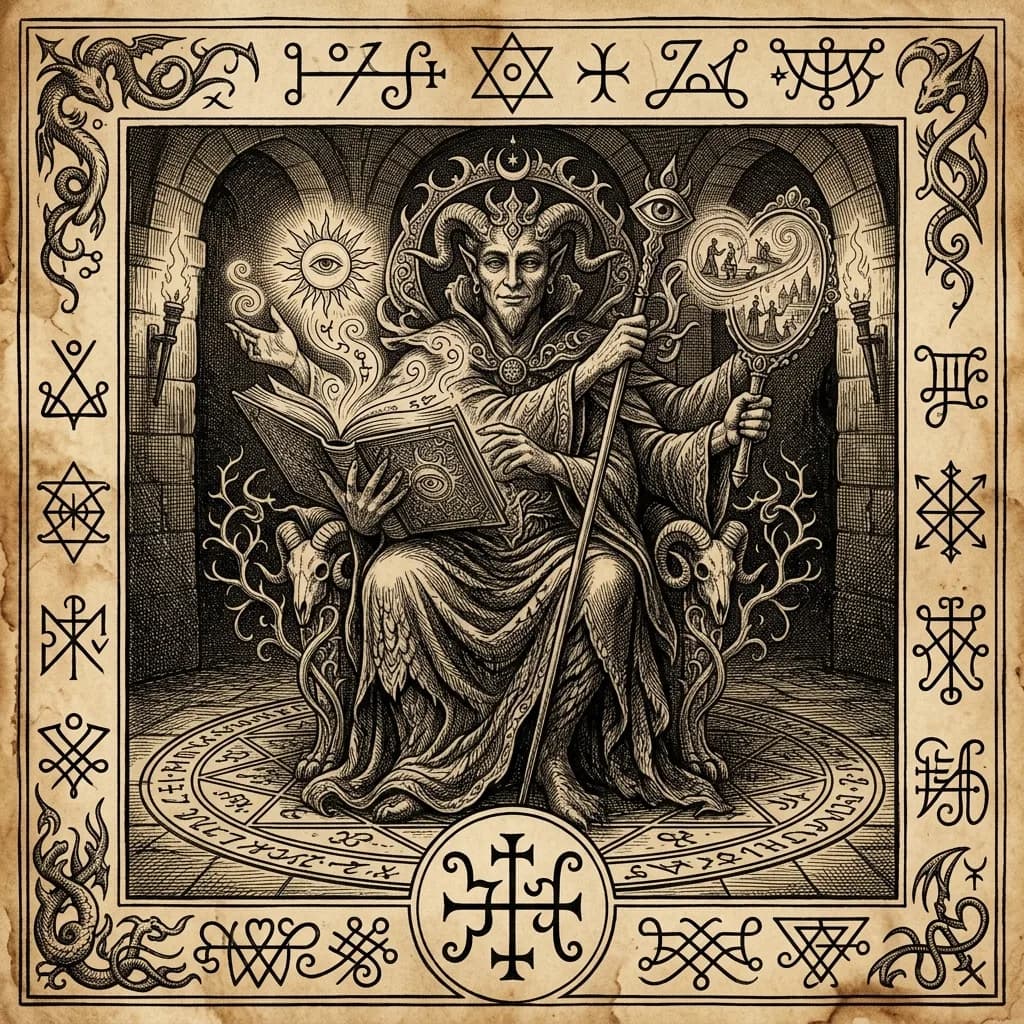
Vassago
PrinceSpirit #3 of the Ars Goetia · 26 legions
Description
Vassago is the 3rd spirit of the Ars Goetia, holding the rank of Prince. He declares things past, present, and to come. He discovers things hidden or lost. His nature is explicitly described as good - a designation unique among all 72 spirits of the Lemegeton. He governs 26 legions of spirits.
Symbolic interpretation
The power to declare things past, present, and to come is the capacity for total temporal vision - not prediction in the probabilistic sense, but access to time as a unified field rather than a sequence of discrete moments. The operative mechanism is the collapse of the distinction between past, present, and future into a single legible structure. What this produces in the person who receives such declarations is a fundamental reorientation of their relationship to causality: events that seemed arbitrary or opaque become intelligible as connected links in a chain. This is consequential because the experience of confusion or despair is almost always rooted in temporal isolation - in not being able to see where something came from or where it is going. Vassago removes that isolation.
The power to discover things hidden or lost is the capacity for retrieval - not search, which is uncertain, but the directed recovery of something that exists but has been obscured or displaced. The mechanism is essentially the elimination of the gap between a thing and knowledge of its location: Vassago does not guess where the lost thing is, he locates it. What this produces in the person it acts on is the resolution of incompleteness. Loss generates a specific kind of psychic arrest - a portion of attention permanently tied to what is missing. The discovery of the hidden or lost releases that arrested attention and restores functional wholeness to the person. The consequentiality is proportional to how much of the self was entangled in the absence.
The explicit designation of Vassago's nature as good is not a moral decoration applied from outside - it is a structural attribute that defines how his power operates and toward what ends it is directed. Among 72 spirits whose operations range from neutral to destructive, this designation identifies a fundamental alignment between Vassago's capacity and the benefit of those who engage with him. The mechanism is one of orientation: his knowledge and retrieval functions are not extractive or coercive but restorative. What this means for anyone who encounters Vassago is that his declarations and discoveries are offered without the kind of hidden cost, distortion, or contamination associated with adversarial intelligence. He reveals what is true, returns what is lost, and does so in a mode that serves rather than undermines.
Vassago has no recorded appearance in the Ars Goetia. The absence of a described form is itself significant. Every other described appearance in the Lemegeton encodes the nature of the spirit's operation - heads, animal attributes, and regalia all signal something about how the spirit functions and what it costs to engage with it. Vassago's formlessness communicates that his operation is not mediated through a specific, bounded mode of manifestation. He does not arrive as a warrior, a serpent, or a sovereign with a crown. He is pure function: disclosure and recovery, without the structural signature of threat or transformation. The absence of form is the signal that he does not come with conditions written into his body.
Archetype
Vassago's derived sign is Pisces, the product of Mutable modality operating through Water. The Water element follows from Diffuse expression meeting Collective orientation: Vassago's disclosures do not arrive through a named confrontation or targeted act - there is no moment of declared revelation to contest, only a gradual saturation of the recipient's epistemic field, and the operation runs on whoever occupies the position of inquirer rather than on any specifically identified person. The Mutable posture is visible in the mechanism itself: Vassago does not initiate a new state of knowledge (Cardinal) or hold a fixed doctrine against erosion (Fixed) - he moves through the temporal field, reading past, present, and future as a continuous terrain and translating what he finds into legible structure. His power to discover things hidden or lost follows the same logic: he does not create a new location for the missing object, he reads the existing structure until the gap resolves. The Generative direction situates him as the source from which disclosure flows outward - he is not accumulating information but distributing it. The domain of Knowledge confirms that the medium is epistemic: what Vassago produces is not a material transfer or an emotional bond but a reconfiguration of what the recipient can know and therefore how they can act. The mechanism that results from Mutable modality moving through a diffuse, collective Water medium is not a force that breaks, holds, or binds - it is a force that permeates and clarifies, which is precisely what makes retrieval and temporal disclosure its natural operations rather than its incidental ones.