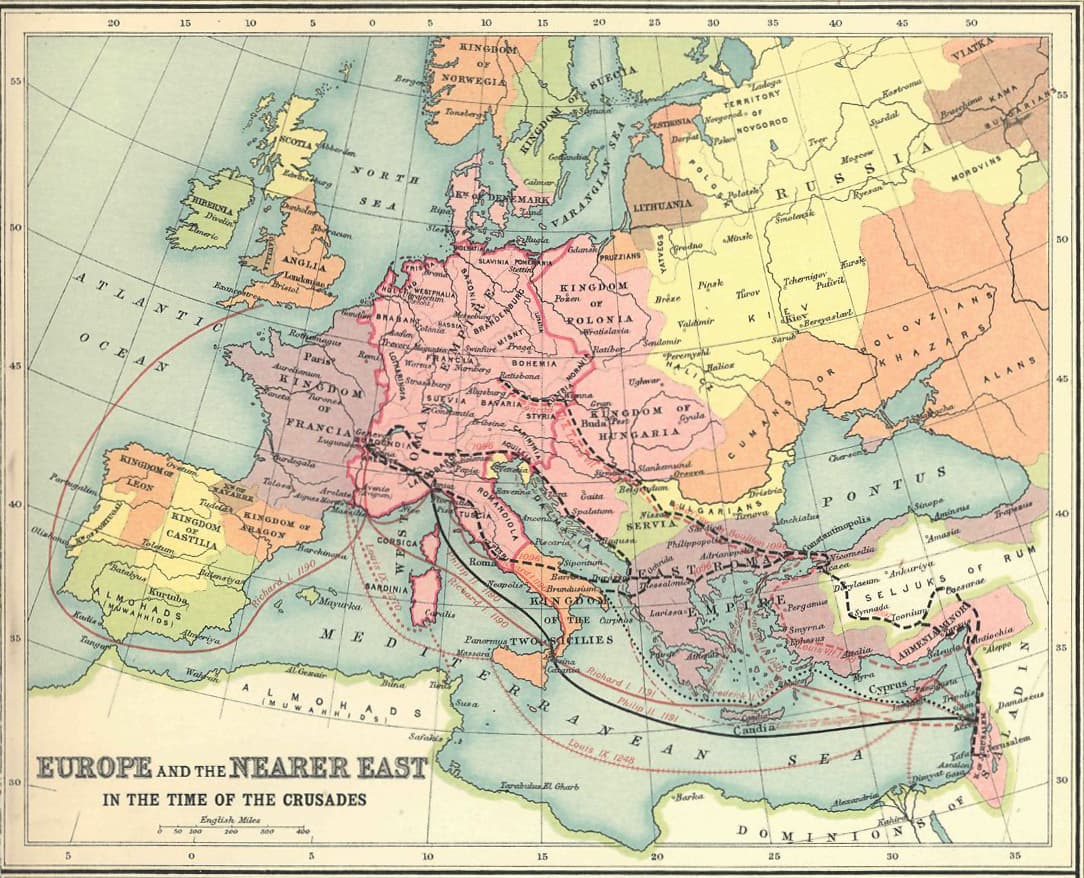
The Crusades
Church history · Updated August 15, 2026
Overview
The crusading movement did not end with the fall of Acre in 1291 but continued as papally sanctioned campaigns into the 18th century, targeting not only Muslims but also pagans and fellow Christians deemed enemies of The Papacy. Between 1095 and 1291, the papacy directed a series of military campaigns to recover and defend the Holy Land from Muslim rulers. The movement expanded far beyond that original goal, growing into an instrument of papal power that altered the political and religious map of Latin Christendom for centuries.
In November 1095, Pope Urban II proclaimed the First Crusade at the Council of Clermont, promising spiritual rewards to Christians who took up arms to reconquer Jerusalem from Muslim rule. The campaign succeeded, capturing the holy city in 1099 and establishing four Crusader States in the Levant. These territories required continuous military expeditions from Catholic Europe for their defense. The Crusade of 1101, the earliest papally sanctioned follow-up expedition, ended in disastrous defeats. Smaller campaigns in subsequent decades consolidated and expanded the Crusader holdings. The fall of Edessa, capital of the first Crusader state, prompted the Second Crusade. Pope Eugene III called the campaign, which failed in 1148 and reduced support for crusading across Latin Christendom. That failure left the Crusader states unable to resist the expansion of Saladin, whose conquests led to the Third Crusade.
Organizing large-scale crusading campaigns required religious, social, and economic institutions. The papacy developed crusade indulgences, established military orders, and taxed clerical income to fund expeditions. These mechanisms outlived the Crusader states themselves, equipping the papacy to launch sanctioned wars against European pagans, rival Christian powers, and internal dissenters well into the 1700s.
The Crusades (stakes)
The Crusades were never simply about reclaiming Jerusalem from Muslim rule. The surface conflict was territorial, but the real fight was over who commanded Christian violence. The papacy claimed the authority to declare holy war, promise forgiveness of sins in exchange for military service, and direct the swords of Europe toward its own chosen targets. This assertion of power put the Pope in direct competition with secular kings who believed they controlled their own armies. The deeper question was whether spiritual authority could legitimately command temporal force, and whether killing could become a guaranteed path to salvation.
In November 1095, Pope Urban II stood before a massive crowd at the Council of Clermont and launched the institutional machinery of crusading. He promised that any Christian who took up arms to reconquer the Holy Land would receive a plenary indulgence, a complete wiping clean of the spiritual debt owed for sin. The Muslim rulers who governed Jerusalem and the surrounding territories, led eventually by figures like Saladin, stood to lose their sovereignty over lands they had controlled for centuries. Secular European monarchs like Louis VII of France saw an opportunity to assert their own independence from papal control by leading crusading armies under their own banners and redirecting the movement toward dynastic ambition. Someone had to lose. If the Pope won, he commanded a pan-European army answerable to no king. If the monarchs won, the crusading movement became a tool of state power with the Pope reduced to blessing royal decisions.
The movement metastasized beyond its original purpose. Papal sanction for sanctified violence expanded into campaigns against pagans in the Baltic, against Christian dissidents within Europe, and against political enemies of The Papacy itself. The Fourth Crusade sacked Constantinople in 1204, gutting a Christian empire and carving up its territory for Venetian and French warlords. Crusading persisted into the eighteenth century as a legal and institutional framework for papally directed warfare, long after the last Crusader stronghold in the Levant fell in 1291. The fundamental question of whether spiritual authority could legitimately command temporal violence was never doctrinally resolved. It simply expanded into broader conflicts over power, identity, and survival. The last papally sanctioned crusade was preached against the Ottoman Turks in 1715.
Continue reading with a Scholar plan
Upgrade to ScholarCommon questions
- What were the Crusades?
- The Crusades were a series of religious and military campaigns during the medieval period, primarily aimed at reclaiming Jerusalem and other holy sites from Muslim control. They involved European Christians seeking to assert religious and political power.
- Who started the Crusades and why?
- The Crusades were initiated by Pope Urban II in 1095, who called for Christians to reclaim the Holy Land from Muslim rule. The aim was to unite European Christians under the Church's banner and expand religious and political influence.
- What was the goal of the Crusades?
- The primary goal of the Crusades was to capture Jerusalem and other sacred sites in the Holy Land from Muslim control, while also expanding Christian political and religious influence.
- Why did the Crusades fail?
- The Crusades failed due to logistical challenges, lack of unity among European forces, strong Muslim resistance, and shifting political alliances. They ultimately could not maintain long-term control over the Holy Land.
- What impact did the Crusades have on Europe?
- The Crusades led to increased cultural exchanges and trade between Europe and the Middle East, stimulated economic growth, and strengthened the power of the Church and European monarchs. They also intensified religious fervor and conflicts.
- How did the Crusades affect the Islamic world?
- The Crusades led to significant military and political challenges for the Islamic world, prompting leaders like Saladin to unify and resist the Crusader states. They also fostered long-lasting animosity and mistrust towards the West.
- What role did religion play in the Crusades?
- Religion was a central motivator for the Crusades, as they were framed as holy wars to reclaim sacred Christian sites. The Church used religious fervor to mobilize European Christians and legitimize military campaigns.
- Who were the key figures in the Crusades?
- Key figures included Pope Urban II, Godfrey of Bouillon, King Richard I of England, and Muslim leaders like Saladin. These leaders played crucial roles in organizing and leading Crusader and Muslim forces.
- What was the outcome of the First Crusade?
- The First Crusade resulted in the capture of Jerusalem in 1099 by the Crusaders, establishing several Crusader states in the region. It was seen as a significant victory for the Christian forces.
- Why did the Crusaders target Jerusalem?
- Jerusalem was targeted because it was a sacred city for Christians, being the site of Jesus Christ's crucifixion and resurrection. Capturing it was seen as a religious duty and a symbol of Christian triumph.
- How did the Crusades influence trade routes?
- The Crusades opened up new trade routes between Europe and the Middle East, facilitating the exchange of goods, ideas, and technologies. This increased trade contributed to the economic growth of European cities.
- What were the consequences of the Crusades for the Byzantine Empire?
- The Crusades weakened the Byzantine Empire, particularly after the Fourth Crusade, which led to the sack of Constantinople in 1204. This event significantly diminished Byzantine power and influence.
- How did the Crusades affect the relationship between Christians and Muslims?
- The Crusades deepened animosities and mistrust between Christians and Muslims, fostering centuries of conflict and hostility. These tensions have had long-lasting impacts on Christian-Muslim relations.
- What were the economic impacts of the Crusades?
- The Crusades stimulated economic growth by increasing trade between Europe and the Middle East. They also led to the development of new financial systems and the rise of merchant classes in European cities.