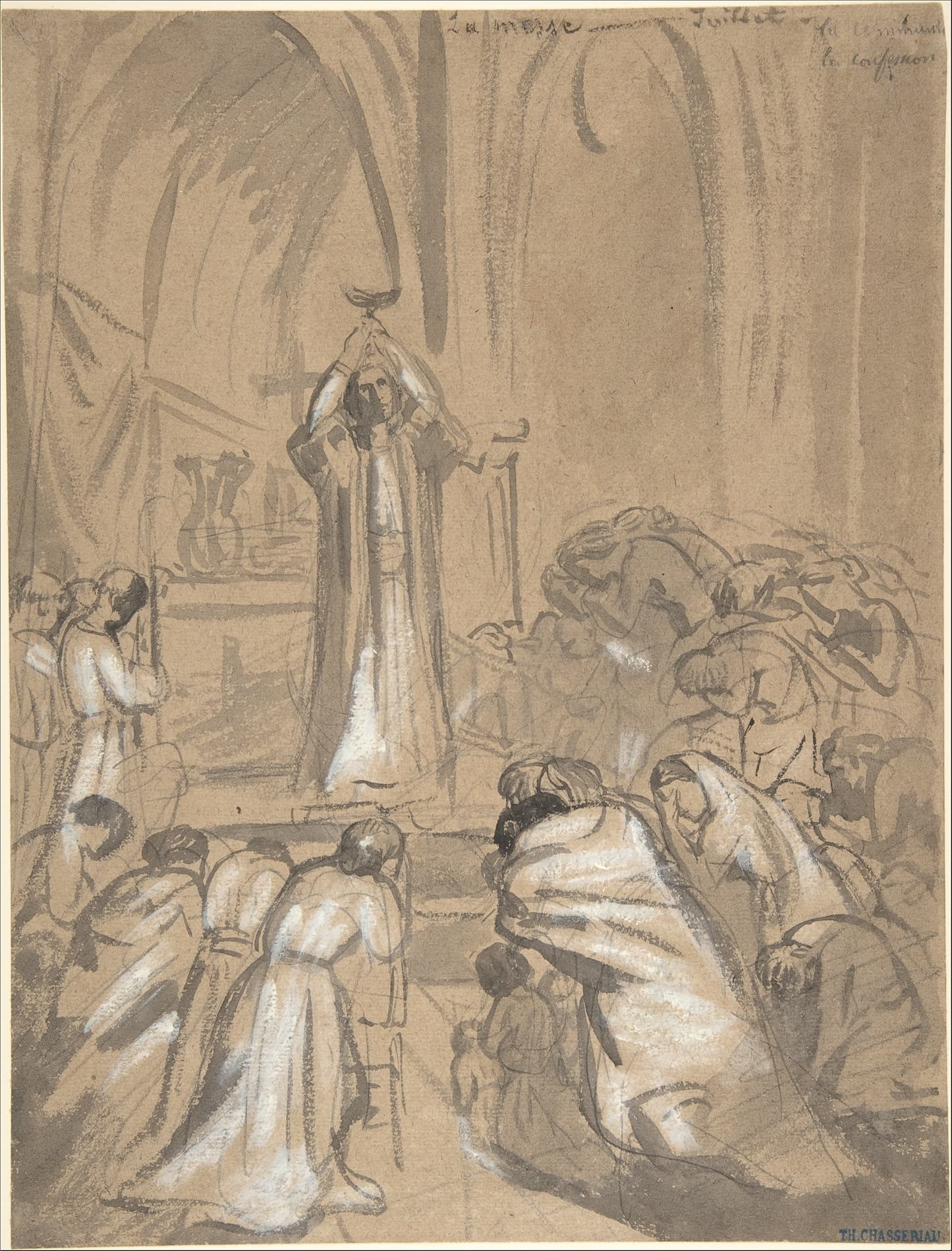
The Mass
Liturgical forms · Updated August 15, 2026
Overview
At one point in its long history, the Catholic Mass included a strikingly theatrical reenactment of the Last Supper. Actors and props aimed to bring the biblical event to life in vivid detail for the congregation. However, the Church eventually deemed this dramatic portrayal too theatrical and removed it from the liturgical practice. Such performances distracted from the solemnity and spiritual focus of the Mass, meant to be a sacred commemoration rather than a theatrical production.
This decision was part of a broader movement within the Church to standardize the liturgy and ensure that it remained a reverent act of worship. Convened in the mid-16th century, the Council of Trent played a crucial role in this process. Under the leadership of Pope Pius V, the Council established what became known as the Tridentine Mass. This version of The Mass stripped away the more theatrical elements, focusing instead on a uniform Latin liturgy practiced across the Catholic world. The aim was to create a sense of unity and consistency in the Church's rite, reinforcing its spiritual purpose over any theatrical interpretations.
Today, The Mass continues to evolve, though with careful attention to preserving its sacred character. The Second Vatican Council in the 1960s introduced changes, allowing the Mass to be celebrated in local languages and encouraging greater participation from the congregation. This move made the Mass more accessible to Catholics around the globe while maintaining the core elements that connect it to its ancient roots. Despite these changes, the essential nature of the Mass as a commemoration of the Last Supper remains unchanged, focusing on the Eucharistic Prayer as its central component.
The Catholic Mass once included a dramatic reenactment of the Last Supper, complete with actors and props, which was later removed for being too theatrical.
Why Fighting Over The Mass Was a Big Deal
The clash over the Mass concerned authority and identity within Christianity. Different factions within the faith competed to define authentic worship and control its practice. The dispute centered on who held the power to define Christian orthodoxy and tradition. The Roman Catholic Church aimed to preserve its doctrinal continuity and ecclesiastical authority, while Protestant reformers sought to reform what they saw as corruptions and establish a more biblical form of worship.
During the Council of Trent, held between 1545 and 1563, these tensions reached a breaking point. The Catholic Church, led by figures like Pope Pius V, defended the Mass as a sacrificial offering to maintain continuity with tradition. This position reinforced their authority and doctrinal consistency. Protestant reformers like Martin Luther argued for The Mass as a commemorative meal, emphasizing the Word and faith rather than sacrifice. They sought to remove what they perceived as deviations from true Christian worship. The Anglican Church, led by Thomas Cranmer, attempted a compromise that balanced reform with tradition to establish a national church. The Council of Trent solidified the Catholic position and created a doctrinal divide with little room for compromise.
The Council's decisions did not resolve the conflict over The Mass, and theological differences persist today. These differences stem from varying interpretations of scripture and tradition, and they shape the identities of Christian denominations. The Catholic Church's reaffirmation of the Mass as a sacrificial act conflicts with Protestant views favoring a commemorative approach. This divide continues to influence Christian worship practices, with each denomination holding to its interpretation. The Vatican still upholds the Mass as central to Catholic worship, while Protestant churches maintain their distinct liturgical practices.
Continue reading with a Scholar plan
Upgrade to ScholarCommon questions
- What is the Mass in the Catholic Church?
- The Mass in the Catholic Church is the central act of worship, commemorating the Last Supper of Jesus Christ with his disciples. It involves the celebration of the Eucharist, where bread and wine are consecrated and consumed.
- Why is the Mass important in Catholicism?
- The Mass is important in Catholicism because it is considered the highest form of worship, where Catholics participate in the sacrificial offering of Jesus Christ. It is a means of receiving grace through the Eucharist and maintaining a connection with the divine.
- What are the different parts of the Mass?
- The Mass consists of two main parts: the Liturgy of the Word and the Liturgy of the Eucharist. It includes readings from Scripture, a homily, the Eucharistic Prayer, and the distribution of Communion.
- How is the Mass different from other Christian services?
- The Mass is distinct from other Christian services primarily due to its focus on the Eucharist as a sacrificial offering. While other denominations may have similar elements, the Catholic Mass emphasizes the real presence of Christ in the Eucharist.
- What is the significance of the Eucharist in the Mass?
- The Eucharist is the central component of the Mass, representing the body and blood of Christ. It is a sacrament of communion with God and the Church, believed to be a source of spiritual nourishment and grace.
- Why do Catholics attend Mass every Sunday?
- Catholics attend Mass every Sunday to fulfill the Third Commandment to keep the Sabbath holy and to participate in the Eucharistic celebration. It is a communal act of worship and an opportunity to receive spiritual nourishment.
- What does it mean to participate in the Mass?
- Participating in the Mass means actively engaging in the prayers, responses, and hymns, as well as receiving the Eucharist. It involves a spiritual and communal connection with the Church and its teachings.
- How did the Mass originate in early Christianity?
- The Mass originated in early Christianity as a continuation of the Last Supper, where Jesus instructed his disciples to 'do this in memory of me.' Early Christians gathered for communal meals that evolved into the structured liturgy of the Mass.
- What changes have occurred in the Mass since the Second Vatican Council?
- Since the Second Vatican Council, the Mass has been allowed to be celebrated in local languages instead of Latin, and greater participation from the congregation is encouraged. These changes aimed to make the Mass more accessible and engaging for Catholics worldwide.
- Why is the Mass sometimes called a 'sacrifice'?
- The Mass is called a 'sacrifice' because it re-presents the sacrifice of Jesus on the cross in an unbloody manner. Catholics believe that the Eucharist is a participation in the one eternal sacrifice of Christ.
- What language is traditionally used in the Mass?
- Traditionally, the Mass was celebrated in Latin, especially after the Council of Trent established the Tridentine Mass. Since the Second Vatican Council, it is often celebrated in the local vernacular language.
- What role does music play in the Mass?
- Music in the Mass enhances the liturgical celebration, helping to express the prayers and emotions of the congregation. It includes hymns, psalms, and chants that align with the themes of the liturgical calendar.
- How is the Mass celebrated differently across cultures?
- While the core structure of the Mass remains the same, cultural elements such as music, language, and customs can vary. These adaptations help make the Mass more relatable and meaningful to diverse congregations.
- What are the requirements for receiving Communion at Mass?
- To receive Communion at Mass, Catholics must be in a state of grace, having confessed any mortal sins. They should also observe a one-hour fast before receiving the Eucharist.
- What is the difference between a High Mass and a Low Mass?
- A High Mass, or Solemn Mass, includes more elaborate rituals, music, and incense, often with a choir and multiple clergy. A Low Mass is simpler, with minimal music and a focus on the spoken word.