Library
Aim
DukeSpirit #23 of the Ars Goetia · 26 legions
Description
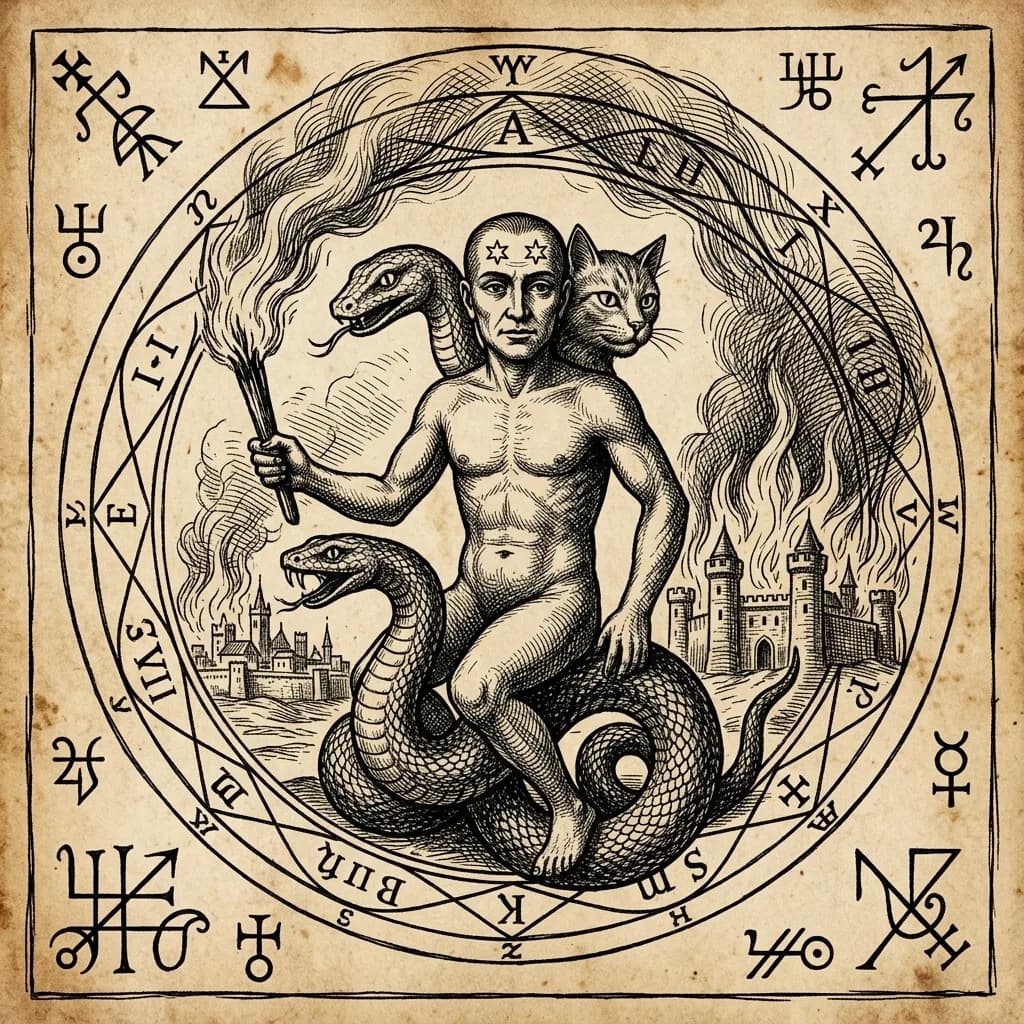
Aim is a Duke of Hell who commands twenty-six legions of spirits. He appears with three heads: the first like a serpent, the second like a man with two stars upon his forehead, the third like a cat. He rides upon a viper. He carries a firebrand in his hand with which he sets fire to cities, castles, and great places. He is subtle. He gives true answers of private matters.
Symbolic interpretation
The capacity to give true answers of private matters is the ability to access information that exists outside the official record - the knowledge that circulates only in whispers, that is held by individuals rather than institutions, and that is suppressed precisely because it is consequential. The operative mechanism is penetration of concealment: not deduction, not inference, but direct access to what has been deliberately withheld. What this produces in those who receive such answers is an immediate collapse of the protective distance that secrecy creates. Private matters derive their power from their containment; once named accurately by an outside party, they lose the protection of hiddenness and become actionable. The person who sought the answer gains leverage; the person whose private matter has been named loses the asymmetry that kept them safe. This is not knowledge in the abstract - it is the specific variety of knowledge that restructures power relations the moment it is spoken.
The setting fire to cities, castles, and great places is not gratuitous destruction. It is the systematic targeting of institutional and architectural structures - the built forms of organized power. Cities are civic order, commerce, and governance. Castles are military and aristocratic authority, the fortified seat of dominion. Great places are the concentrated nodes of prestige, administration, and memory. To set fire to all three is to attack the material substrate of civilization simultaneously at its social, military, and symbolic registers. The mechanism is thermodynamic and irreversible: fire does not merely damage, it consumes, transforms, and renders uninhabitable. What it produces in the people who witness it is the sudden experience of institutional nullity - the recognition that the structures organizing their lives are contingent and combustible, not permanent. This is not the same as chaos. It is the enforced recognition that power has a physical address, and that address can burn.
Subtlety as a named attribute is not a personality trait - it is a functional mode of operation. To be subtle is to act through indirection, to move through channels that are not observed as channels, to produce effects whose causes remain opaque. The operative mechanism is the suppression of visible agency: the subtle actor achieves outcomes without appearing to have acted. What this capacity produces in those subject to it is a specific form of vulnerability, because it removes the usual cues that alert people to incoming influence. A direct threat can be met; an influence that does not announce itself cannot be defended against in the ordinary way. The combination of subtlety with the other two powers - revelation of private knowledge and incendiary destruction - transforms both. Fire set by a subtle hand is fire that appears to have no origin. Private answers given with subtlety arrive without revealing how they were obtained. Subtlety is the condition under which the other powers operate at maximum efficiency.
The three heads - serpent, starred man, and cat - and the viper mount, combined with the firebrand, constitute a composite image that encodes the spirit's operational structure visually. The serpent head names the mode of approach: ground-level, sinuous, invisible in approach, associated across traditions with both wisdom and lethal concealment. The human head with two stars on the forehead names elevated perception - the stars mark a figure who sees by a different light than ordinary human sight, whose intelligence is oriented upward and outward rather than merely socially. The cat head names nocturnal acuity, independence from human hierarchy, and the capacity to move without sound - the predator that is also a domestic presence, trusted and familiar, which can observe everything from inside a household. The viper as mount doubles the serpent attribute: Aim does not merely wear the serpent's face, he rides on its body, meaning his movement through the world is itself serpentine in mechanism. The firebrand in hand is the instrument, not an ornament - it is held ready, not sheathed, which means the capacity for incendiary action is always actively carried, never stored at a distance.
Archetype
Aim derives as Cardinal Air, placing it under Libra - where Cardinal modality meets the Direct à — Collective element derivation. The Air element emerges because Aim's expression is Direct and its orientation is Collective: there is a specific, nameable act (the revelation of private matters, the firebrand applied to identifiable structures) directed not at a single target but at whoever occupies the relevant position in the system - the castle-holder, the city's administrator, the person whose private matter is consequential to others. The force runs on positions, not persons. Cardinality appears in the mechanism of revelation itself: when a private matter is accurately named by an outside party, it does not gradually erode concealment - it breaks open a new state that did not previously exist. The asymmetry collapses at the moment of naming. The person who held the secret held it completely until that instant; afterward, the protective structure is gone and cannot be restored. This is initiation in the strict sense - a threshold crossed, not a condition accumulated. The same Cardinal posture governs the incendiary function: fire applied to cities, castles, and great places does not slowly degrade institutional infrastructure, it inaugurates a condition of nullity. The thermodynamic irreversibility is part of the mechanism - Cardinal force does not negotiate with what already exists, it overrides it. Aim's Receptive direction (Axis 5) operates within this Cardinal-Air frame as the accumulation of true answers before their release: the force draws information inward until the moment of disclosure, at which point the Cardinal operation fires. The combination means that Libra here names an operator whose medium is collective epistemic structure and whose posture is founded disruption - the force that breaks open shared informational arrangements at the precise moment the gathered intelligence reaches actionable weight.
In popular culture
Aim has no significant pop culture presence.