Daniel 3:1-30 · Daniel · Updated April 25, 2026
Fiery Furnace
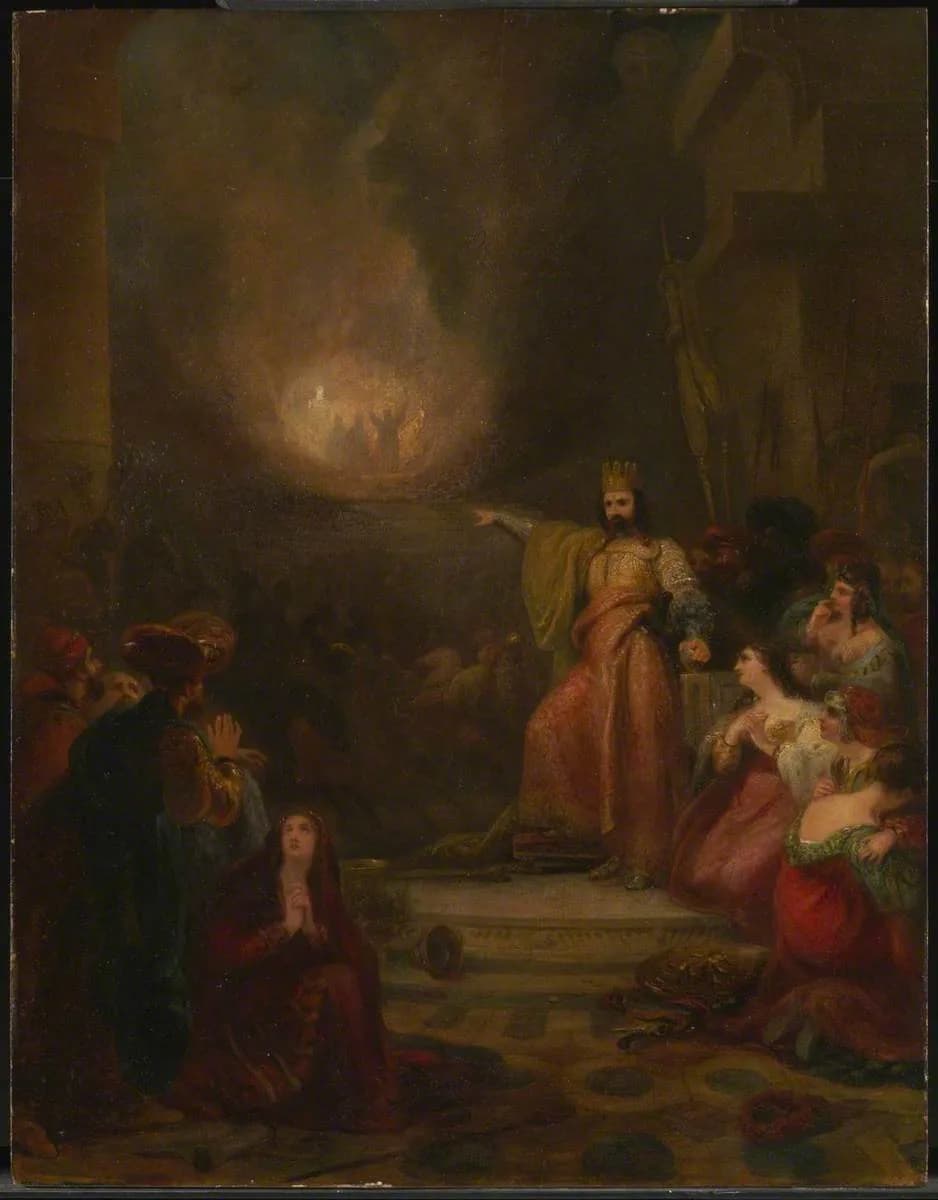
King Nebuchadnezzar sets up a golden image and commands all to worship it, threatening death in a fiery furnace for those who refuse. Shadrach, Meshach, and Abednego refuse to worship the image and are thrown into the furnace, but they are miraculously unharmed, leading Nebuchadnezzar to praise their God and promote them.
Summary
The passage from Daniel 3:1-30 is a narrative about faith and deliverance set during the reign of King Nebuchadnezzar of Babylon. Nebuchadnezzar constructs a massive golden image on the plain of Dura and commands all his officials and people to worship it when they hear musical instruments (3:1-5). Anyone who refuses to worship the image will be thrown into a fiery furnace (3:6). Shadrach, Meshach, and Abednego, three Jewish men appointed over the province of Babylon, refuse to bow to the image, defying the king's decree (3:12).
As the story unfolds, Nebuchadnezzar is furious with Shadrach, Meshach, and Abednego and summons them to explain their actions (3:13-14). Despite the threat of the furnace, the three men declare their faith in their God, asserting that He can deliver them from the fire, but even if He does not, they will not serve the king's gods or worship the image (3:17-18). Enraged, Nebuchadnezzar orders the furnace to be heated seven times hotter than usual and commands his strongest soldiers to bind and throw the men into the blazing furnace (3:19-21). The fire is so intense that it kills the soldiers who carry out the king's orders (3:22).
Nebuchadnezzar is astonished to see not three, but four men walking unharmed in the fire, with the fourth appearing like a divine being (3:25). He calls Shadrach, Meshach, and Abednego out of the furnace, and they emerge unscathed, without even the smell of fire on them (3:26-27). Nebuchadnezzar praises their God, acknowledging His power to save and issues a decree that no one should speak against the God of Shadrach, Meshach, and Abednego (3:28-29). The king then promotes the three men within Babylon (3:30), concluding that there is no other god who can deliver in such a manner. This passage centers on the power of unwavering faith and divine intervention. Shadrach, Meshach, and Abednego's refusal to worship the golden image set up by King Nebuchadnezzar is a direct assertion of their faith in God, even when faced with death (3:17-18). Their deliverance from the fiery furnace demonstrates their trust in God's ability to save, which in turn leads to a change in Nebuchadnezzar's perspective. The king's acknowledgment of their God as powerful and unique emphasizes the narrative's focus on God's supremacy over earthly rulers and idols (3:28-29). The event mattered because it demonstrated that true faith can withstand the greatest trials and bring about recognition of divine power even from non-believers.
Chiastic structure
ⓘDaniel 3:5-6
“ye fall down and worship the golden image... whoso falleth not down... shall be cast into the midst of a burning fiery furnace.”
Daniel 3:25
“Lo, I see four men loose, walking in the midst of the fire, and they have no hurt; and the form of the fourth is like the Son of God.”
Daniel 3:28-29
“Blessed be the God of Shadrach, Meshach, and Abednego... there is no other God that can deliver after this sort.”
A and A' mirror each other in the theme of worship and divine deliverance. A describes the command to worship the golden image, while A' shows the acknowledgment of the true God after the deliverance.
Interpretation and theological stakes
Continue reading with a Scholar plan
Upgrade to Scholar