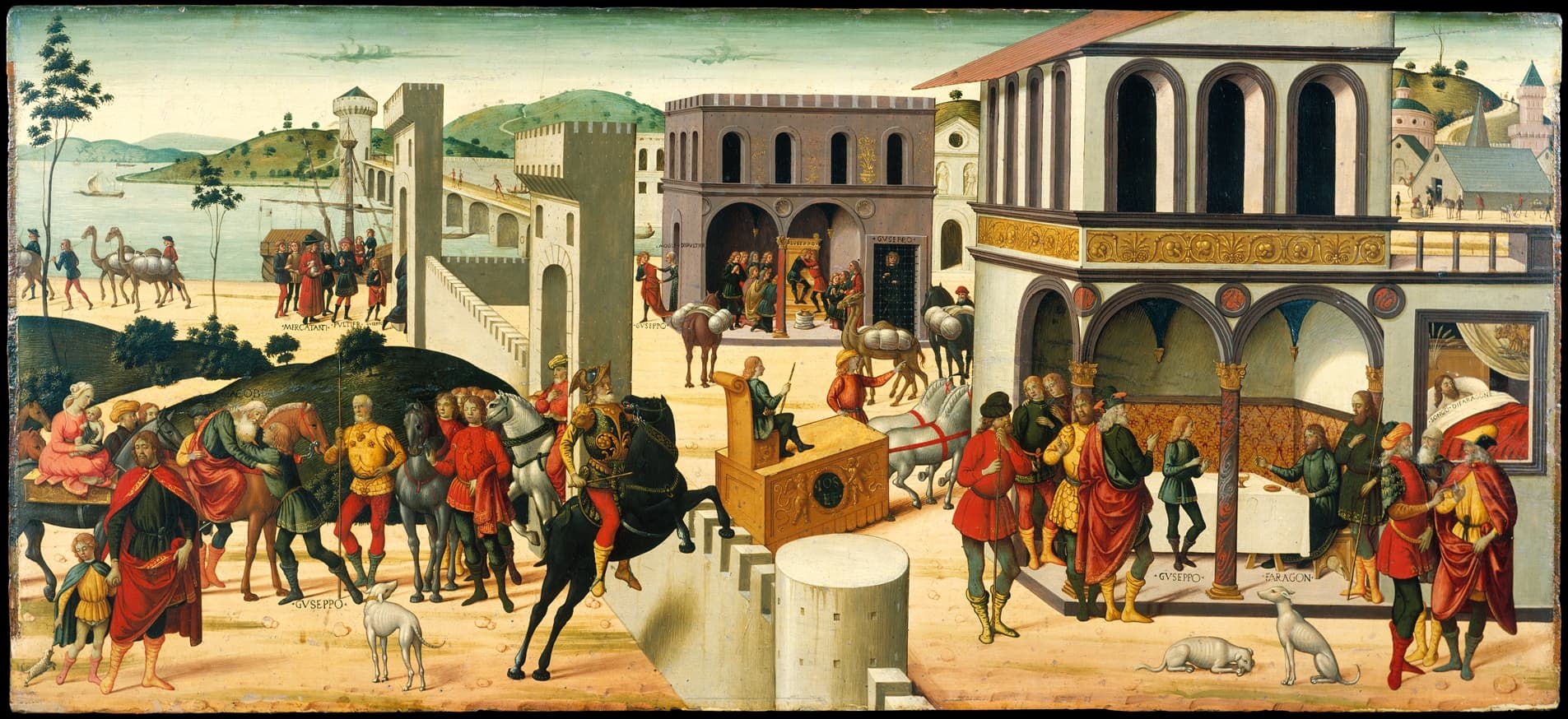
Genesis 37:12-36 · Genesis · Updated April 25, 2026
Joseph Sold by Brothers
Joseph's brothers go to feed their father's flock in Shechem. Joseph is sent by his father to check on them, but they conspire to kill him. Instead, they sell him to the Ishmaelites, who take him to Egypt, and deceive their father into thinking Joseph is dead.
Summary
Genesis 37:12-36 details a significant moment in the story of Joseph, a favored son of Jacob (also known as Israel). Joseph's brothers harbor resentment towards him due to their father's favoritism and Joseph's dreams, which suggest he will rule over them. Joseph is sent by Jacob from Hebron to check on his brothers who are tending sheep in Shechem. Upon arrival in Shechem, Joseph learns from a man that his brothers have moved on to Dothan, so he follows them there (Genesis 37:12-17).
As Joseph approaches, his brothers see him from a distance and plot to kill him, mocking him as "this dreamer" (Genesis 37:18-19). Reuben, the eldest, intervenes to prevent murder, suggesting instead that they throw Joseph into a pit, intending to rescue him later (Genesis 37:21-22). The brothers strip Joseph of his coat of many colors and cast him into an empty pit (Genesis 37:23-24). While they eat, a caravan of Ishmaelites on their way to Egypt passes by. Judah proposes selling Joseph to the Ishmaelites instead of killing him, and the brothers agree. Joseph is sold to the Ishmaelites for twenty pieces of silver and taken to Egypt (Genesis 37:25-28).
Reuben returns to find Joseph gone and is distraught. The brothers deceive their father by dipping Joseph's coat in goat blood and presenting it to Jacob, who believes a wild animal has killed Joseph (Genesis 37:29-33). Jacob mourns, refusing comfort from his family, declaring he will mourn until he joins Joseph in death (Genesis 37:34-35). Meanwhile, Joseph is sold by the Midianites in Egypt to Potiphar, an officer of Pharaoh and captain of the guard, setting the stage for Joseph's future in Egypt (Genesis 37:36). The primary conclusion of the passage where Joseph is sold by his brothers is the destructive power of jealousy and the resulting betrayal. The text shows how the brothers' envy, fueled by their father Jacob's favoritism and Joseph's prophetic dreams, leads them to conspire against him (Genesis 37:18). Their actions, from plotting to kill him to selling him into slavery, reveal the depth of their resentment. This betrayal sets off a chain of events that greatly impacts Joseph's life and the future of the family, illustrating how unchecked jealousy can lead to severe, life-altering consequences.
Chiastic structure
ⓘGenesis 37:12-17
“And his brethren went to feed their father's flock in Shechem... And Joseph went after his brethren, and found them in Dothan.”
Genesis 37:26-27
“And Judah said unto his brethren, What profit is it if we slay our brother... Come, and let us sell him to the Ishmeelites...”
Genesis 37:31-33
“And they took Joseph's coat, and killed a kid of the goats, and dipped the coat in the blood... an evil beast hath devoured him...”
Both A and A' involve Joseph's journey and the deception surrounding his fate. A is about Joseph being sent to find his brothers, and A' is about the deception of his supposed death.
Interpretation and theological stakes
Continue reading with a Scholar plan
Upgrade to Scholar