Hebrews 8:1-13 · Hebrews · Updated April 25, 2026
New Covenant Superior
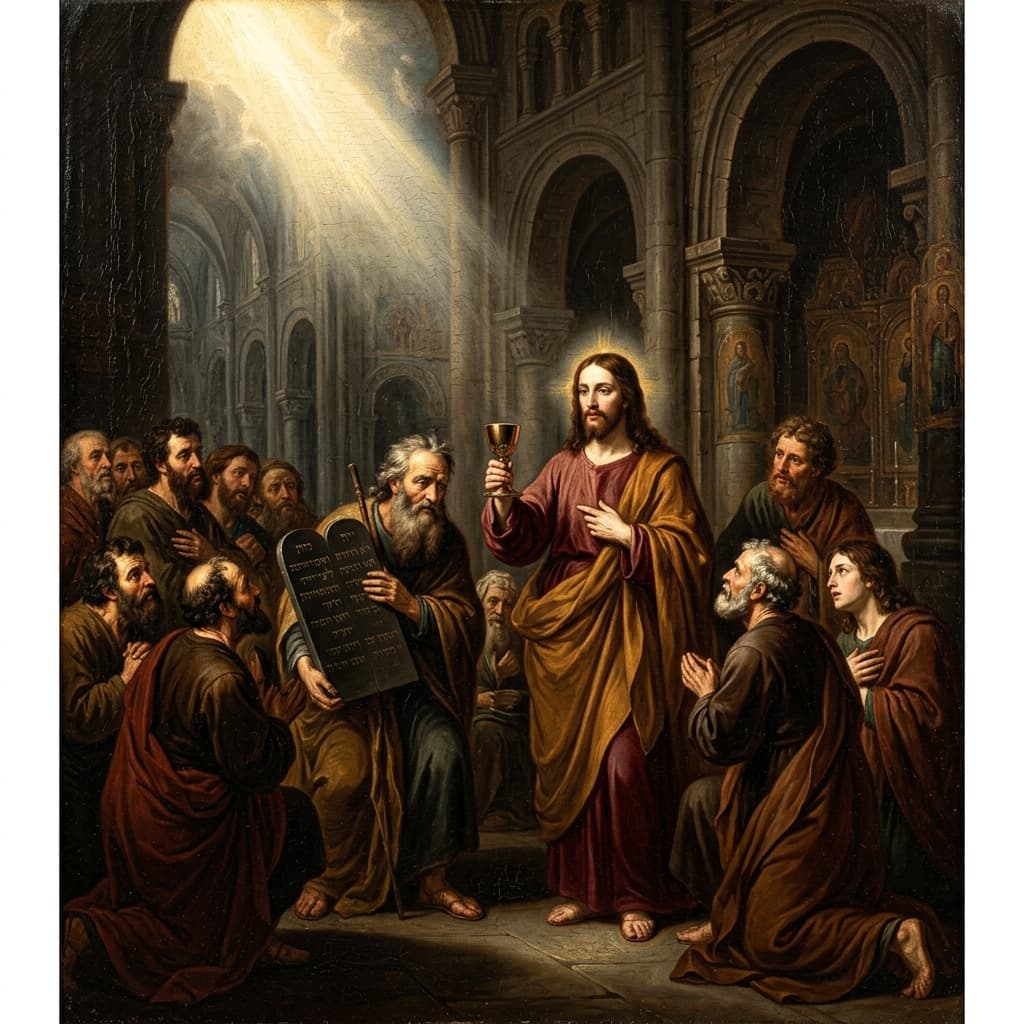
The passage discusses the superiority of the new covenant mediated by Jesus, the high priest, who serves in the heavenly sanctuary. It contrasts the new covenant with the old, emphasizing that the new covenant is established on better promises and involves a direct relationship with God.
Summary
This passage from Hebrews 8 discusses the transition from the old covenant, given through Moses, to the new covenant established by Jesus. It opens by emphasizing the role of Jesus as a high priest who is seated at the right hand of God in heaven (8:1). This sets the stage for a comparison between the earthly tabernacle, which was built by human hands, and the heavenly one, which is overseen by Jesus (8:2). The text highlights that while earthly priests offer gifts and sacrifices, Jesus serves in a superior, heavenly ministry.
The passage continues by explaining that Jesus has obtained a more excellent ministry because he is the mediator of a better covenant, established on better promises (8:6). The text notes that if the first covenant had been perfect, there would have been no need for a second one (8:7). God, finding fault with the people under the old covenant, declares that He will establish a new covenant with the house of Israel and Judah, different from the one made when He led them out of Egypt (8:8-9). This New Covenant involves God placing His laws in their minds and writing them on their hearts, establishing a direct relationship with His people (8:10).
The passage concludes by stating that under this new covenant, there will be no need for people to teach others to know the Lord, as all will know Him, from the least to the greatest (8:11). God promises to be merciful and to remember their sins no more (8:12). The final verse declares that by calling this covenant "new," God has made the first one obsolete, indicating that it is ready to disappear (8:13). The passage establishes the significance of the new covenant as a superior arrangement between God and His people.
Chiastic structure
ⓘHebrews 8:7-8
“For if that first had been faultless, then should no place have been sought for the second.”
Hebrews 8:6
“But now hath he obtained a more excellent ministry, by how much also he is the mediator of a better covenant, which was established upon better promises.”
Hebrews 8:13
“In that he saith, A new, he hath made the first old. Now that which decayeth and waxeth old ready to vanish away.”
A and A' both discuss the inadequacy and obsolescence of the old covenant, highlighting the transition to the new covenant.
Interpretation and theological stakes
Continue reading with a Scholar plan
Upgrade to Scholar