Judges 16:4-31 · Judges · Updated April 25, 2026
Samson & Delilah
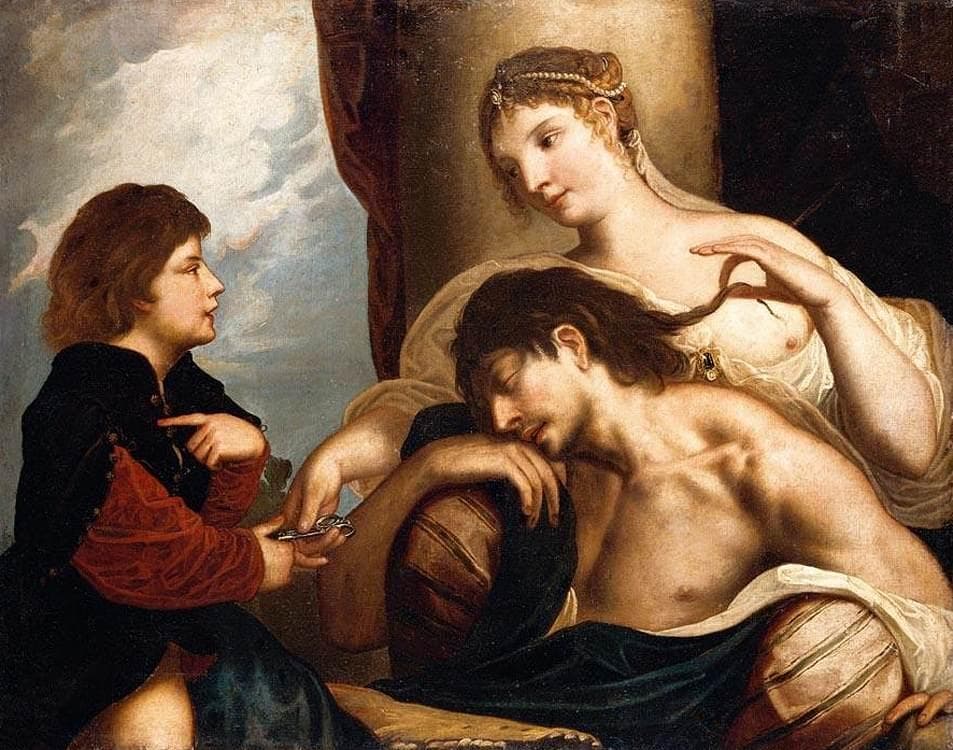
Samson falls in love with Delilah, who is bribed by the Philistine lords to discover the secret of his strength. After several failed attempts, Samson reveals that his strength lies in his uncut hair. Delilah betrays him, leading to his capture, but Samson ultimately brings down the Philistine temple, killing himself and many Philistines.
Summary
Judges 16:4-31 recounts the story of Samson and Delilah, a key episode in the life of Samson, a judge of Israel known for his immense strength. Samson falls in love with Delilah, a woman in the valley of Sorek (16:4). The Philistine lords approach Delilah, offering her a substantial sum of silver to discover the source of Samson's strength so they can overpower him (16:5). Delilah agrees and begins to coax Samson into revealing his secret.
Delilah repeatedly asks Samson to disclose the secret of his strength. Initially, Samson deceives her with false explanations, such as binding him with fresh bowstrings or new ropes, which do not work (16:7-12). Eventually, after persistent nagging, Samson confides in Delilah that his strength lies in his uncut hair, as he is a Nazarite dedicated to God from birth (16:17). Delilah informs the Philistine lords, and while Samson sleeps, they shave off his hair, stripping him of his strength (16:19). The Philistines capture Samson, blind him, and imprison him in Gaza (16:21).
Samson is brought to a Philistine temple to entertain them during a celebration. As his hair begins to regrow, he prays to God for strength one last time (16:28). Positioned between two pillars, Samson pushes them apart, causing the temple to collapse, killing himself and thousands of Philistines (16:30). The passage concludes with Samson's family retrieving his body for burial, marking the end of his twenty years as a judge of Israel (16:31). The story of Samson and Delilah in Judges 16:4-31 illustrates the fragility of human strength when disconnected from divine purpose. Samson's downfall begins with his betrayal by Delilah, a woman he loves, and culminates in his capture and humiliation by the Philistines. This sequence of events shows a critical turning point where Samson's physical prowess, symbolized by his uncut hair, is stripped away, revealing his vulnerability without God's favor. The narrative conveys that Samson's strength was not merely in his hair but in his adherence to his Nazarite vow, which was a visible manifestation of his commitment to God. The collapse of the Philistine temple, triggered by Samson's final act of strength, reflects the restoration of his divine connection, emphasizing that true power lies in faithfulness to God.
Chiastic structure
ⓘJudges 16:19-20
“And his strength went from him. And he wist not that the LORD was departed from him.”
Judges 16:28
“O Lord GOD, remember me, I pray thee, and strengthen me, I pray thee, only this once.”
Judges 16:30
“So the dead which he slew at his death were more than they which he slew in his life.”
A and A' mirror each other through the theme of Samson's strength being compromised and then restored, leading to his final act of deliverance.
Interpretation and theological stakes
Continue reading with a Scholar plan
Upgrade to Scholar