Christianity and the Crusades
Secret Societies · Updated August 15, 2026
Overview
The Bible passages cited to justify crusading violence emphasize feeding the hungry and clothing the naked, yet the Crusades involved armed conquest and killing in the name of the same faith. This contradiction cuts to the heart of Christianity's relationship with holy war. For any Christian reader, the central question is whether the institutional Church can sanctify bloodshed using texts that command mercy. The medieval papacy built an entire theology of armed pilgrimage on this foundation, and the tension between that theology and the plain words of Scripture defines the controversy.
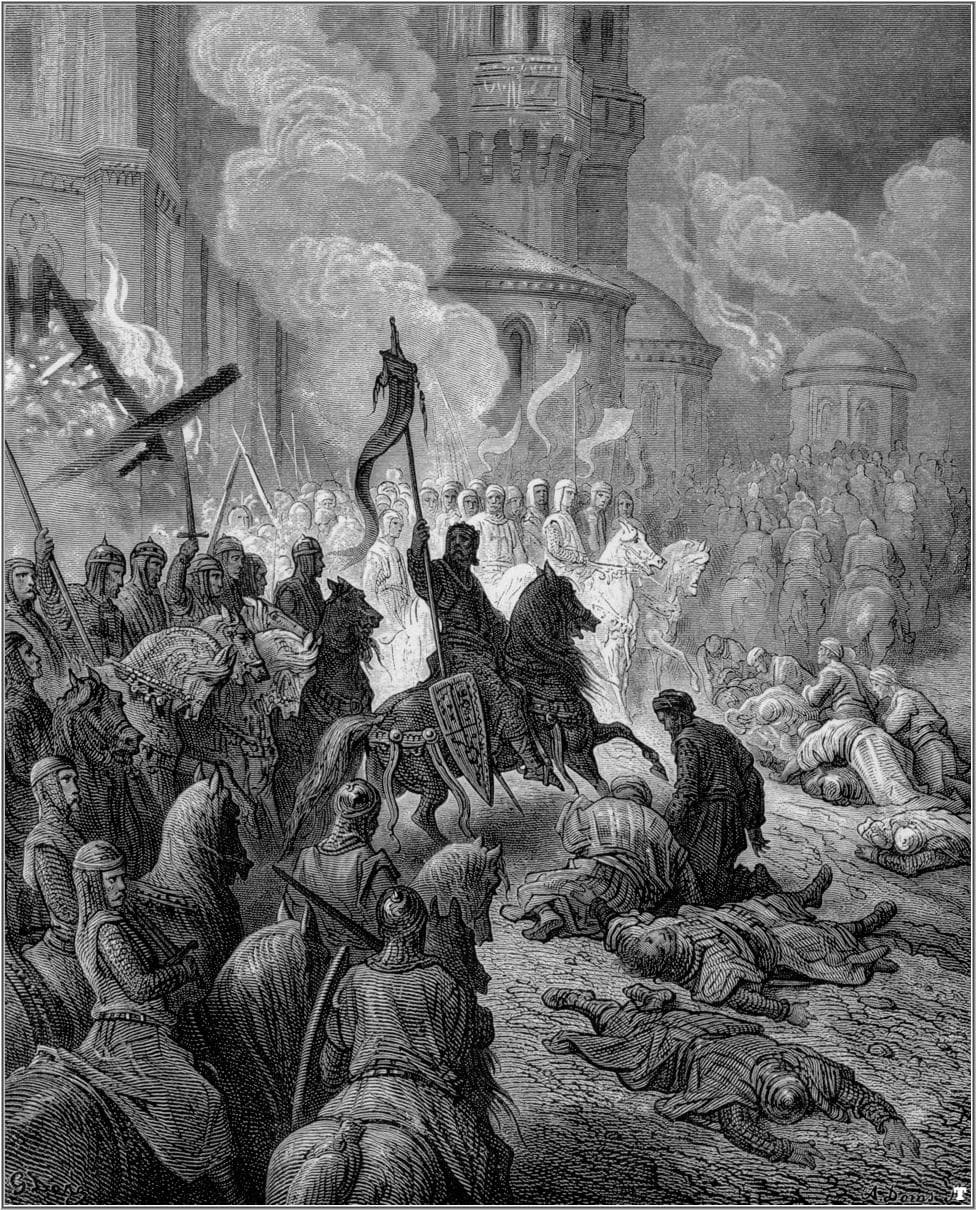
In November 1095, Pope Urban II stood at the Council of Clermont and promised spiritual rewards for armed service. He offered crusade indulgences,remission of earthly punishment for sin,to anyone who took up the sword for the Church. This marked the first time The Papacy formally directed military force with the offer of spiritual merit, creating a new category of sanctioned violence. The First Crusade resulted in the establishment of four Crusader States in the Levant between 1098 and 1109: the County of Edessa, the Principality of Antioch, the Kingdom of Jerusalem, and the County of Tripoli. The fall of Edessa in 1144 prompted the Second Crusade, which failed in 1148 after a disastrous siege of Damascus. That failure drained support for crusading across Latin Christendom. The movement expanded far beyond the Holy Land, targeting pagans, Christian dissidents, and papal enemies. Similar spiritual rewards were offered for these campaigns, and crusading continued into the 18th century, long after the traditional 1291 endpoint of Holy Land campaigns.
Scripture directly contradicts the crusading project. Matthew 25:35-40 defines true faith as feeding the hungry, clothing the naked, and visiting the imprisoned. James 2:14-17 declares faith without works dead, specifying works of mercy toward the vulnerable. Isaiah 58:6-7 calls for loosening the bands of wickedness and feeding the hungry. Galatians 6:2 commands bearing one another's burdens. None of these passages carve out exceptions for enemies. The medieval papacy appropriated these texts to justify armed conquest, a radical departure from their plain meaning. A Bible reader finds no mandate for holy war in these verses. Church history records both the institutional Church's endorsement of crusading and persistent theological critique from voices that refused to equate violence with pilgrimage.
The most common misunderstanding treats The Crusades as a unified, monolithic movement. They were a complex series of campaigns spanning centuries, targeting varied enemies, and evolving from Holy Land recovery to broader papal objectives. The Crusades were not a single event but an institution that adapted to political needs over hundreds of years.
The Bible passages cited to justify crusading violence emphasize feeding the hungry and clothing the naked, yet the Crusades involved armed conquest and killing in the name of the same faith.