Freemasonry and Christianity
Secret Societies · Updated August 15, 2026
Overview
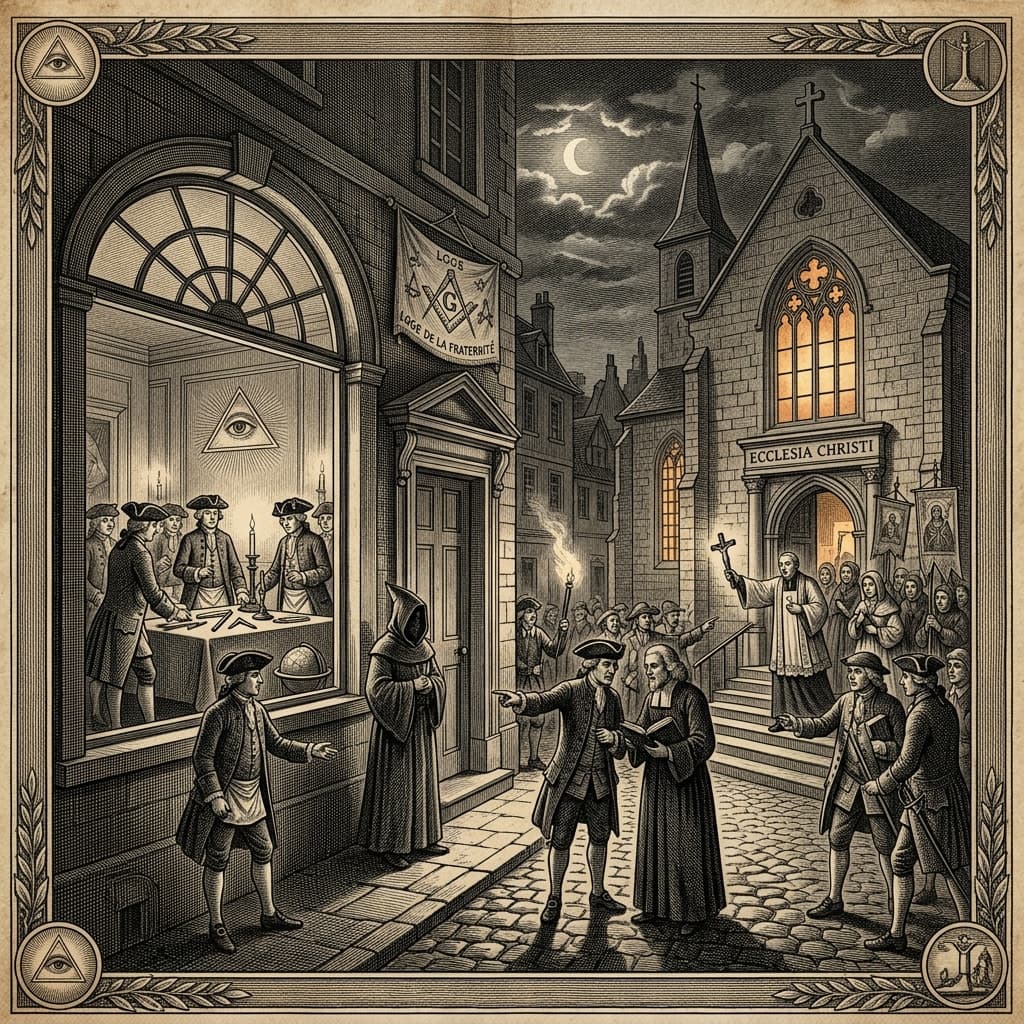
The conflict between Freemasonry and Christianity was never simply a theological disagreement about secret handshakes or ritual wording. The real question was whether a brotherhood demanding primary loyalty oaths could coexist with a religion claiming exclusive spiritual authority over the conscience. The deeper fight was over institutional power. The Catholic Church feared that Masonry's universalism and oath-bound secrecy created a parallel moral authority that diluted Christian identity and undermined clerical control over public life. If a man could take a blood-oath in a Masonic Lodge on Monday and take communion on Sunday, the parish priest lost his monopoly on that man's moral life. The Church could not tolerate a rival.
On April 20, 1884, Pope Leo XIII published Humanum Genus, the most comprehensive papal condemnation of the fraternity ever issued. He declared the organization fundamentally opposed to Christian civilization and demanded that all Catholics sever their Masonic ties under pain of grave sin. The Catholic Church stood to preserve its exclusive grip on the spiritual lives of millions; Leo XIII understood that losing this fight meant surrendering the Church's role as the supreme arbiter of public morality. The Protestant Anti-Masonic Movement wanted the same outcome for different reasons. Led by figures like Edith Starr Miller, these Protestants attacked Masonry as a deceptive religion masquerading as a fraternal society, arguing that its rituals led Christians into syncretism and idolatry. They fought to defend biblical exclusivity against Masonic universalism. Against both stood the Christian Freemasons, championed early on by Rev. James Anderson, who insisted Masonry was not a religion but a fraternal order compatible with Christian faith. Anderson and his allies fought to preserve a space where moral instruction and charitable works could proceed across denominational lines without ecclesiastical gatekeeping. Someone had to lose. If the Churches won, Masonry was branded a heresy and driven underground. If Masonry won, the clergy lost their authority to define who was a moral man.
The fight was never truly settled. The 1983 revision of Canon Law dropped the explicit excommunication language for Masonic membership, creating ambiguity that the Congregation for the Doctrine of the Faith under Cardinal Ratzinger attempted to close by reaffirming incompatibility. Protestant denominations remain divided, with some permitting dual membership and others prohibiting it outright. The core tension between universalist fraternal oaths and exclusive religious authority is structural. It cannot be resolved without one side abandoning its foundational claim. A global brotherhood built on oath-bound loyalty across faiths cannot coexist with a Church that demands total spiritual submission. Today, the Catholic Church still bars its members from joining the Freemasons under penalty of grave sin.
The conflict between Freemasonry and Christianity was never truly about secret rituals but about who controls the moral vocabulary of Western civilization: the Church or voluntary fraternal orders operating outside ecclesiastical jurisdiction.
Freemasonry and Christianity (stakes)
The conflict between Freemasonry and Christianity was never simply a theological disagreement about secret handshakes or ritual wording. The real question was whether a brotherhood demanding primary loyalty oaths could coexist with a religion claiming exclusive spiritual authority over the conscience. The deeper fight was over institutional power. The Catholic Church feared that Masonry's universalism and oath-bound secrecy created a parallel moral authority that diluted Christian identity and undermined clerical control over public life. If a man could take a blood-oath in a Masonic Lodge on Monday and take communion on Sunday, the parish priest lost his monopoly on that man's moral life. The Church could not tolerate a rival.
On April 20, 1884, Pope Leo XIII published Humanum Genus, the most comprehensive papal condemnation of the fraternity ever issued. He declared the organization fundamentally opposed to Christian civilization and demanded that all Catholics sever their Masonic ties under pain of grave sin. The Catholic Church stood to preserve its exclusive grip on the spiritual lives of millions; Leo XIII understood that losing this fight meant surrendering the Church's role as the supreme arbiter of public morality. The Protestant Anti-Masonic Movement wanted the same outcome for different reasons. Led by figures like Edith Starr Miller, these Protestants attacked Masonry as a deceptive religion masquerading as a fraternal society, arguing that its rituals led Christians into syncretism and idolatry. They fought to defend biblical exclusivity against Masonic universalism. Against both stood the Christian Freemasons, championed early on by Rev. James Anderson, who insisted Masonry was not a religion but a fraternal order compatible with Christian faith. Anderson and his allies fought to preserve a space where moral instruction and charitable works could proceed across denominational lines without ecclesiastical gatekeeping. Someone had to lose. If the Churches won, Masonry was branded a heresy and driven underground. If Masonry won, the clergy lost their authority to define who was a moral man.
The fight was never truly settled. The 1983 revision of Canon Law dropped the explicit excommunication language for Masonic membership, creating ambiguity that the Congregation for the Doctrine of the Faith under Cardinal Ratzinger attempted to close by reaffirming incompatibility. Protestant denominations remain divided, with some permitting dual membership and others prohibiting it outright. The core tension between universalist fraternal oaths and exclusive religious authority is structural. It cannot be resolved without one side abandoning its foundational claim. A global brotherhood built on oath-bound loyalty across faiths cannot coexist with a Church that demands total spiritual submission. Today, the Catholic Church still bars its members from joining the Freemasons under penalty of grave sin.
Continue reading with a Scholar plan
Upgrade to Scholar