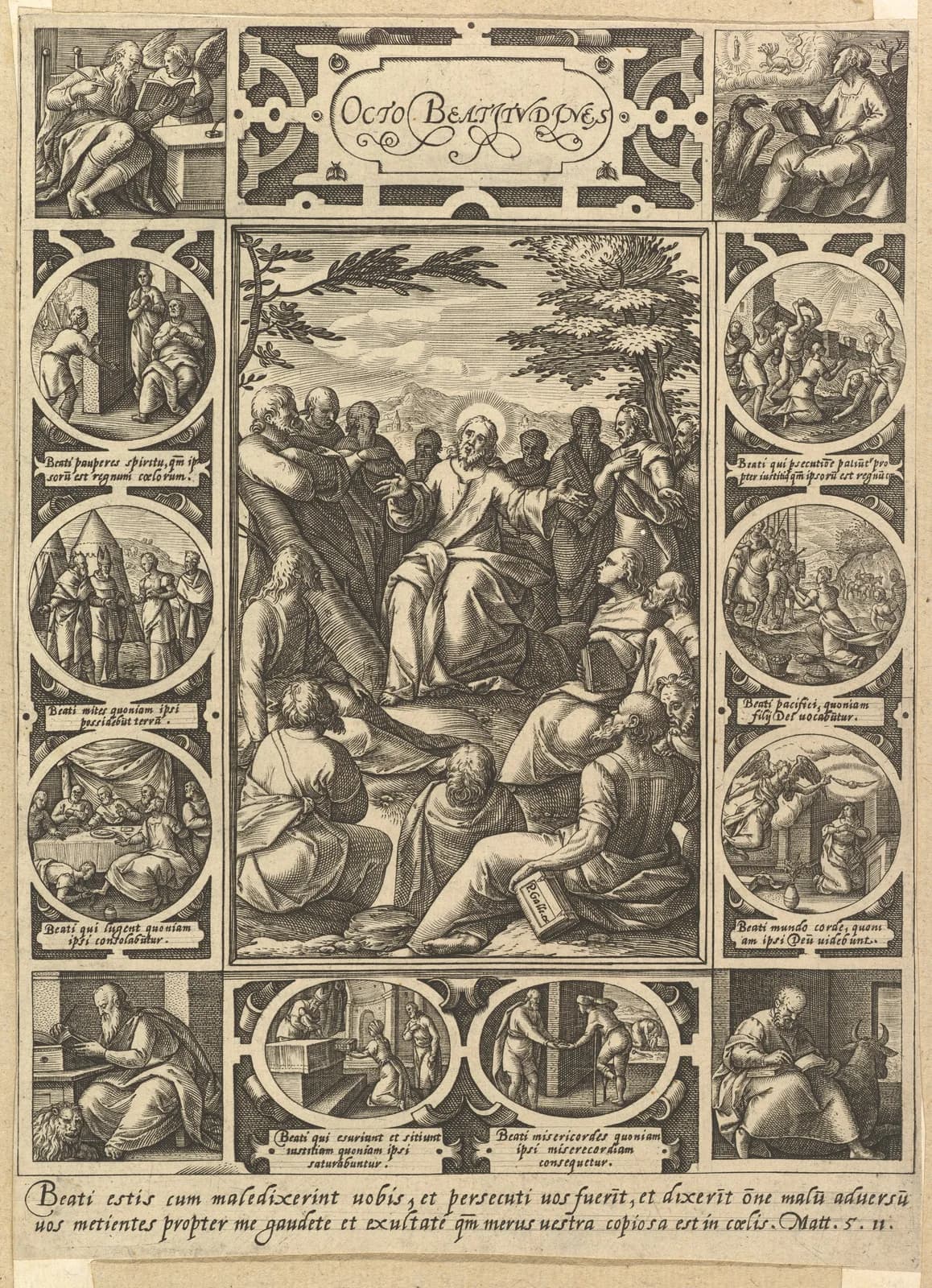
The Beatitudes
Foundational texts · Updated August 15, 2026
Overview
The Beatitudes, a cornerstone of Christian teaching found in the Gospel of Matthew, were not originally intended as a mere set of moral guidelines but rather as a radical vision of a new social order. Including blessings for the poor in spirit, the meek, and the peacemakers, among others, these teachings were revolutionary in their context. Roman imperial power and rigid social hierarchies dominated the world, and the Beatitudes presented an upside-down kingdom where the last would be first and the marginalized would inherit the earth. This vision was not just about personal morality but about reordering society's values.
The Beatitudes are part of the Sermon on the Mount, a collection of teachings attributed to Jesus and recorded in the Gospel of Matthew, likely written between 80 and 90 AD. Shared in Greek, the lingua franca of the Eastern Mediterranean region at that time, these teachings were accessible to a broad audience. A similar set of teachings appears in the Gospel of Luke as the Sermon on the Plain, suggesting that different oral traditions circulated these ideas before committing them to text. Augustine and other early Christian leaders interpreted the Beatitudes as a guide to spiritual perfection, emphasizing their potential to transform not only individual lives but also the communities they touched.
Today, The Beatitudes continue to resonate, having influenced numerous movements for social justice, such as the Civil Rights Movement in the United States. Their message of hope and justice for the oppressed remains powerful. While interpretations have varied over the centuries, this collection of teachings still challenges individuals and communities to envision a world where humility, mercy, and peace are paramount. This enduring vision of a new social order highlights the Beatitudes' lasting impact on both religious thought and societal change.
The Beatitudes were not originally intended to be a set of moral guidelines but rather a radical vision of a new social order.
Common questions
- What are the Beatitudes in the Bible?
- The Beatitudes are a series of blessings pronounced by Jesus in the Sermon on the Mount, found in the Gospel of Matthew, which outline the values of the kingdom of heaven, such as humility, mercy, and peacemaking.
- Why are the Beatitudes important in Christianity?
- The Beatitudes are important because they present a radical vision of a new social order based on values like humility, mercy, and peace, challenging individuals and communities to live according to these principles.
- How many Beatitudes are there in the Sermon on the Mount?
- There are eight Beatitudes in the Sermon on the Mount as recorded in the Gospel of Matthew.
- What is the meaning of 'Blessed are the poor in spirit'?
- 'Blessed are the poor in spirit' means that those who or recognize their spiritual need and dependence on God are blessed, as they are open to receiving the kingdom of heaven.
- What does 'Blessed are the meek' mean in the Beatitudes?
- 'Blessed are the meek' refers to those who are gentle and humble, promising them that they will inherit the earth, symbolizing a reward for their humility.
- How do the Beatitudes differ from the Ten Commandments?
- The Beatitudes focus on internal attitudes and values like humility and mercy, while the Ten Commandments are a set of rules and prohibitions outlining moral behavior.
- What is the significance of 'Blessed are the peacemakers'?
- 'Blessed are the peacemakers' highlights the importance of reconciliation and peace, promising that those who actively seek peace will be called children of God.
- How can the Beatitudes be applied in daily life?
- The Beatitudes can be applied by intentionally practicing humility, showing mercy, and making peace in personal interactions and community involvement, aligning one's life with the values of the kingdom of heaven.
- Why did Jesus teach the Beatitudes?
- Jesus taught the Beatitudes to present a vision of a new social order and to challenge existing societal norms, emphasizing values that reflect the kingdom of heaven.
- What is the historical context of the Beatitudes?
- The Beatitudes were taught in a context dominated by Roman imperial power and rigid social hierarchies, offering a revolutionary vision of an upside-down kingdom where the marginalized are blessed.
- How do the Beatitudes relate to Christian ethics?
- The Beatitudes relate to Christian ethics by providing a framework for living a life that reflects the values of humility, mercy, and peace, which are central to Christian moral teachings.
- What is the difference between the Beatitudes in Matthew and Luke?
- The Beatitudes in Matthew are part of the Sermon on the Mount and include eight blessings, while in Luke, they are part of the Sermon on the Plain and include four blessings and corresponding woes.
- How do the Beatitudes reflect Jesus' teachings on humility?
- The Beatitudes reflect Jesus' teachings on humility by emphasizing the blessedness of the poor in spirit and the meek, highlighting the value of recognizing one's dependence on God and being gentle.
- What role do the Beatitudes play in Catholic social teaching?
- The Beatitudes play a significant role in Catholic social teaching by providing a foundation for promoting social justice, emphasizing the dignity of every person, and advocating for the marginalized and oppressed.