Elden Ring and the influence of Lurianic Kabbalah
The game's structure maps precisely onto Luria's three-act cosmology of contraction, shattering, and repair, in a way no other religious framework does.

Elden Ring is one of the most successful video games ever made. Released in 2022 by FromSoftware, it sold 30 million copies in its first three years and became the most awarded Game of the Year in the history of the medium.¹ Its mythology, written in collaboration with George R.R. Martin², has drawn serious cultural analysis focused on its religious and mythological influences. We argue that Lurianic Kabbalah is the most important to the game's cosmology.
What Is Kabbalah
Kabbalah is a school of Jewish mystical thought concerned with reconciling the nature of God and the nature of the universe. Its most influential formulation comes from Isaac Luria, a Jewish theologian³ who spent much of his life contemplating a theological problem: if God is truly infinite and boundless and all-pervasive, there is no room for a universe. A world cannot coexist with an infinite God.
Luria's answer was that God created the universe not by expanding outward, but by contracting inward. By withdrawing into himself, God opened a void, a space defined by divine absence, in which a finite creation could exist. He called this act tzimtzum, contraction.
Into that void, God poured divine light, organizing it through ten vessels called sephirot, arranged in a structure known as the Tree of Life. Each sephira represented a different quality of divine emanation: from Keter, the Crown, at the apex, closest to the infinite divine source, to Malkuth, the Kingdom, at the base, representing material reality.
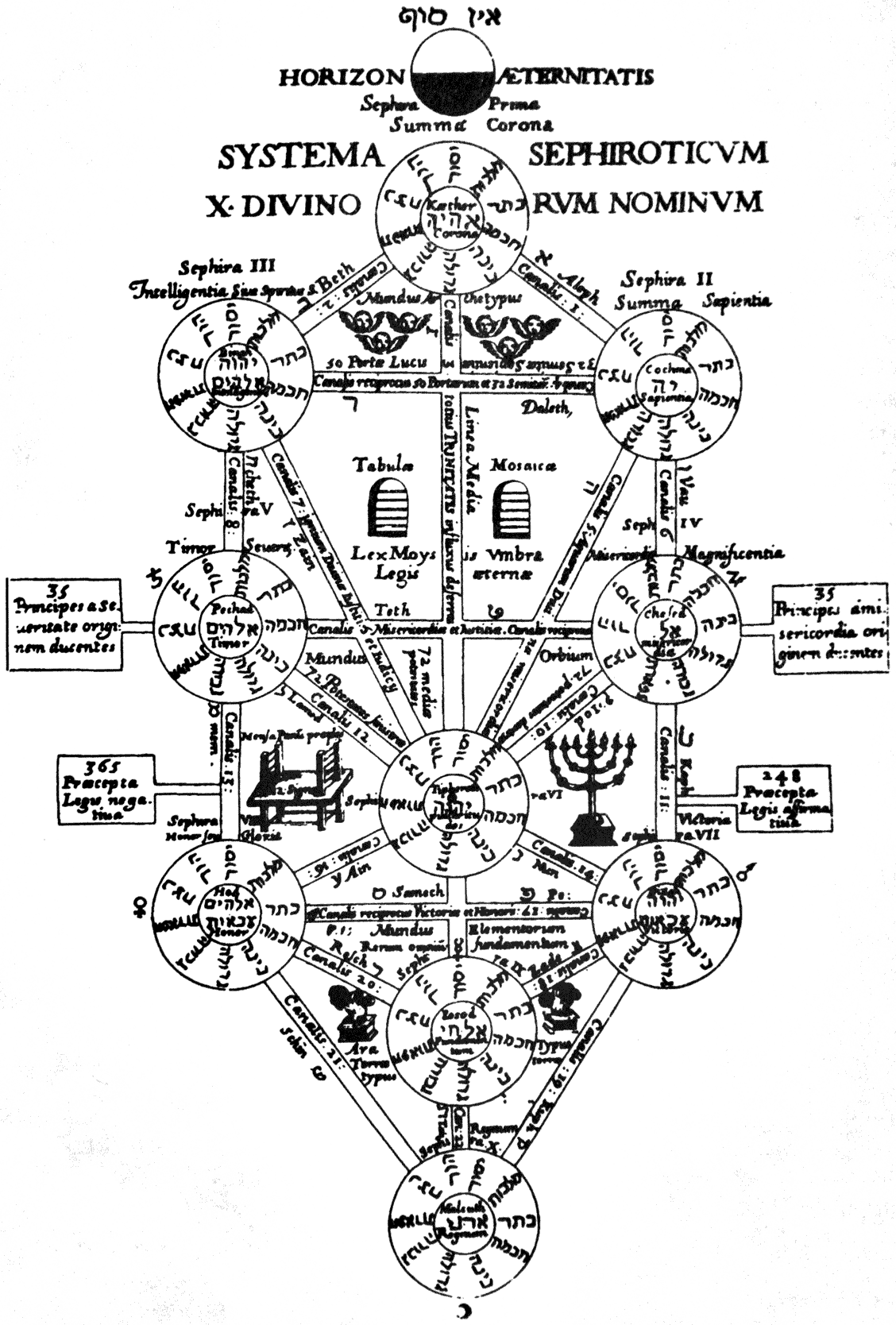
According to Kabbalah, during an event known as shevirat ha-kelim, the Shattering of the Vessels, these sephiroth were damaged. The upper three sephirot, closest to the divine source, held, but the lower seven could not contain infinite light and broke apart. Fragments of divine lights scattered into the void, embedded in the wreckage. This premise is the condition of existence: a broken world, animated by divine light trapped inside dead husks - corrupting earthly influences that draw us further from God and closer to earthly material trappings. In Lurianic thought, human existence is oriented toward tikkun: the gathering of scattered sparks, the repair of what broke. We are light encased in shells.
With that framework in mind, the world of Elden Ring becomes legible in a new way.
The world of Elden Ring
In Elden Ring, you play as the Tarnished, an outcast exiled from the Lands Between, stripped of the grace that once connected you to the divine order, and called back to a world in ruins. The Lands Between was once governed by the Golden Order: a cosmic hierarchy presided over by Queen Marika the Eternal and organized around the Erdtree, a vast golden tree whose light and grace sustained the world. The Erdtree was the axis of creation, the source from which divine order flowed downward into the world, and the structure that gave the Lands Between its coherence.
That order was destroyed by an event called the Shattering. Marika, for reasons the game reveals slowly, shattered the Elden Ring, the artifact at the heart of the Golden Order. The divine structure broke apart. Its fragments, the Great Runes, were inherited by Marika's demigod offspring, who went to war with each other to claim them. The war ended not in victory but in frozen stalemate, the demigods entrenched in their domains, the world in permanent chaos, grace stripped from the Tarnished who once served the Order.
As the Tarnished, your task is to return, gather the Great Runes, and restore the Elden Ring to become the Elden Lord.
How Elden Ring reflects Jewish Kabbalah
Now that we've established the foundations of both Jewish Kabbalah and Elden Ring's cosmology, we can see how tightly their themes fit.
The most immediate structural parallel: the central event in Elden Ring's backstory is literally called the Shattering. You begin the game in a physically broken world whose continents are strangle isolated. Most of the enemies you fight are hollow, degraded versions of themselves - demi-humans, husks. Some enemies are literally ceramic jars. When you break them, you absorb the divine energy they were holding inside. The game is not being subtle: this is a world of broken vessels that once contained something sacred and no longer do.
At the center of this world stands the Erdtree, which corresponds directly to the Kabbalistic Tree of Life. In Kabbalah, the Tree of Life has ten sephirot, each representing a channel through which the remote divine source communicates with and organizes the world below it, covering attributes like wisdom, understanding, and beauty. In Elden Ring, the equivalent of the remote divine source is the Greater Will, an entity so remote it communicates only through intermediaries. The two gods Radagon and Marika, who are revealed to occupy a single divine body, correspond to the inseparable upper pair of sephirot on the Kabbalistic tree. These three, the Greater Will and the Radagon-Marika pair, correspond to the three sephirot that Kabbalistic tradition holds were preserved after the cosmic Shattering. The remaining seven sephirot correspond to the seven demigod shardholders, the broken vessels that shattered under what they carried and scattered across the world. Your job as the Tarnished is to gather the fragments they hold, which is tikkun, the Kabbalistic concept of cosmic repair.
Elden Ring and tikkun: repairing a broken world
What you do as the Tarnished, following the light of grace across the Lands Between, is tikkun olam.
The Sites of Grace are the nitzotzot, points where divine light still pools in the ruins, marking the path through the broken world. Following them leads you to each of the shattered demigod-vessels. You break them, take their Great Runes, and carry the fragments forward. Along the way you encounter other vessels, some of them literally that, animated pots and jars that carry runes within them, and from those too you extract what divine light remains. Each rune collected is a spark gathered. Each demigod defeated is a broken vessel cleared.
At the end of this gathering, you repair the Elden Ring and ascend as Elden Lord. The World of Chaos becomes, at least in the dominant ending, the World of Rectification. You have performed the repair that the Lurianic system says is the purpose of existence.
Other influences
Elden Ring draws on many traditions beyond Kabbalah. Consider the Christian influence alone: the very arc of the Tarnished, a fallen creature guided by lights of grace toward restoring the Elden Ring and reestablishing a Golden Order above all gods, carries unmistakably Christian contours. The crucified figures scattered throughout the Lands Between confirm that these overtones are not accidental. They are woven into the fabric of the world deliberately.
But Christianity, like Norse myth and Gnosticism, explains the texture without explaining the architecture. Lurianic Kabbalah provides a complete scaffolding: the shattering, the husk-like demeanor of nearly all inhabitants of the world, the tree at its center, and the specific player task of repair. Where other traditions illuminate corners of the world, Kabbalah illuminates the blueprint from which the world was drawn. It is the framework that governs the entire cosmology of the Lands Between, and the most engrossing and comprehensive lens through which the game can be understood. Once you see it, you cannot look away.