What Distinguishes the Major Branches of Christianity?
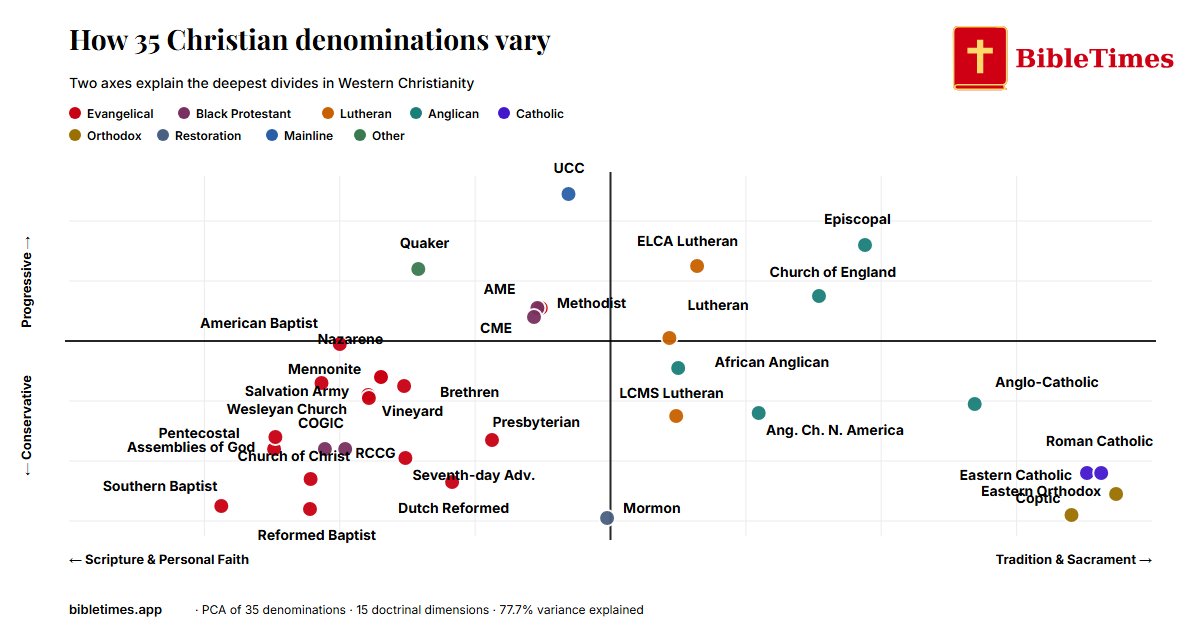
Two axes account for 77.7 percent of the variance across 35 denominations and 15 doctrinal dimensions. Here is what they are.

Ask someone what separates a Baptist from a Catholic, or an Episcopal church from an Eastern Orthodox one, and you will get a different answer depending on who you ask. Worship style, church authority, the role of Scripture, views on sacraments, politics: all of these get named. The real answer is that no single dimension separates them. What actually distinguishes Christian denominations is a pattern of differences across many doctrinal commitments simultaneously, and that pattern has a structure. Two axes account for the vast majority of it.
The Methodology
This analysis scores 35 Christian denominations across 15 doctrinal dimensions on a 1-10 scale. The dimensions span verbal inerrancy, sola scriptura, sacramental realism, apostolic succession, ecclesiastical authority, the weight given to tradition, liturgical formality, Marian devotion, charismatic gifts, social conservatism, doctrinal rigidity, afterlife specificity, premillennialism, synergism, and exclusivity.
The scores were then submitted to principal component analysis (PCA), a statistical technique that identifies the underlying axes along which observations actually vary. PCA does not impose categories. It finds the directions of maximum variance in the data and reports what percentage of total variation each axis explains. The first two components together explain 77.7 percent of the variance: PC1 accounts for 51.4 percent and PC2 for 26.3 percent. Together they describe the shape of Christian denominational space more completely than any single doctrinal question could.
The First Axis: Scripture and Personal Faith versus Tradition and Sacrament
The first axis, which explains more than half the total variance, runs from denominations that center authority in Scripture and the individual believer on the left, to denominations that center authority in tradition, clergy, and the sacramental system on the right.
Southern Baptist, Assemblies of God, and Pentecostal denominations sit at the far left. For these traditions, the Bible is the sole and sufficient rule of faith, salvation is a personal transaction between the individual and God, and the institutional church has no independent sacramental role. The ordinances (baptism and communion) are signs, not means of grace.
Eastern Orthodox, Roman Catholic, Eastern Catholic, and Coptic denominations sit at the far right. For these traditions, the church precedes the Bible historically and interprets it authoritatively. The sacraments are not signs but vehicles of grace. Salvation is mediated through the church, its priesthood, and its liturgical life. Tradition, including conciliar decisions and patristic theology, carries binding authority alongside Scripture.
Anglican denominations are the most revealing case. They are uniquely spread across this axis. African Anglican and the Anglican Church in North America sit near center-right, while Anglo-Catholic and Episcopal sit far right and far progressive respectively. The Anglican tradition carries both Catholic sacramental theology and Protestant Scripture-first instincts, and different provinces have resolved that tension differently.
The Second Axis: Progressive versus Conservative
The second axis runs from theologically progressive traditions at the top to theologically conservative ones at the bottom. This axis captures a cluster of positions: on gender and sexuality, on the relationship between Christian ethics and contemporary culture, on doctrinal flexibility versus confessional rigidity, and on eschatology.
The United Church of Christ sits at the furthest progressive extreme, followed by Quakers and ELCA Lutherans. These traditions tend toward non-creedal or minimally creedal stances, affirm women in all ordained roles, and read Christian ethics through an evolving engagement with contemporary norms.
Southern Baptist, Reformed Baptist, Coptic, and Eastern Orthodox denominations sit at the conservative extreme. These traditions hold fixed confessional standards, restrict ordained ministry, and read contemporary cultural shifts as largely in tension with Christian teaching.
Mormon occupies a distinctive position: near center on the Scripture-Tradition axis (it claims additional scripture beyond the Protestant canon while also rejecting Catholic ecclesiastical tradition) but strongly conservative on PC2. It forms its own cluster, which is analytically correct: the Latter-day Saint tradition does not map cleanly onto the standard Protestant-Catholic spectrum.
Black Protestant Denominations
COGIC and RCCG cluster with evangelical Protestants on both axes: high Scripture authority, theologically conservative. AME and CME sit closer to mainline Protestantism on the progressive axis while remaining Protestant on the Scripture-Tradition axis. This reflects the historical divergence within Black Protestantism between Holiness-Pentecostal traditions and historically mainline denominations, a split that mirrors the broader evangelical-mainline divide but developed through a distinct institutional history.
Lutheran Diversity
The three Lutheran denominations in the dataset are more spread than their shared confessional origin would suggest. LCMS (Lutheran Church Missouri Synod) sits conservatively on both axes. ELCA sits moderately progressive. Generic "Lutheran" sits near center. The Lutheran tradition holds confessional documents (the Augsburg Confession, Luther's catechisms) in common but has divided sharply over how to apply them to contemporary questions, particularly on biblical authority and human sexuality.
What This Shows
The structure of Christian denominational difference is not random and not primarily driven by worship style or cultural preference. It is organized around two deep theological commitments that have been argued over since the Reformation: where authority resides, and how fixed Christian ethics are. The Pew Research Center's Religious Landscape Study documents the same fault lines through self-reported belief data. The PCA here finds them structurally, without asking denominations to self-describe.
The concentration of explained variance in two components (77.7 percent) suggests that Christian denominational identity, despite its apparent complexity, is organized around a surprisingly compact set of underlying questions. Almost every specific doctrinal difference between denominations, from views on baptism to the role of Mary to millennial eschatology, correlates strongly with position on one or both of these two axes.